

Infrastructure as Code (IaC): The Complete Guide to Managed IaC Services in 2026
This complete guide to Infrastructure as Code (IaC) explains how managed IaC services help businesses automate infrastructure provisioning, improve scalability, and streamline DevOps operations. Learn the best tools, strategies, and best practices for managing modern cloud infrastructure efficiently in 2026.


Introduction: Why Infrastructure as Code (IaC) Is No Longer Optional
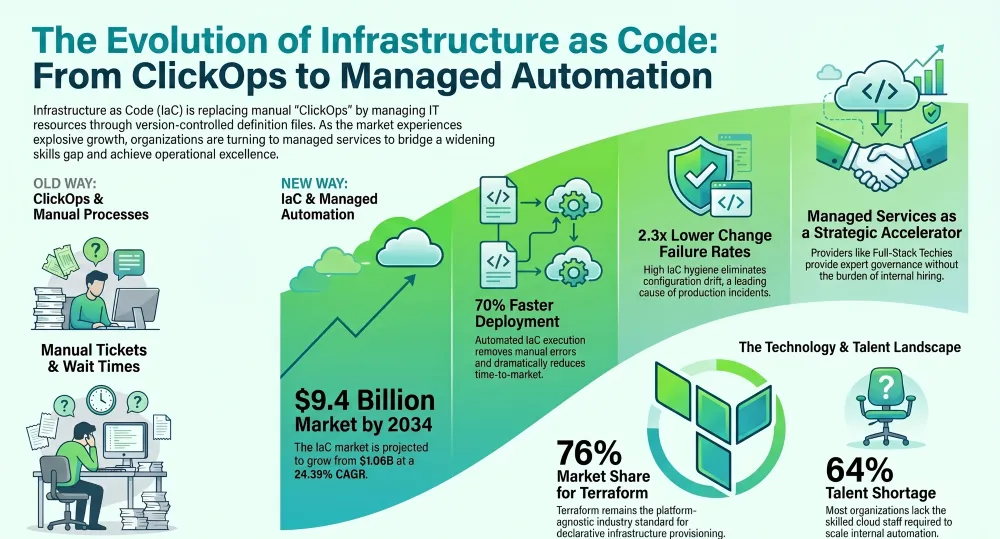
Not long ago, provisioning a server meant opening a ticket, waiting three days, and praying the system administrator configured it the same way as the last one. Today, that model is broken — and the organizations still relying on it are already falling behind. Infrastructure as Code (IaC) is the practice of managing, provisioning, and configuring IT infrastructure through machine-readable definition files rather than physical hardware configuration or interactive configuration tools. In plain terms, your servers, networks, databases, and cloud resources are described in code — versioned, tested, and deployed just like application software. This isn’t just a DevOps trend. It’s a fundamental shift in how modern businesses operate their technology foundations. The global Infrastructure as Code (IaC) market was valued at approximately USD 1.06 billion in 2024 and is anticipated to reach around USD 9.40 billion by 2034, growing at a compound annual growth rate of 24.39% over the forecast period. That trajectory tells a clear story: enterprises worldwide are standardizing on IaC as the baseline for all cloud operations. Meanwhile, according to Gartner, the worldwide infrastructure as a service (IaaS) market grew 22.5% in 2024, reaching $171.8 billion — driven by enterprises seeking greater flexibility, improved resilience, and optimized performance through cloud migration and modernization. Whether you are a startup provisioning your first cloud environment or an enterprise managing thousands of resources across AWS, Azure, and Google Cloud, this guide covers everything you need to know about Infrastructure as Code (IaC), the tools that power it, the challenges of doing it at scale, and how managed IaC services like those offered by Full-Stack Techies can eliminate the complexity entirely.
Key Takeaways: The Future of Infrastructure Automation
- Explosive Market Growth: The IaC market is projected to grow from $1.06 billion in 2024 to $9.40 billion by 2034, driven by a universal shift toward cloud-native operations.
- Terraform Dominance: Terraform remains the “industry standard” with a 76% market share, though open-source alternatives like OpenTofu and programming-language-based tools like Pulumi are gaining traction.
- The Skills Shortage Reality: Approximately 64% of organizations report a shortage of skilled cloud and automation staff, making DevOps as a Service a strategic necessity for scaling businesses.
- Operational Excellence through Modularity: Successful IaC implementation requires modular templates, remote state locking, and automated CI/CD pipelines to prevent catastrophic state corruption and security liabilities.
- Managed Services as an Accelerator: Partnering with an experienced provider like Full-Stack Techies enables enterprises to leverage battle-tested template libraries and expert architecture without the burden of building internal platform engineering teams from scratch.
What Is Infrastructure as Code (IaC)? A Clear Definition
Infrastructure as Code (IaC) is the process of defining, provisioning, and managing IT infrastructure through code files that are human-readable, version-controlled, and repeatable. Instead of clicking through a cloud console or running ad hoc shell scripts, engineers write declarative or imperative configuration files that describe exactly what the infrastructure should look like — and a tool like Terraform, Ansible, or AWS CloudFormation then makes it so. The core principle: infrastructure is treated with the same rigor, discipline, and tooling as application code. This means:
- Infrastructure changes go through code review and pull requests
- Environments can be reproduced identically across development, staging, and production
- Changes are auditable with a complete history
- Rollbacks are as simple as reverting to a previous commit
Declarative vs. Imperative IaC
There are two primary approaches to Infrastructure as Code (IaC): Declarative IaC — You define the desired end state of the infrastructure, and the tool figures out how to get there. Terraform and AWS CloudFormation use this model. If you declare “I want three EC2 instances,” the tool creates them — and if one already exists, it creates only the remaining two. Imperative IaC — You specify the exact commands to execute step by step. Tools like Ansible and Chef often use this approach, providing more granular control at the cost of increased complexity. The declarative segment dominated the IaC market in 2023, though the imperative segment is projected to witness the highest CAGR through 2030, driven by organizations seeking more granular control over complex and customized infrastructure configurations. Most mature IaC strategies use both — declarative tooling for infrastructure provisioning (what cloud resources exist) and imperative tooling for configuration management (how those resources are configured after creation).
Reach Us We can Help You with Your IAC!
The Business Case for Infrastructure as Code (IaC)
Before diving into tools and services, it’s worth grounding this conversation in real business outcomes. Why should a CTO, VP of Engineering, or IT Director care about Infrastructure as Code?
1. Dramatic Reduction in Deployment Time
Manual infrastructure provisioning — what engineers call “ClickOps” — is painfully slow. Using ClickOps, creating a single EC2 instance might take two minutes — but for 100 instances, that scales to over three hours of error-prone, attention-intensive manual work. With IaC, that same task executes in minutes with zero human error in the deployment itself. Research indicates that implementing automated IaC solutions can lead to a 70% reduction in deployment times — a transformative improvement for teams shipping products frequently.
2. Consistency Across Environments
One of the most expensive problems in software development is the “it works on my machine” problem applied to infrastructure. When staging environments differ from production — even subtly — bugs slip through and production incidents follow. Infrastructure as Code eliminates this by ensuring every environment is provisioned from the same code base.
3. Built-In Compliance and Audit Trail
In regulated industries — financial services, healthcare, government — proving that infrastructure was configured correctly at a specific point in time is a compliance requirement. IaC makes this trivial. Every change is a commit. Every commit has a timestamp, author, and justification. Compliance teams get a complete, verifiable audit trail by default.
4. Reduced Configuration Drift
The DORA 2023 State of DevOps Report found that teams dealing with frequent configuration drift had 2.3× higher change failure rates than teams maintaining consistent IaC hygiene. Configuration drift — where the actual state of cloud infrastructure diverges from what the code declares — is one of the most insidious sources of production incidents.
5. Scalability Without Proportional Headcount
IaC decouples infrastructure scale from staffing scale. With well-structured IaC templates, a small platform engineering team can manage infrastructure that would previously require dozens of system administrators. This is precisely why IaC managed service and DevOps as a service models have become so attractive to growing organizations.
Core IaC Tools: The Complete Landscape
Understanding the tool ecosystem is essential for selecting the right infrastructure provisioning services strategy. Here’s a breakdown of the major players.
Managed Terraform — The Industry Standard
Terraform, created by HashiCorp, is the dominant IaC tool in the market today. Terraform commands a 76% market share according to the CNCF 2024 Annual Survey, with 90% of cloud users already using some form of Infrastructure as Code. Terraform lets you define resources and infrastructure in human-readable, declarative configuration files, and manages your infrastructure’s lifecycle across multiple cloud platforms. Its state management capability allows you to track resource changes throughout your deployments, and over 1,000 providers exist to manage resources on AWS, Azure, Google Cloud Platform, Kubernetes, GitHub, and dozens of other services. Why Terraform dominates: Terraform’s cloud-agnostic nature is its defining advantage. Terraform is platform agnostic — you can use it with any cloud services provider — and it is agentless, requiring no software to be installed on the managed infrastructure. Terraform modules provide a powerful way to reuse code and stick to the Don’t Repeat Yourself (DRY) principle. Terraform’s key workflow follows a simple three-step pattern: Initialize (install required plugins), Plan (preview changes before they happen), and Apply (execute the changes). This plan-before-apply model is one of Terraform’s greatest safety features — engineers can see exactly what will change before committing to it. The scaling challenge with Terraform: While Terraform excels at small to medium deployments, it introduces real complexity at enterprise scale. Organizations running more than 500 managed resources in a single workspace routinely report 15–30 minute plan times, turning what should be a fast feedback loop into a deployment bottleneck. This is precisely the gap that managed Terraform services, and IaC managed services fill — providing the operational expertise, module governance, state management, and automation pipelines that make Terraform viable at enterprise scale without requiring organizations to build that capability internally.
AWS CloudFormation
AWS CloudFormation is Amazon’s native IaC service. It uses JSON or YAML templates to define AWS resources and manages their lifecycle through a concept called “stacks.” It’s tightly integrated with AWS services and requires no state management (AWS handles it), but it’s limited exclusively to the AWS ecosystem. IaC templates in CloudFormation are particularly powerful for organizations standardizing on AWS, as they integrate natively with AWS Identity and Access Management (IAM), AWS Config, and AWS Service Catalog.
Ansible
Ansible, maintained by Red Hat, takes an agentless, SSH-based approach to infrastructure provisioning and configuration management. It’s particularly popular for post-provisioning configuration — installing software, managing services, and deploying application code. Ansible IaC templates (called playbooks) are written in YAML and are highly readable.
Pulumi
Pulumi is a newer entrant that allows engineers to write Infrastructure as Code in general-purpose programming languages — Python, TypeScript, Go, C#, and Java — rather than domain-specific languages like HCL. For development teams that are more comfortable in traditional programming languages, Pulumi significantly lowers the barrier to entry for IaC.
OpenTofu
OpenTofu emerged as an open-source fork of Terraform after HashiCorp changed Terraform’s licensing in 2023. OpenTofu provides the same features Terraform offers but is committed to remaining open source, with changes made based on community input — particularly important for experienced engineers frustrated with Terraform’s unaddressed limitations. For organizations concerned about vendor lock-in with HashiCorp’s commercial offerings, OpenTofu is a compelling alternative.
IaC Templates: The Building Blocks of Repeatable Infrastructure
IaC templates are the reusable, parameterized code files that define infrastructure configurations. They are the core artifact of any Infrastructure as Code practice — the equivalent of application code modules. Well-designed IaC templates share several characteristics:
- Modularity — Templates are broken into small, composable units (Terraform calls these “modules”) that can be combined like LEGO blocks. A “VPC module,” a “Kubernetes cluster module,” and a “RDS database module” can be combined to build a complete application environment.
- Parameterization — Templates accept input variables, allowing the same template to be deployed with different configurations (e.g., the same template provisions both a small development environment and a large production environment by changing variable values).
- Versioning — IaC templates live in Git repositories and are versioned like any other code. This enables controlled rollouts, safe experimentation, and reliable rollbacks.
- Validation and Testing — Modern IaC pipelines include linting, static analysis, and automated testing of templates before they reach production. Tools like Checkov, TFLint, and Terratest enable policy enforcement and unit testing of IaC templates.
The challenge most organizations face is that building and maintaining a high-quality library of IaC templates requires significant up-front investment and ongoing expertise. This is where an experienced IaC managed service provider becomes invaluable — they bring pre-built, battle-tested template libraries that organizations can adopt immediately rather than building from scratch.
Infrastructure Provisioning Services: From Manual to Fully Managed
Infrastructure provisioning services exist on a spectrum — from self-managed open-source tools at one end to fully managed IaC services at the other.
Self-Managed IaC
Organizations using self-managed IaC tools take full responsibility for:
- Installing, configuring, and maintaining IaC tooling
- Writing and maintaining IaC templates and modules
- Managing Terraform state (a surprisingly complex operational problem at scale)
- Building and maintaining CI/CD pipelines for infrastructure changes
- Detecting and remediating configuration drift
- Training and upskilling engineering teams
- Staying current with cloud provider API changes and tool updates
This model works well for organizations with mature DevOps capabilities and dedicated platform engineering teams. For everyone else, it introduces significant overhead. The HashiCorp State of Cloud Strategy Survey 2024 showed that 64% of organizations report a shortage of skilled cloud and automation staff — creating a dangerous gap between the widespread desire to adopt IaC and the in-house expertise required to operate it effectively.
IaC Managed Service — The Strategic Alternative
An IaC managed service provider handles the full lifecycle of infrastructure automation — from designing the IaC architecture to writing IaC templates, building deployment pipelines, managing state, monitoring for drift, and keeping everything current. The advantages are substantial:
- Speed to value — Rather than spending months building IaC capability from scratch, organizations get production-ready infrastructure automation in weeks.
- Access to expertise — Experienced IaC practitioners who have solved the same problems across dozens of client environments bring hard-won knowledge that in-house teams would take years to accumulate.
- Ongoing governance — IaC managed service providers continuously monitor infrastructure against defined policies, detect drift, and maintain compliance — work that often falls through the cracks in self-managed environments.
- Cost predictability — Fixed-fee managed services convert the unpredictable cost of building and maintaining internal IaC capability into a predictable operational expense.
This is exactly the value proposition behind Full-Stack Techies’ managed infrastructure services — providing organizations with enterprise-grade IaC capabilities without the enterprise-grade overhead of building it in-house.
Managed Terraform Service: A Deep Dive
Managed Terraform is the most common form of IaC managed service, given Terraform’s dominant market position. A managed Terraform service typically encompasses several key capabilities:
Terraform Architecture Design
A managed Terraform service begins with architecture — designing the Terraform workspace structure, module hierarchy, and state backend configuration appropriate for the organization’s scale and complexity. Poor architecture decisions made early in a Terraform implementation compound dramatically over time, so getting this right is critical.
Module Development and Governance
Developing a well-governed library of reusable Terraform modules for the organization’s common infrastructure patterns. This includes establishing versioning conventions, documentation standards, testing requirements, and security baselines baked into every module.
State Management
Terraform state is the source of truth for what infrastructure exists. Mismanaging state is one of the most common sources of serious infrastructure incidents. A managed Terraform service handles remote state storage (typically in S3 or Terraform Cloud), state locking, encryption, and access control — ensuring state is always consistent and secure.
CI/CD Pipeline Integration
Integrating Terraform into the organization’s CI/CD pipelines so that infrastructure changes follow the same automated, reviewed, tested deployment process as application code. This typically involves automated terraform plan on pull requests, policy-as-code checks (using tools like Open Policy Agent or Sentinel), and controlled terraform apply gates.
Drift Detection and Remediation
Regularly comparing the actual state of cloud infrastructure against the Terraform-declared state, detecting drift, and either alerting engineering teams or automatically remediating it. Drift is inevitable in any organization where humans have cloud console access — a managed Terraform service makes it a solved problem rather than a lurking threat.
Ongoing Maintenance
Keeping Terraform versions, provider versions, and module versions current — a continuous maintenance task that often gets deprioritized in self-managed environments. Full-Stack Techies provides all of these capabilities as part of its managed Terraform service offering, giving clients the full benefit of Terraform’s power without the operational burden of running it themselves.
DevOps as a Service: The Broader Context
Infrastructure as Code (IaC) doesn’t exist in isolation. It’s one component of a broader DevOps as a service capability — the combination of practices, tools, and cultural patterns that enable organizations to deliver software reliably and rapidly. DevOps as a service bundles:
- IaC for infrastructure automation
- CI/CD pipelines for application delivery
- Monitoring and observability for operational visibility
- Security automation (DevSecOps) for compliance
- Container and Kubernetes management for application workloads
- Incident management and on-call processes
For organizations that want to adopt modern DevOps practices but lack the internal expertise to build them, a DevOps as a service partner provides the entire capability as a managed engagement. The IaC market’s growth is driven substantially by DevOps adoption, multi-cloud strategies, demand for automated infrastructure, and the need for faster, error-free deployments. These aren’t separate trends — they reinforce each other. More DevOps adoption drives more IaC adoption, and IaC enables more sophisticated DevOps practices. Full-Stack Techies offers DevOps as a service engagements that include IaC as a core component — building the complete automation foundation that allows development teams to ship faster and operations teams to sleep better.
Industry Updates: What the Data Says About IaC in 2025
The Infrastructure as Code landscape is evolving rapidly. Here are the most significant developments shaping the market right now.
AI-Augmented IaC
Artificial intelligence is beginning to fundamentally change how IaC is written and managed. The integration of AI into Infrastructure as Code has the potential to significantly advance the market. With AI infrastructure-as-code generators, users can input their desired infrastructure configurations in natural language, and the system automatically generates the corresponding IaC templates, code comments, and execution instructions — eliminating the need for manual coding. This trend is accelerating. AI-assisted IaC tools are lowering the barrier to entry for teams without deep Terraform expertise, enabling them to describe their infrastructure requirements in plain English and receive production-ready IaC templates as output. While human expertise remains essential for reviewing and governing AI-generated infrastructure code, this development significantly expands who can participate in IaC workflows.
The Multi-Cloud Mandate
The demand for Infrastructure as Code is increasing significantly due to the growing use of cloud computing and the shift toward multi-cloud environments. Businesses relying on multiple cloud providers — such as AWS, Azure, and Google Cloud — to avoid vendor lock-in, reduce costs, and utilize specialized features find that managing infrastructure manually across these platforms is challenging and prone to errors. IaC, and Terraform in particular, resolves this by providing a single language and workflow for managing infrastructure across all cloud providers simultaneously.
The Skills Gap Is Widening
The HashiCorp State of Cloud Strategy Survey 2024 found that 64% of organizations report a shortage of skilled cloud and automation staff — creating a dangerous gap between Terraform’s widespread adoption and the expertise required to operate it effectively at scale. This skills gap is one of the primary drivers behind the growth of managed IaC services and DevOps as a service models. Organizations that cannot hire and retain the expertise internally are increasingly outsourcing it to specialized partners.
Gartner’s Cloud Infrastructure Outlook
According to Gartner, enterprises want to transform their IT infrastructure by leveraging multiple platforms for AI and prioritizing modernization by migrating existing workloads to the cloud. They are also deploying cloud-native applications across diverse environments — a trend further fueled by demand for flexibility with data residency and sovereignty. All of these trends — AI workloads, cloud modernization, multi-cloud adoption, data sovereignty requirements — increase the complexity of infrastructure management and, consequently, the value of IaC and IaC managed services.
Common IaC Challenges and How to Solve Them
Even with the best tools, Infrastructure as Code implementations encounter predictable challenges. Understanding these challenges — and their solutions — is part of what separates experienced practitioners from beginners.
Challenge 1: State Management at Scale
Terraform’s state file is simultaneously its greatest strength (it knows exactly what exists) and its greatest operational complexity (it must be stored, protected, and kept consistent). Remote state backends, state locking, and access control are non-negotiable for any production Terraform deployment. Solution: Use a remote state backend (Terraform Cloud, S3 with DynamoDB locking, or Azure Blob Storage) from day one. Never use local state for anything beyond personal experimentation.
Challenge 2: Module Library Drift
As IaC template libraries grow organically over time, module quality and governance tend to degrade. Teams fork modules to meet specific requirements. Security patches in root modules require coordinated updates across dozens of dependents. Adopting semantic versioning for Terraform modules has measurable impact — approximately 60% of organizations that enforce semantic versioning report significantly better module maintainability. Solution: Establish module governance policies from the start. Enforce semantic versioning. Build automated testing for modules. Designate ownership for each module and establish clear update processes.
Challenge 3: Configuration Drift
Even in organizations with mature IaC practices, drift happens. On-call engineers make emergency changes directly in the cloud console. Auto-scaling events modify resources. Third-party integrations change settings outside of IaC control. Over time, the gap between the declared state (code) and the actual state (cloud) widens — until something breaks. Solution: Implement automated drift detection that runs on a schedule and alerts when actual infrastructure diverges from declared state. In mature implementations, automated drift remediation can restore consistency without human intervention.
Challenge 4: Security and Secrets Management
IaC code is often stored in version control repositories accessible to many team members. If secrets (database passwords, API keys, cloud credentials) are embedded in IaC templates, they become a serious security liability. Solution: Never store secrets in IaC code. Use secrets management tools — HashiCorp Vault, AWS Secrets Manager, Azure Key Vault — and reference secrets dynamically at runtime rather than embedding them in IaC templates.
Challenge 5: Testing Infrastructure Code
Unlike application code, IaC is difficult to test without actually provisioning real resources — which costs money and takes time. Many teams skip IaC testing entirely, leading to broken deployments discovered in production. Solution: Adopt a layered testing strategy. Use linting and static analysis (TFLint, Checkov) for fast, cheap checks. Use automated plan validation in CI/CD. Use ephemeral test environments for integration testing. Tools like Terratest enable programmatic testing of Terraform configurations.
How Full-Stack Techies Delivers IaC Managed Services
Implementing and maintaining Infrastructure as Code (IaC) at scale is a discipline that takes years to master. The tool proficiency alone is just the beginning — true IaC maturity requires architectural judgment, security knowledge, CI/CD expertise, and the operational discipline to keep everything running reliably over time. Full-Stack Techies brings all of this as a ready-to-deploy capability through its IaC managed service and managed Terraform service offerings. Here’s what working with Full-Stack Techies looks like in practice:
- Assessment and Architecture — Full-Stack Techies begins every engagement with a thorough assessment of the current infrastructure landscape, identifying what exists, what’s already managed by IaC, and what the gaps are. From this foundation, they design an IaC architecture appropriate for the organization’s scale, cloud provider mix, and compliance requirements.
- Template Library Development — Full-Stack Techies develops a comprehensive library of organization-specific IaC templates covering all common infrastructure patterns — VPCs, Kubernetes clusters, databases, message queues, CDN configurations, monitoring stacks, and more. These templates are production-hardened, security-reviewed, and immediately deployable.
- Pipeline Integration — Full-Stack Techies integrates IaC workflows into existing CI/CD pipelines, so infrastructure changes follow the same automated, reviewed deployment process as application code. Policy-as-code checks enforce security and compliance standards automatically on every change.
- Ongoing Management — Full-Stack Techies provides continuous drift monitoring, security scanning, version management, and operational support. When cloud providers release new services or breaking changes, Full-Stack Techies updates the IaC templates and module library so clients don’t have to.
- DevOps as a Service — For organizations that want to go beyond IaC to a complete DevOps as a service model, Full-Stack Techies offers end-to-end DevOps capability — spanning infrastructure provisioning services, application CI/CD, container orchestration, observability, and security automation.
Whether an organization is starting its IaC journey from scratch or looking to mature an existing implementation that has grown unwieldy, Full-Stack Techies provides the expertise, tooling, and ongoing support to make it work. Also Read: The Ultimate Guide to DevOps as a Service (DaaS) in 2026
Get scalable, fast, and user-friendly DevOps Solutions tailored to your needs.
Get Free ConsultationIaC Best Practices: A Reference Guide
For teams building or maturing their Infrastructure as Code practice, these best practices represent the accumulated wisdom of the industry.
- Store everything in version control. Every IaC template, every module, every variable file belongs in Git. Infrastructure changes that aren’t tracked in version control are invisible to auditors, dangerous for rollbacks, and impossible to collaborate on effectively.
- Use remote state with locking. Never use local Terraform state in any environment beyond personal development. Remote state with locking prevents concurrent modifications that can corrupt state and cause catastrophic infrastructure incidents.
- Implement infrastructure CI/CD. Treat IaC changes with the same rigor as application code changes. Automated linting, policy checks, plan previews, and controlled apply workflows are non-negotiable for production infrastructure.
- Design for modularity. Write IaC templates as composable modules rather than monolithic configurations. Modules are easier to test, easier to reuse, and easier to update independently.
- Separate state by environment and component. Don’t put all infrastructure in a single Terraform workspace. Separate workspaces by environment (dev/staging/prod) and by logical component (networking/compute/data) limit blast radius and improve plan performance.
- Enforce security policy as code. Use tools like Checkov, Terrascan, or Open Policy Agent to enforce security policies on IaC code automatically, before changes reach production. Misconfigured S3 buckets, overly permissive security groups, and unencrypted databases should be caught in code review, not in a security audit.
- Document everything. IaC templates should include comprehensive documentation explaining what each module does, what inputs it expects, what outputs it provides, and what decisions were made and why. The next engineer to work with the code — which may be you six months from now — will thank you.
- Practice disaster recovery. Regularly validate that infrastructure can be destroyed and recreated from IaC alone. If this process has never been tested, it isn’t reliable.
The Future of Infrastructure as Code (IaC)
Looking ahead, several trends will define the next phase of Infrastructure as Code evolution. AI-native IaC workflows will become standard. Natural language interfaces for generating IaC templates, AI-assisted code review for IaC changes, and automated remediation of policy violations will progressively reduce the expertise barrier for IaC adoption while increasing the leverage of experienced practitioners. Platform engineering will grow as a discipline. Growth in the IaC market is driven by DevOps adoption, multi-cloud strategies, demand for automated infrastructure, and the need for faster, error-free deployments — all of which point toward dedicated platform engineering teams who provide IaC capabilities as an internal service to development teams. Policy as code will expand beyond security to cover cost, performance, and sustainability. Infrastructure that exceeds cost thresholds, violates performance requirements, or carries an unacceptable carbon footprint will be blocked automatically by policy guardrails in IaC pipelines. GitOps for infrastructure will mature. The GitOps model — where Git is the single source of truth for infrastructure state, and automated systems continuously reconcile actual state to match declared state — is already well-established for Kubernetes and is expanding to broader infrastructure management. Organizations that invest in IaC maturity today are building the foundation for all of these capabilities. Those that defer are making every future infrastructure initiative harder.
Conclusion: Infrastructure as Code (IaC) Is the Foundation of Modern Cloud Operations
Infrastructure as Code (IaC) has evolved from a DevOps best practice into a business-critical capability. In a world where cloud infrastructure powers every customer interaction, competitive differentiation, and operational process, managing that infrastructure manually is a liability — one that compounds with every passing quarter. The evidence is unambiguous. Organizations with mature IaC practices deploy faster, experience fewer incidents, maintain better compliance, and scale more efficiently than those without. The market’s explosive growth — projected to reach nearly USD 9.4 billion by 2034 — reflects the universal recognition of this reality. The question for most organizations is not whether to adopt Infrastructure as Code but how to do it effectively. Building the capability in-house is possible for organizations with deep DevOps expertise and the patience to invest in multi-year capability development. For everyone else, partnering with an experienced IaC managed service provider accelerates the journey from months or years to weeks. Full-Stack Techies specializes in exactly this. From managed Terraform services and IaC template library development to end-to-end DevOps as a service engagements, Full-Stack Techies provides the expertise, tooling, and ongoing support to make Infrastructure as Code work in practice — not just in theory. If your organization is ready to move from manual infrastructure provisioning services to a fully automated, code-driven operational model, Full-Stack Techies is the partner to make it happen. Ready to modernize your infrastructure operations with Infrastructure as Code? Contact Full-Stack Techies today to discuss how our managed IaC services and managed Terraform expertise can accelerate your cloud journey. Also Read: The Ultimate Guide to Managed DevOps Services for Modern Enterprises (2026 Edition) Also Read: How to Build HIPAA-Compliant DevOps Pipelines: A Step-by-Step Guide (2026 Edition)



