Cloud DevOps Readiness Checklist: Top 26 Things to Verify Before Moving to Managed DevOps
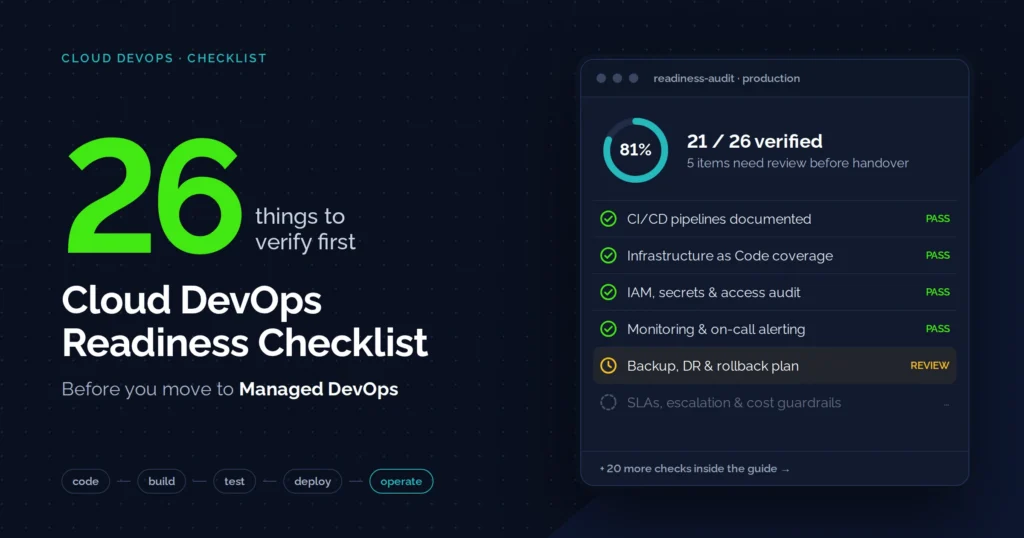

Many teams assume they are “cloud DevOps ready” because they already run workloads in AWS or Azure. But cloud presence is not the same as operational readiness. True readiness means your infrastructure, security controls, automation, documentation, and team processes are stable enough for someone outside your organization to take over tomorrow.
This checklist helps you identify those gaps early, before a managed DevOps provider discovers them during onboarding.
Cloud DevOps Readiness Checklist: Overview
A cloud DevOps readiness checklist is the internal audit you run on your own systems, security, and processes before you hand any of it to a managed DevOps provider. It is not about judging vendors. It is about knowing your starting point.
Gartner forecasts worldwide public cloud end-user spending will reach $850 billion in 2026, up 21.3% from 2025. That growth is not translating into equal value for everyone. McKinsey research found that while 95% of companies say they’re capturing some value from cloud, most of that value sits in isolated pockets, and only about a third of firms track cost savings outside their IT department.
Here is the full 26-point checklist across seven readiness areas:
Business Strategy Alignment
- Have you defined clear business goals for migration?
- Have you chosen the right cloud deployment model for your workload?
- Have you mapped which workloads should move first?
Cloud Infrastructure Readiness
- Have you completed a full infrastructure and application inventory?
- Have you mapped dependencies between applications and databases?
- Have you calculated realistic AWS, Azure, or GCP hosting costs?
- Have you decided between rehost, replat form, or refactor for each workload?
CI/CD Pipeline Automation
- Have you evaluated your CI/CD pipeline maturity?
- Is your infrastructure fully defined as code?
- Are you using GitOps as the single source of truth for deployments?
- What are developer communities saying about automation gaps before handover?
Security and Compliance Posture
- Have you audited IAM policies and enforced least privilege access?
- Is multi-factor authentication enabled across every cloud account?
- What do security engineers keep flagging during handover audits?
- Have you mapped which compliance standards apply to your industry and region?
Monitoring and Incident Response
- Do you have centralized logging and alerting in place?
- Have you documented rollback and disaster recovery procedures?
- Have you defined incident response SLAs before onboarding a provider?
- Is your pipeline ready for AI agents making autonomous deployment decisions?
Team and Operational Handover
- Have you defined which decisions stay in-house versus with the provider?
- Do you have documented runbooks your provider can actually follow?
- What’s the most common regret teams share after outsourcing DevOps?
- Have you planned a knowledge transfer window before go-live?
Cost and FinOps Planning
- Have you benchmarked your current cloud spend against actual usage?
- Have you identified idle or oversized resources before migration?
- Have you set a realistic budget for ongoing managed DevOps, not just the migration?
Work through these before your first vendor call, not after your first bill arrives. Moving to a managed DevOps model is less about finding the right vendor and more about being honest with yourself first. Most failed transitions we see don’t fail because the provider was bad. They fail because the client wasn’t actually ready, they just thought they were.
Is Your Business Strategy Aligned Before You Move to Managed DevOps?
Before you touch infrastructure, get your leadership team to agree on why you’re doing this at all.
1. Have you defined clear business goals for the migration?
Cost reduction, faster releases, better security, and scalability all sound good together, but they pull in different directions when you’re actually building. Pick one primary driver and let the rest be secondary.
- If cost is primary: expect slower migration, more re-architecture work upfront
- If speed is primary: expect higher short-term cloud spend
- If security is primary: expect longer compliance review cycles before go-live
2. Have you chosen the right cloud deployment model for your workload?
Public, private, hybrid, and multi-cloud each solve different problems, and multi-cloud is the one companies pick for the wrong reasons most often.
| Model | Best for | Common mistake |
|---|---|---|
| Public cloud | Startups, variable workloads | Assuming it’s always cheapest |
| Private cloud | Regulated data, legacy systems | Underestimating maintenance overhead |
| Hybrid | Gradual migration, mixed compliance needs | Poor network design between environments |
| Multi-cloud | Vendor lock-in avoidance | Adding it without a real operational need |
3. Have you mapped which workloads should move first?
Not every application deserves the same migration path. A workload set to retire in two years doesn’t need the same treatment as your core revenue product.
- Move low-risk, high-value workloads first to build internal confidence
- Leave workloads with unclear ownership until dependencies are documented
- Treat this as a sequencing decision, not an all-at-once event
Is Your Cloud Infrastructure Actually Ready to Migrate?
This is where most teams overestimate their own readiness. An inventory that lives in someone’s head is not an inventory.
4. Have you completed a full infrastructure and application inventory?
List every server, database, integration, and application in scope, including the ones nobody officially owns anymore.
- Document data volumes and growth rate per system
- Flag which applications have no active internal owner
- Note license and contract expiry dates tied to current infrastructure
5. Have you mapped dependencies between applications and databases?
Dependency mapping is where most readiness assessments underestimate effort, and it’s the step that causes the most rework when it’s skipped.
- A single shared database can quietly block ten migration timelines
- API dependencies between internal services are easy to miss on paper
- Third-party integrations often have hidden rate limits that only surface under load
6. Have you calculated realistic AWS, Azure, or GCP hosting costs?
Use the provider’s own calculator as a starting point, then validate it against a third-party cost tool, because the two rarely agree exactly.
- AWS DevOps environments tend to run cheaper at small scale, pricier at enterprise scale with heavy egress
- Azure DevOps setups often work out cheaper for organizations already on Microsoft licensing
- Build in a 15 to 20% buffer for the first two billing cycles while usage patterns stabilize
7. Have you decided between rehost, replatform, or refactor for each workload?
These three paths solve different problems, and mixing them without a clear rule per workload is how timelines slip.
- Rehost (lift and shift): fastest, lowest cloud-native benefit, good for workloads nearing retirement
- Replatform: moderate effort, some cloud benefits like managed databases or auto-scaling
- Refactor: highest effort, highest long-term payoff, reserved for strategic, long-lived applications
Is Your CI/CD Pipeline Automated Enough for Managed DevOps?
A managed DevOps partner inherits whatever automation maturity you already have. If your pipeline is half-manual, they’ll spend their first month rebuilding it instead of improving it.
8. Have you evaluated your CI/CD pipeline maturity?
Be honest about where you sit: fully manual deploys, partially automated with manual gates, or genuinely continuous delivery.
- Manual approval steps that exist “just in case” are usually a sign of low confidence in testing, not a real control
- Count how many people are required to complete a single production deploy today
9. Is your infrastructure fully defined as code?
Terraform, CloudFormation, and similar tools only deliver value when used consistently across every environment, not just production.
- Partial IaC adoption, where staging is manual and production is code, is a common and costly gap
- Configuration drift between environments is one of the top causes of “it worked in staging” incidents
10. Are you using GitOps as the single source of truth for deployments?
Untracked manual changes to infrastructure are one of the fastest ways a managed DevOps handover goes wrong in the first few weeks.
- Every infrastructure change should trace back to a commit, not a console click
- Rollbacks should be a git revert, not a support ticket
11. What are developer communities saying about automation gaps before handover?
A long-running r/devops thread called “The 15-point DevOps Checklist” (42 upvotes, 12 comments) breaks readiness down into exactly this kind of gap: Infrastructure As Code, Routine Automation, Self-Service Configuration, Automated Builds, Continuous Integration, and Continuous Delivery all show up as separate line items, not one bundled “we do CI/CD” checkbox. The thread’s own framing makes the point well: these are treated as individually verifiable steps, because teams that lump them together tend to discover the gaps only after something breaks.
- Automated builds without automated release management still leaves a manual bottleneck at the last mile
- Community discussion around this list repeatedly flags the feedback loop (post-deploy monitoring feeding back into planning) as the point most teams skip
Is Your Security and Compliance Posture Ready for a Managed Partner?
Security review needs to happen before you grant access, not after, and this is the section where enterprises most often get caught out.
12. Have you audited IAM policies and enforced least privilege access?
Review who can access what, then remove access nobody currently needs.
- Apply least privilege as a default, not an exception process
- Service accounts often carry more permissions than the humans who created them
13. Is multi-factor authentication enabled across every cloud account?
MFA should be treated as baseline hygiene, not an advanced security measure you get to later.
- Check root and admin accounts specifically, these get missed more often then you’d expect
- Confirm MFA applies to API access paths too, not just console logins
14. What do security engineers keep flagging during handover audits?
A pattern that comes up again and again in engineering writeups: secrets sitting in repos or plain environment variables are the single most common finding during handover audits. Reference context: GitHub, Vault Production Readiness Checklist.
- Centralize secrets in a vault-based system (HashiCorp Vault, AWS Secrets Manager, Azure Key Vault) before any external engineer gets access
- Rotate every credential that was previously shared over email, Slack, or shared docs
15. Have you mapped which compliance standards apply to your industry and region?
GDPR, HIPAA, SOC 2, and data residency rules need to be resolved on your side before onboarding, not negotiated mid-project.
- Healthcare and financial services face the strictest data localization requirements
- A provider offering Secure DevOps services should be able to show existing compliance frameworks they’ve already built for similar clients
Are Your Monitoring and Incident Response Systems Production Ready?
You can’t hand over what you can’t currently see. Visibility has to exist before it can be transferred.
16. Do you have centralized logging and alerting in place?
Siloed logs per environment or per team defeat the purpose of centralization, even if each individual log is technically fine.
- One unified logging layer beats five well-maintained separate ones
- Alert fatigue from noisy, low-value alerts is often worse than having too few alerts
17. Have you documented rollback and disaster recovery procedures?
A rollback plan that only works because one engineer remembers the steps isn’t a plan, its a liability.
- Document data lifecycle and retention policies, including what moves to archival storage and when
- Test the rollback procedure at least once before go-live, not during an actual incident
18. Have you defined incident response SLAs before onboarding a provider?
Decide your own expectations for response time and escalation before the vendor conversation, so you’re negotiating from a position of clarity.
- Critical failures typically warrant a 15 to 30 minute first-response target in enterprise SLAs
- Define escalation paths for both business hours and after-hours incidents separately
19. Is your pipeline ready for AI agents making autonomous deployment decisions?
Agentic pipelines and AI-assisted coding are moving from experimental to mainstream faster than most governance policies are keeping up.
- Policy-as-code guardrails matter more once AI agents can propose or push changes with limited human review
- Approval gates for AI-generated infrastructure changes should exist before, not after, you adopt these tools
Is Your Team Ready to Hand Over Operational Control?
The technical checklist matters less if your people aren’t aligned on what “handover” actually means day to day.
20. Have you defined which decisions stay in-house versus with the provider?
Draw this line before day one. Ambiguity here is the single biggest source of friction in the first 90 days of any managed DevOps engagement.
- Architecture decisions often stay in-house even when execution moves to the provider
- Emergency response authority needs a clear, written owner, not an assumed one
21. Do you have documented runbooks your provider can actually follow?
A runbook that only makes sense to the person who wrote it isn’t documentation, its personal notes.
- Write runbooks assuming the reader has zero prior context on your systems
- Include the “why” behind each step, not just the command to run
22. What’s the most common regret teams share after outsourcing DevOps?
Engineering teams tend to ask for readiness help in public long before they ever mention a vendor by name. A r/devops thread titled “Checklist: are we ready for production?” (24 upvotes, 19 comments) shows this pattern clearly: a team running GCP and AWS across EC2, Compute Engine, and RDS/Cloud SQL asked the community for a production readiness checklist just before going live, not after something went wrong. That instinct, asking before handover rather than after, is exactly what separates teams that transition smoothly from teams that don’t.
- The most active replies in threads like this focus on monitoring, rollback, and access control gaps, the same categories that cause regret post-handover
- If your team hasn’t asked itself “are we actually ready” out loud, that’s usually a sign the answer is no
23. Have you planned a knowledge transfer window before go-live?
A structured transfer period, even a short one, prevents the “throw it over the wall” transition that causes early outages.
- Prepare documentation from your side rather than waiting for the provider to extract it from your team
- If you haven’t already, review our DevOps Vendor Evaluation Checklist once you’re ready to compare providers, since readiness and evaluation are two different steps
Have You Budgeted for the Real Cost of Cloud DevOps?
Cost surprises are the most common reason managed DevOps relationships sour within the first year, and most of it is preventable with basic FinOps discipline.
24. Have you benchmarked your current cloud spend against actual usage?
You can’t measure savings later if you don’t have an honest baseline now.
- Track spend by service, team, and environment separately
- Flag any resource nobody can explain the purpose of
25. Have you identified idle or oversized resources before migration?
Migrating waste just moves the waste, it doesn’t eliminate it.
- Right-size instances based on actual utilization data, not original provisioning estimates
- Tag resources for cost allocation before migration, not as an afterthought during it
26. Have you set a realistic budget for ongoing managed DevOps, not just the migration?
Migration cost and ongoing managed service retainer cost are two different numbers, and treating them as one is how budgets blow up at renewal.
- Ask providers to separate one-time setup fees from recurring service costs clearly
- A capable DevOps as a Service partner should show you a FinOps reporting process as part of onboarding, not as a paid add-on later
Where This Leaves You
Twenty-six checks across seven areas sounds like a lot, but most organizations already have half the answers. They just haven’t written them down in one place before starting vendor conversations.
Run through this list honestly, even the uncomfortable parts. The gaps you find now are far cheaper to fix than the ones a managed DevOps partner finds for you after go-live.
Bottom Line
Managed DevOps only works when the client walks in with their own house in order. Twenty-six items feels like a lot on paper, but almost every organization already has partial answers scattered across different teams, tools, and people’s heads.
The real value of this checklist isn’t the list itself. It’s the exercise of writing every answer down in one place before a vendor asks you the same questions during onboarding, at which point gaps cost time and money instead of just effort.
Run it once internally, fix what you can before any vendor conversation starts, and use the rest as your actual RFP input.
Frequently Asked Questions
Q1. What is a cloud DevOps readiness checklist?
It's an internal audit of your infrastructure, security, automation, and team processes before you move to a managed DevOps provider. It's about your own readiness, not the vendor's.
Q2. How long does a cloud DevOps readiness assessment usually take?
For a mid-sized organization, expect one to three weeks depending on how many workloads and teams are involved. Enterprises with legacy systems or multiple compliance regions typically need longer.
Q3. Do I need this checklist if I'm only moving one application to the cloud?
Yes, though scope shrinks accordingly. Dependency mapping, security review, and cost benchmarking still apply even to a single workload migration.
Q4. What's the biggest readiness gap companies underestimate?
Documentation and dependency mapping consistently rank as the most underestimated steps. Teams assume tribal knowledge is documentation until someone outside the team actually has to use it.
Q5. Should I complete this checklist before or after choosing a managed DevOps vendor?
Before. Readiness and vendor evaluation are two separate steps, and going into vendor conversations with clear answers gives you leverage during pricing and SLA negotiations.