

10 Types of DevOps as a Service Models Explained
Understanding different DevOps as a Service Models helps organizations choose the right approach for scaling software delivery. From fully managed DevOps teams to platform-based automation models, this guide explains the 10 most common service models.


Introduction
The way modern software teams build, test, and deploy applications has changed dramatically. At the center of this transformation is DevOps as a Service — a delivery approach that packages the people, processes, and tools of DevOps into an outsourced, subscription-based, or managed model. Whether you’re a startup trying to ship fast or an enterprise modernizing legacy infrastructure, understanding the right DevOps as a Service models can be the difference between operational chaos and a seamlessly automated software pipeline.
According to recent market research, the global DevOps market is projected to surpass $25 billion by 2028, fueled by the rapid adoption of cloud computing, microservices, and the relentless demand for shorter release cycles. Yet, many organizations still struggle to build a mature DevOps operating model in-house — they lack the talent, tooling, or organizational alignment to make it work.
That’s where DevOps as a Service (DaaS) steps in. Instead of hiring, training, and retaining entire DevOps teams, companies can leverage external expertise, managed platforms, and proven frameworks tailored to their unique environments.
In this listicle, we break down the 10 types of DevOps as a Service models you need to know — what they are, how they work, who they’re best suited for, and what to consider before choosing one. Whether you’re exploring a fully managed DevOps engagement or a consulting-only advisory model, this guide covers the full spectrum.
Key Takeaways: 10 Types of DevOps as a Service Models Explained
- DevOps as a Service (DaaS) is not one-size-fits-all. There are 10 distinct models — from Fully Managed DevOps to Hybrid engagements — each designed to meet organizations at different stages of DevOps maturity.
- The right model depends on your context. Startups benefit most from a Fully Managed model, while mid-size and enterprise organizations often find greater value in Hybrid, Platform Engineering, or SRE as a Service approaches.
- A strong DevOps operating model is the foundation of fast, reliable software delivery. Without it, teams face siloed workflows, inconsistent deployments, and slow incident recovery — regardless of how good their tools are.
- DevSecOps is no longer optional. Integrating security directly into the DevOps pipeline — rather than treating it as a final checkpoint — is now a baseline expectation, especially for organizations handling sensitive data or pursuing compliance certifications.
- CI/CD pipeline automation is the highest-impact starting point for most organizations. Streamlining build, test, and deployment processes delivers immediate, measurable gains in deployment frequency and release confidence.
- DORA metrics are the gold standard for measuring DevOps success. Deployment Frequency, Lead Time for Changes, Change Failure Rate, and Mean Time to Recovery give organizations an objective view of their delivery performance over time.
- Cloud-native DevOps requires specialized expertise. Kubernetes, service meshes, and microservices architectures introduce significant operational complexity — making Cloud-Native DevOps as a Service a smart choice for teams without deep container orchestration experience.
- Platform Engineering as a Service scales DevOps across the entire organization. By building internal developer platforms, companies eliminate tooling sprawl and empower every product team with consistent, self-service delivery workflows.
- Observability is what separates reactive teams from proactive ones. Monitoring and Observability as a Service ensures engineering teams have real-time visibility into system health, enabling faster diagnosis and resolution of issues before customers are impacted.
- Full-Stack Techies offers the expertise to implement any DevOps as a Service model effectively — whether you need end-to-end managed DevOps, a targeted CI/CD overhaul, or a strategic advisory engagement to design your DevOps operating model from the ground up.
Quick Comparison: Which DevOps Model Fits You?
| Model | Primary Focus | Best For | Key Benefit |
|---|---|---|---|
| Fully Managed | End-to-end Ownership | Startups & Rapid Scaling | Zero internal overhead |
| CI/CD as a Service | Automation Pipelines | Teams with “Bottle-necked” releases | Immediate speed gains |
| DevSecOps | Security & Compliance | Regulated Industries (Fintech/Health) | Shift-left security |
| SRE as a Service | Reliability & Uptime | High-traffic Consumer Apps | Reduced downtime |
| Platform Engineering | Internal Developer Platforms | Large Enterprise Orgs | Developer self-service |
| Hybrid Model | Filling Capability Gaps | Mid-market with existing teams | Cost-efficient scaling |
What Is DevOps as a Service?
Before diving into the individual models, it’s worth establishing a clear foundation. DevOps as a service refers to the practice of outsourcing DevOps capabilities — such as CI/CD pipeline management, infrastructure automation, monitoring, security, and release orchestration — to a third-party provider or leveraging a managed platform that delivers these capabilities on demand.
Unlike traditional IT outsourcing, DevOps as a services model is inherently collaborative. It blends cultural principles (collaboration, shared ownership, continuous improvement) with technical tooling (containers, Kubernetes, IaC, GitOps) and delivers them through a service-oriented lens.
A well-implemented DevOps operating model should:
- Accelerate software delivery cycles
- Reduce the mean time to recovery (MTTR) from incidents
- Improve deployment frequency and reliability
- Enable infrastructure scalability through automation
- Bridge the gap between development and operations teams
With that context established, let’s explore the 10 distinct types of DevOps as a Service models in detail.
Also Read: The Ultimate Guide to DevOps as a Service (DaaS) in 2026
Get scalable, fast, and user-friendly DevOps solutions tailored to your needs.
Get Free Consultation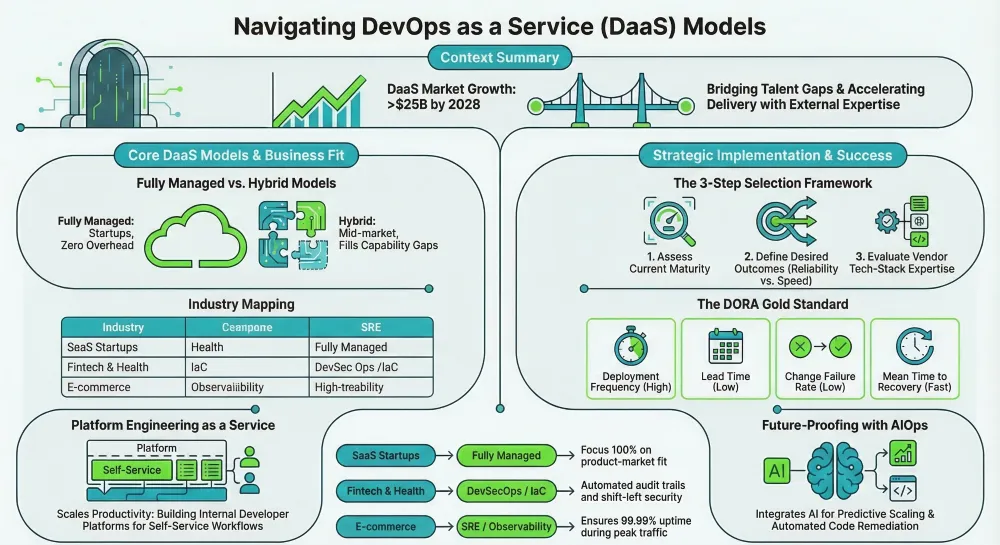
1. Fully Managed DevOps as a Service
What It Is
The fully managed model is the most comprehensive DevOps as a Service offering available. In this model, a third-party provider — such as Full-Stack Techies — takes complete ownership of your DevOps lifecycle. From designing CI/CD pipelines and provisioning cloud infrastructure to monitoring system health and responding to incidents, everything is handled end-to-end by the service provider.
This model is ideal for organizations that either don’t have a DevOps team in place or want to hand off DevOps operations entirely so their internal engineers can focus on product development.
How It Works
The provider embeds their engineers into your workflows, typically beginning with an assessment of your existing infrastructure and development practices. From there, they design a custom DevOps operating model that aligns with your business objectives, set up automation pipelines, and establish ongoing monitoring and alerting systems.
Who It’s For
- Early-stage startups without a dedicated DevOps function
- Mid-market companies are scaling rapidly without the headcount to match
- Enterprises migrating from on-premise to the cloud
Key Considerations
- Vendor lock-in risk if processes are not documented
- Requires strong communication and SLA agreements
- Best paired with providers who understand your tech stack deeply
Full-Stack Techies offers fully managed DevOps engagements that cover everything from pipeline automation to cloud cost optimization, ensuring your engineering team can move fast without breaking things.
2. DevOps Consulting and Advisory Model
What It Is
In the DevOps consulting model, an external DevOps expert or firm provides strategic guidance, assessments, and recommendations without necessarily taking over day-to-day operations. Think of it as having a seasoned DevOps architect available to review your current state, identify gaps, and prescribe a roadmap.
This is one of the most popular DevOps as a Service models for organizations that already have some DevOps maturity but are stuck on specific challenges like tool selection, organizational alignment, or scaling.
How It Works
Engagements typically begin with a DevOps maturity assessment covering culture, automation, measurement, and sharing (the CALMS framework). The consultant then delivers a prioritized action plan with recommendations for tooling, process improvements, and team structures.
Who It’s For
- Mid-size to enterprise organizations with existing DevOps teams
- Companies undergoing digital transformation
- Teams that need to justify DevOps investment to leadership
Key Considerations
- Value is tied to the quality of the advisor’s experience
- Implementation still falls on the internal team
- Best used as a supplement to internal capability, not a replacement
3. CI/CD Pipeline as a Service
What It Is
Continuous Integration and Continuous Delivery (CI/CD) Pipeline as a Service focuses specifically on the automation of code integration, testing, and deployment. Rather than building and maintaining your own Jenkins, GitLab CI, or GitHub Actions infrastructure, the provider delivers a fully managed CI/CD environment.
This is one of the most tangible and measurable DevOps as a services offerings, as it directly impacts how quickly and reliably code reaches production.
How It Works
The provider sets up your build pipelines, integrates them with your version control system, configures automated testing stages, and manages deployment gates. They also handle pipeline maintenance, version updates, and security scanning integration.
Who It’s For
- Development teams spending too much time on pipeline maintenance
- Organizations migrating from legacy build systems
- Teams adopting GitOps or trunk-based development practices
Key Considerations
- Must integrate seamlessly with existing source control and issue tracking tools
- Pipeline design needs to reflect your branching strategy
- Monitoring and alerting for pipeline failures is critical
Full-Stack Techies specializes in building robust, scalable CI/CD pipelines using industry-standard tools like GitHub Actions, GitLab CI, Jenkins, and ArgoCD — tailored to your team’s workflow and deployment frequency.
4. Infrastructure as Code (IaC) as a Service
What It Is
Infrastructure as Code as a Service takes the philosophy of treating infrastructure like software — versioned, tested, and automated — and delivers it as a managed capability. The provider writes, maintains, and manages your Terraform, Pulumi, CloudFormation, or Ansible configurations, ensuring your cloud infrastructure is reproducible, auditable, and version-controlled.
This model is a cornerstone of any mature DevOps operating model and is especially valuable for organizations running multi-cloud or hybrid cloud environments.
How It Works
Providers audit your existing infrastructure (if any), design an IaC architecture that reflects your cloud topology, and implement modules for compute, networking, storage, and security. They also manage drift detection, state management, and ongoing infrastructure updates.
Who It’s For
- Organizations moving away from manual cloud provisioning
- Teams scaling infrastructure across multiple environments (dev, staging, prod)
- Companies requiring audit trails and compliance documentation for infrastructure changes
Key Considerations
- State file management and security is critical (especially in Terraform)
- IaC design must align with your cloud provider’s best practices
- Requires close collaboration with application developers to model infrastructure needs accurately
5. DevSecOps as a Service
What It Is
Security can no longer be bolted on at the end of the software delivery lifecycle. DevSecOps as a Service integrates security practices directly into the DevOps pipeline — automating vulnerability scanning, compliance checks, secrets management, and threat modeling from the very first line of code.
This model operationalizes the “shift-left” philosophy, catching security issues early when they are cheapest to fix, rather than late in the cycle or worse, in production.
How It Works
Providers embed security tooling directly into CI/CD pipelines (SAST, DAST, SCA), manage secrets vaults (e.g., HashiCorp Vault, AWS Secrets Manager), configure container image scanning, and establish compliance policy-as-code frameworks. They also conduct regular security reviews and penetration testing.
Who It’s For
- Organizations in regulated industries (finance, healthcare, government)
- SaaS companies handling sensitive customer data
- Teams preparing for SOC 2, ISO 27001, or PCI-DSS certifications
Key Considerations
- Security tooling must not significantly slow down pipeline velocity
- Requires ongoing tuning to reduce false positive rates
- Must cover the entire SDLC, not just the CI pipeline
Full-Stack Techies integrates DevSecOps practices across your entire delivery pipeline, helping you achieve security compliance without sacrificing deployment speed.
6. Cloud-Native DevOps as a Service
What It Is
Cloud-Native DevOps as a Service is built around the modern cloud ecosystem — Kubernetes, containers, service meshes, serverless functions, and managed cloud services. This model ensures your DevOps as a service strategy is purpose-built for cloud-native architectures rather than retrofitted from legacy approaches.
It encompasses everything from containerizing applications and managing Kubernetes clusters to implementing GitOps workflows and optimizing cloud costs.
How It Works
Providers design your cloud-native stack, set up managed Kubernetes environments (EKS, GKE, AKS), implement Helm chart management, configure service meshes like Istio or Linkerd, and establish observability stacks using tools like Prometheus, Grafana, and the OpenTelemetry framework.
Who It’s For
- Organizations adopting a microservices architecture
- Teams migrating monoliths to containers
- Businesses looking to maximize cloud platform capabilities
Key Considerations
- Kubernetes complexity requires deep expertise; choose providers with demonstrated experience
- Cost management in cloud-native environments requires active attention
- Multi-cluster management adds significant operational overhead
7. Site Reliability Engineering (SRE) as a Service
What It Is
Site Reliability Engineering (SRE) as a Service brings Google’s pioneering approach to large-scale system reliability to organizations of all sizes. SRE as a Service providers embed reliability engineering principles — error budgets, service level objectives (SLOs), blameless postmortems, and toil reduction — into your operations without requiring you to hire and build an entire SRE function.
This model is one of the most sophisticated DevOps as a Service models and is particularly powerful for organizations where uptime and reliability are a direct business metric.
How It Works
Providers define SLOs and SLIs for your key services, establish error budgets, build automated alerting and on-call rotation systems, lead postmortem processes after incidents, and systematically work to reduce operational toil through automation.
Who It’s For
- High-traffic consumer applications where downtime is costly
- Organizations with frequent production incidents seeking to improve MTTR
- Teams that want to apply engineering discipline to operations
Key Considerations
- Requires strong buy-in from product and engineering leadership
- Error budget policies must be enforced organizationally, not just technically
- Works best when integrated with your existing development team’s workflows
8. Monitoring and Observability as a Service
What It Is
You cannot improve what you cannot measure. Monitoring and Observability as a Service provides a fully managed approach to collecting, correlating, and acting on metrics, logs, and traces across your entire technology stack. This model goes beyond basic uptime monitoring to deliver deep, actionable insights into application performance, user experience, and infrastructure health.
Modern observability is built on the three pillars — metrics, logs, and traces — and this DevOps as a services model ensures all three are implemented, maintained, and continuously improved.
How It Works
Providers set up and manage your observability stack (Datadog, New Relic, Grafana + Prometheus, Elastic Stack, Jaeger, etc.), configure dashboards and alerting rules, integrate distributed tracing across services, and build runbooks for common alert scenarios.
Who It’s For
- Organizations with complex, distributed systems
- Teams experiencing blind spots during incidents
- Companies that need SLA reporting and performance benchmarks for customers
Key Considerations
- Observability costs can scale quickly with data volume; requires careful management
- Alert fatigue is a real problem — providers should tune signal-to-noise ratios
- Custom dashboards need to be maintained as your architecture evolves
Full-Stack Techies builds bespoke observability frameworks that give engineering teams real-time visibility into system health, performance bottlenecks, and user-impacting issues before your customers even notice them.
9. Platform Engineering as a Service
What It Is
Platform Engineering as a Service represents a more modern evolution of the DevOps operating model. Rather than each development team managing their own tooling and infrastructure, Platform Engineering creates an internal developer platform (IDP) — a curated set of self-service capabilities that development teams use to build, deploy, and operate their applications with minimal friction.
This model shifts the focus from “enabling DevOps practices team by team” to “building scalable platform infrastructure that empowers all teams.”
How It Works
Providers design and build internal developer platforms using tools like Backstage (Spotify’s open-source IDP), Port, or custom-built platforms. These platforms abstract away infrastructure complexity, provide golden paths for common development workflows, and enforce organizational standards automatically.
Who It’s For
- Larger engineering organizations with multiple product teams
- Companies suffering from “DevOps sprawl” where every team has different tooling
- Organizations wanting to scale developer productivity across the board
Key Considerations
- Platform engineering is a product — it requires treating internal developers as users
- Requires significant investment in design and ongoing maintenance
- Governance and standardization must be balanced with developer autonomy
10. Hybrid DevOps as a Service Model
What It Is
The hybrid model is arguably the most pragmatic and widely applicable of all DevOps as a Service models. In this approach, organizations blend internal DevOps capabilities with external managed services — handling some functions in-house while outsourcing others to specialized providers.
For example, a company might manage its own Kubernetes clusters but outsource CI/CD pipeline management, security scanning, and observability to Full-Stack Techies. Or an organization may handle application deployment internally while engaging an external SRE team for on-call coverage and incident response.
How It Works
The hybrid model requires a clear delineation of responsibilities — essentially a RACI matrix that defines what is owned internally versus externally. Providers typically offer modular service packages, allowing organizations to select exactly which capabilities they need managed externally.
Who It’s For
- Organizations with some existing DevOps maturity wanting to fill specific gaps
- Companies that want cost-efficiency without full outsourcing
- Teams that need to scale DevOps capabilities rapidly during periods of growth
Key Considerations
- Clear ownership and handoff protocols are essential to avoid gaps in accountability
- Integration between internal tools and external services must be seamless
- Regular reviews of the hybrid mix ensure the model continues to serve evolving needs
Full-Stack Techies offers flexible, modular DevOps as a Service engagements that can be tailored to fit into your existing structure — whether you need us to own a single service layer or operate across your entire delivery stack.
How to Choose the Right DevOps as a Service Model
Selecting the right model from this list isn’t about picking the most feature-rich option — it’s about matching the model to your organization’s current maturity, goals, and constraints. Here’s a simple framework to guide your decision:
Assess your current state. Conduct a DevOps maturity assessment to understand where your organization stands across the dimensions of culture, automation, measurement, and sharing.
Define your outcomes. Are you trying to reduce deployment time, improve system reliability, achieve compliance certifications, or enable developer self-service? Each outcome maps more naturally to certain models.
Consider your team structure. A small startup without a dedicated DevOps engineer will gravitate toward the fully managed model, while a mid-size company with a capable platform team may only need targeted consulting or a specialized managed service.
Evaluate vendor expertise. Look for providers with deep expertise in your specific cloud environment, tech stack, and industry. Generic DevOps services rarely deliver the same value as domain-specific expertise.
Plan for knowledge transfer. The best DevOps as a service engagements build internal capability over time, rather than creating permanent dependency on external providers.
Matching Models to Industry Needs
Selecting a model often depends on your specific regulatory and operational landscape:
- Fintech & Healthcare: Prioritize DevSecOps as a Service and IaC as a Service. These models ensure that every infrastructure change is audited and security is baked into the pipeline to meet SOC2 or HIPAA requirements.
- E-commerce & Retail: Focus on SRE as a Service and Monitoring/Observability. During peak seasons like Black Friday, the cost of downtime is catastrophic; having managed reliability ensures 99.99% uptime.
- SaaS Startups: The Fully Managed Model is the standard. It allows the founding team to focus 100% on product-market fit while the service provider builds a production-grade environment.
- Legacy Enterprise: Use the Consulting Model followed by Platform Engineering. This allows for a strategic roadmap to modernize legacy silos into a unified developer platform.
Also Read: How to Hire the Best DevOps as a Service Provider in 2026: The Ultimate Executive Guide
Why Full-Stack Techies Is the Right Partner for DevOps as a Service
Navigating the landscape of DevOps as a Service models requires both technical depth and strategic thinking — and that’s exactly what Full-Stack Techies brings to every engagement.
Whether you need a fully managed DevOps team to own your entire delivery pipeline, specialized expertise to harden your DevSecOps posture, or a strategic advisory partner to design your DevOps operating model from scratch, Full-Stack Techies has the experience, tools, and talent to make it happen.
Our teams are fluent in the full DevOps toolchain — Terraform, Kubernetes, ArgoCD, GitHub Actions, Datadog, HashiCorp Vault, Istio, and more — and have delivered successful DevOps transformations for organizations ranging from Series A startups to global enterprises.
We don’t just implement DevOps. We help you build the culture, processes, and automation that make fast, reliable, and secure software delivery a sustainable competitive advantage.
The Next Evolution: AI-Driven DevOps as a Service
As we move further into 2026, DevOps as a Service is evolving beyond manual automation. We are now integrating AIOps (Artificial Intelligence for IT Operations) into our managed models. This includes:
- Predictive Scaling: Using AI to forecast traffic spikes and scale infrastructure before latency occurs.
- Automated Remediation: AI agents that can identify common pipeline failures and suggest (or apply) code fixes in real-time.
- Generative IaC: Leveraging LLMs to accelerate the creation of Terraform and CloudFormation templates, reducing setup time from days to minutes.
At Full-Stack Techies, we ensure your DevOps operating model is not just automated, but intelligent and future-ready.
Conclusion
The evolution of DevOps as a Service has given organizations of every size access to the kind of operational excellence that was once reserved only for the world’s largest tech companies. From fully managed DevOps engagements and CI/CD Pipeline as a Service to Platform Engineering and SRE as a Service, the spectrum of available models is rich, nuanced, and full of opportunity.
Understanding the differences between these DevOps as a Service models — and knowing when to apply each — is the first step toward building a delivery engine that consistently ships high-quality software, fast.
As you evaluate your options, remember that the right model isn’t the one with the most features — it’s the one that aligns most closely with your team’s current reality, your business goals, and the outcomes you’re trying to achieve.
Ready to find the right DevOps as a Service model for your organization? Full-Stack Techies is here to help you assess, design, and implement a DevOps strategy that drives real business results. Get in touch with our team today.
Frequently Asked Questions About DevOps as a Service Models
Q1: What Is DevOps as a Service and How Does It Work?
DevOps as a Service (DaaS) is a model where a third-party provider manages your DevOps functions u2014 including CI/CD pipelines, infrastructure automation, monitoring, and security u2014 on a subscription or engagement basis. Instead of building an in-house DevOps team, businesses partner with experts like Full-Stack Techies to access on-demand DevOps capabilities that accelerate delivery, reduce costs, and improve system reliability.



