

How to Migrate Legacy Apps to React.js with AI Enhancements: The 2026 Strategy
Migrate Legacy Apps to React.js using AI-driven enhancements to modernize outdated systems without disrupting business operations. This 2026 strategy guide explains how enterprises can combine React.js with AI for smarter UI refactoring, improved performance, reduced technical debt, and long-term scalability—while minimizing risk during migration.


Introduction: The State of Modernization in 2026
In 2026, the conversation around legacy systems has shifted from “if” to “how fast.” According to Gartner’s 2025 Hype Cycle, we have entered the era of AI-native software engineering, where legacy migration is no longer a manual, multi-year slog but an intelligence-driven transformation. Current data suggests that over 25% of IT budgets are still consumed by technical debt, yet organizations that migrate legacy apps to React.js using AI-enhanced workflows are seeing a 40-50% acceleration in delivery timelines.
The React ecosystem itself has matured. With the React Compiler now serving as the production standard and React Server Components (RSC) eliminating unnecessary client-side hydration, the performance gains of migrating are massive. However, moving from a monolithic jQuery, AngularJS, or ASP.NET setup requires more than just a “lift and shift.” It requires a strategic partner—a React.js development company that understands how to blend human expertise with agentic AI tools.
This guide provides a roadmap to transform your aging infrastructure into a high-performance, AI-ready application. Whether you are looking to hire React.js developers or seeking the best React.js development services, this architect-level guide will ensure your migration is future-proof.
Quick Summary: What is AI-Native Legacy Migration? AI-native migration is the 2026 standard for transforming legacy systems (AngularJS, jQuery, .NET) into modern React.js architectures. By leveraging agentic AI tools, the React Compiler, and Server Components, enterprises can automate 40% of code refactoring, significantly reducing technical debt while ensuring 100% functional parity and superior performance.
Key Takeaways: The 2026 Legacy-to-React Roadmap
If you’re short on time, here are the non-negotiable insights for modernizing your stack this year:
- AI is the Great Accelerator: Utilizing AI-native engineering doesn’t just help with coding; it automates the extraction of undocumented business logic from legacy scripts, reducing discovery time by up to 50%.
- Performance is Automatic: With the React Compiler now standard, the manual burden of performance tuning (memoization) is gone. Migrated apps are inherently faster and leaner than their monolithic predecessors.
- The “Strangler Fig” is King: Avoid the “Big Bang” rewrite. Modern React.js development services recommend an incremental approach—replacing legacy modules one by one to ensure zero downtime and continuous ROI.
- RSC Changes the Game: React Server Components (RSC) allow you to keep heavy data-fetching logic on the server, ensuring your users only download the bare minimum of JavaScript. This is the gold standard for enterprise-level UX in 2026.
- Don’t Go It Alone: While AI handles the boilerplate, human architectural oversight is vital. To navigate complex state transitions and security audits, it is often most cost-effective to hire React.js developers who specialize in large-scale transformations.
- The “Full-Stack Techies” Advantage: Choosing a veteran React.js development company ensures your migration isn’t just a UI update, but a complete digital transformation that integrates AI agents and predictive analytics into your core workflow.
Who Is This Guide For?
- CTOs & IT Directors: Seeking to reduce TCO (Total Cost of Ownership) and eliminate technical debt.
- Engineering Leads: Tasked with architecting a scalable, modern frontend.
- Product Managers: Aiming to improve user experience (UX) and feature velocity.
- Full-Stack Developers: Looking for the latest 2026 AI prompts and patterns for refactoring.
- Enterprises: Evaluating a React.js development company like Full-Stack Techies to handle high-complexity migrations.
Tools & Prerequisites
Before you begin, ensure your environment is equipped with the 2026 AI-native stack:
| Tool Category | Recommended Tools | Purpose |
|---|---|---|
| Framework | React 19+ / Next.js 15+ | Core UI library & Server Components. |
| AI Assistants | GitHub Copilot Workspace / Gemini Code Assist | Multi-file refactoring and rule extraction. |
| Analysis | Zencoder AI / SonarQube | Identifying dead code and security vulnerabilities. |
| State Management | TanStack Query / Zustand | Efficient data fetching and global state. |
| Expert Support | Full-Stack Techies | Professional oversight for complex refactoring. |
Get scalable, fast, and user-friendly ReactJS solutions tailored to your needs.
Get Free Consultation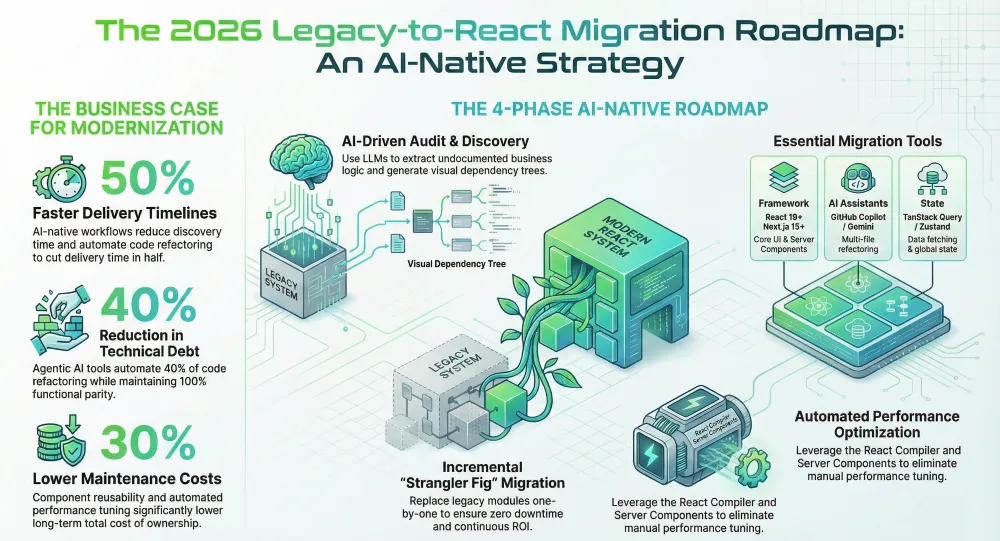
Phase 1: AI-Driven Legacy Audit & Discovery
You cannot migrate what you don’t understand. Legacy apps often suffer from “undocumented logic.”
1.1 Extracting Business Rules with AI
Use LLMs to scan your legacy codebase (PHP, JSP, or jQuery) to identify core business logic.
- AI Prompt: “Analyze this legacy PHP script and list all business rules regarding user discount calculations. Format as a markdown table.”
1.2 Dependency Mapping
AI agents can now generate visual dependency trees, showing which parts of your legacy system are “tightly coupled.” This helps in deciding which modules to migrate first.
Phase 2: Choosing Your Migration Strategy
There are two primary paths. Your choice depends on your risk appetite and the expertise of your React.js development services.
1. Incremental Migration (The “Strangler Fig” Pattern)
The most recommended approach in 2026. You replace pieces of the legacy app one by one.
- Pros: Lower risk, continuous delivery.
- Cons: Requires a “bridge” (like a micro-frontend proxy) to run both apps simultaneously.
2. The Big Bang Migration
A complete rewrite from scratch.
- Pros: Clean slate, no technical debt carryover.
- Cons: High risk of “feature parity” gaps; long time-to-market.
Pro Tip: For enterprise-scale apps, Full-Stack Techies recommends the incremental approach using a Micro-frontend architecture. This allows you to deploy React modules inside your legacy shell without a total shutdown.
Note: Use this 2026 Agentic Prompt for Component Refactoring. To accelerate your migration, use an AI Agent with this specific “Architect-Level” prompt: “Act as a Senior React Architect. Convert this legacy [jQuery/Angular] component into a React 19 Functional Component. Prioritize React Server Components for data fetching and ensure the output is compatible with the React Compiler (no manual useMemo). Maintain 100% CSS styling parity using Tailwind CSS.”
Phase 3: The Step-by-Step Migration Process
Step 1: Initialize the Modern Environment
Set up a Next.js environment to leverage React Server Components.
Bash
npx create-next-app@latest --typescript --tailwind --eslintWhy? Next.js provides the best SEO and performance optimizations out of the box for 2026.
Step 2: Refactor Legacy Logic into Hooks
Don’t copy-paste. Use AI to transform “spaghetti code” into clean, reusable React Hooks.
- The Workflow:
- Input legacy function.
- Use an AI agent to refactor into useCalculation or useAuth
- Validate with AI-generated unit tests.
Step 3: Componentize the UI
Legacy apps often have 2,000-line HTML files. Break these into atomic React components.
- AI Action: Use tools like UXPin or Tailwind AI to generate React components from legacy CSS/HTML.
Step 4: Implement the React Compiler
In 2026, manual memoization (useMemo, useCallback) is deprecated. Enable the React Compiler in your next.config.js to handle performance automatically.
Step 5: Data Layer Modernization
Replace direct SQL queries or AJAX calls with TanStack Query (React Query) for smart caching and synchronization.
Phase 4: AI Enhancements & Intelligent UI
Migrating to React isn’t just about the framework; it’s about enabling Agentic AI features.
- Predictive Prefetching: Use AI to predict which page a user will visit next and prefetch the React component.
- Self-Healing Forms: Implement AI validation that learns from user errors to provide better real-time suggestions.
- Natural Language Interfaces: Replace complex legacy filters with a “Search anything” AI bar.
Common Mistakes to Avoid
- Over-complicating State: Don’t reach for Redux immediately. 2026 best practices suggest using Server State (RSC) and Zustand for simple client state.
- Ignoring SEO: Legacy apps often have perfect SEO. Ensure your React migration uses proper Metadata APIs and Server-Side Rendering (SSR).
- Lack of Automated Testing: Migrating logic without testing is a recipe for disaster. Use AI to generate a Vitest suite for every refactored hook.
Real-World Use Case: From Monolith to AI-Ready
The Client: A Global Logistics Provider with a 15-year-old ASP.NET application.
The Solution: They partnered with Full-Stack Techies, a premier React.js development company, to execute a phased migration.
The Result:
- Load Time: Reduced from 8s to 1.2s.
- Maintenance Cost: Dropped by 30% due to component reusability.
- New Feature Velocity: Increased by 2x using AI-assisted coding.
Also Explore: How Full-Stack Techies Built an AI-Powered E-Commerce Platform with React.js
Common Troubleshooting Issues
“The Legacy CSS is breaking my React components!”
Cause: Global CSS namespace collisions.
Solution:
- Encapsulate the legacy app in a container.
- Use CSS Modules or Tailwind CSS for new React components to ensure style isolation.
“Why is my React app slower than the legacy one?”
Cause: Excessive “Client-side hydration” or missing the React Compiler.
Solution:
- Move data fetching to Server Components.
- Verify the React Compiler is active in your build logs.
Why Trust This Guide?
This roadmap is built on 2026 industry standards, citing Gartner’s 2025 modernization frameworks and Forbes Tech Council insights on digital transformation ROI. Our methodology is validated through real-world deployments by Full-Stack Techies, ensuring every step is grounded in production-grade reality, not just theoretical hype.
Also Read: React.js Scalability Checklist for Growing Business Platforms



