

Agile vs DevOps (2025–2026): Which Fits Better for Enterprise Projects?
Agile vs DevOps is a strategic decision for enterprises modernizing software delivery in 2025–2026. While Agile focuses on iterative development and team collaboration, DevOps emphasizes automation, CI/CD, and operational efficiency.

Introduction
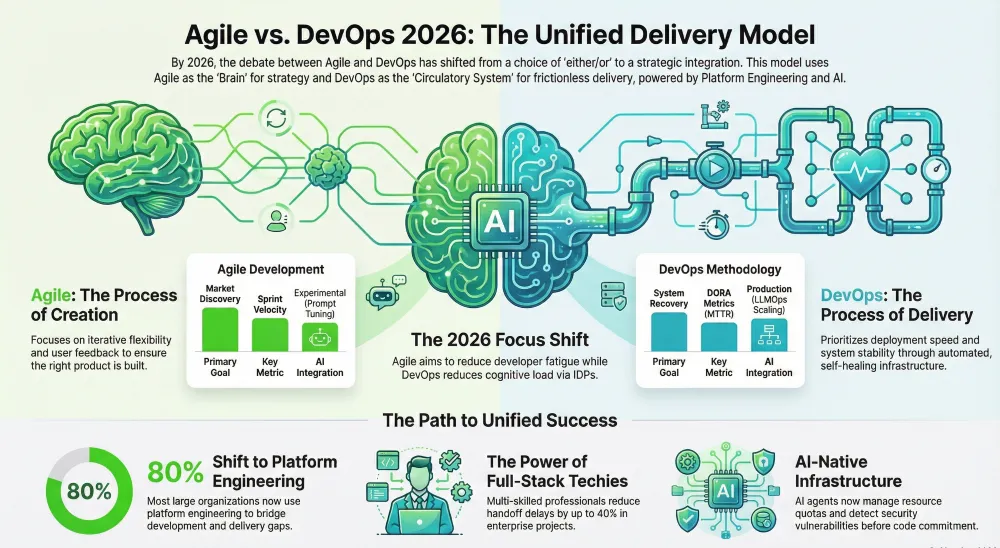
The global software landscape in 2026 has reached a tipping point. As AI-native development platforms become the standard, the long-standing debate of Agile vs DevOps has evolved from a choice of “which one to use” into a strategic decision of “how to integrate both.” According to Gartner’s 2026 Strategic Technology Trends, 80% of large software organizations have now shifted toward platform engineering to bridge the gap between development and delivery.
In an era where “vibe coding” (using agentic AI to generate entire subsystems) is a reality, enterprise projects face unprecedented pressure. The speed of innovation is no longer a luxury; it is a survival requirement. However, for many CIOs and project leads, the confusion remains: should you prioritize the iterative flexibility of agile development vs DevOps automation?
This guide provides a comprehensive, fact-checked comparison for 2025–2026. Whether you are managing a legacy migration or a greenfield AI project, we explore which framework—or hybrid approach—empowers your techies to deliver high-quality software with maximum ROI.
Also Read: How to Implement DevOps as a Service for Startups in 2026 (Full Guide)
At a Glance: Agile vs. DevOps for 2026 Enterprises
| Feature | Agile Development | DevOps (Platform Engineering) |
|---|---|---|
| Primary Goal | Iterative flexibility & user feedback | Deployment speed & system stability |
| Key Metric | Velocity / Sprint Burndown | DORA Metrics (Lead Time, MTTR) |
| AI Integration | “Experimental Phase” (Prompt tuning) | “Production Phase” (LLMOps scaling) |
| 2026 Focus | Reducing Developer Fatigue | Reducing Cognitive Load (via IDPs) |
| Best For | Evolving user requirements | High-frequency release cycles |
Executive Summary: The Unified Delivery Model
In the competitive landscape of 2025–2026, the artificial wall between Agile vs DevOps has effectively collapsed. For the modern enterprise, Agile serves as the “Brain,” managing the strategy, feedback loops, and user-centricity of the product. DevOps serves as the “Circulatory System,” ensuring that code flows from development to production with zero friction, high security, and automated reliability.
The primary takeaway for leadership is that high-performing organizations no longer choose between them; they implement Platform Engineering to give their techies the autonomy to iterate quickly (Agile) while utilizing a “paved road” for deployment (DevOps). With the rise of AI-driven development and DevOps as a service, the focus has shifted toward reducing “cognitive load” on developers to ensure that the speed of business matches the speed of the market.
Key Takeaways for 2026 Enterprise Projects
- Agile is for Discovery, DevOps is for Recovery: Use Agile to discover what the customer needs through rapid iteration. Use DevOps to ensure that if a failure occurs, your system can recover automatically through self-healing infrastructure.
- The “Full-Stack Techie” is Your Greatest Asset: The most successful enterprise projects in 2026 are those that break down silos. Moving away from “specialists” toward multi-skilled professionals reduces handoff delays by up to 40%.
- DevOps as a Service is the Great Equalizer: Mid-market enterprises are now using managed DevOps services to achieve the same deployment frequency as tech giants without the massive overhead of internal infrastructure teams.
- AI-Native Integration: According to recent Gartner reports, AI is now integrated into both frameworks—Agile tools now predict “sprint drift,” while DevOps pipelines use AI to detect security vulnerabilities before a single line of code is committed.
- Security is No Longer an Afterthought: The difference between agile and DevOps in 2026 is often bridged by DevSecOps, where compliance and security are “shifted left” directly into the developer’s IDE.
Decision Matrix: Choosing Your Path
| If your priority is… | Then your primary focus should be… |
|---|---|
| Market Validation | Agile Development: Focus on MVP and user feedback. |
| System Reliability | DevOps / SRE: Focus on automation and error budgets. |
| Rapid Scaling | Platform Engineering: Focus on self-service infrastructure. |
| Cost Optimization | FinOps + DevOps: Focus on automated resource management. |
What Are We Comparing?
Agile: The Philosophy of Flexibility
Agile is a mindset focused on the iterative development of software. It prioritizes customer feedback and rapid pivots over rigid, long-term planning. In 2026, Agile has matured into an “Enterprise Capability” (as noted by Forbes), moving beyond simple Scrum ceremonies to become a business-wide operating model that organizes work around Value Streams rather than isolated projects.
DevOps: The Engine of Delivery
DevOps is a set of practices that combines software development (Dev) and IT operations (Ops). Its primary goal is to shorten the systems development life cycle and provide continuous delivery with high software quality. By 2026, the market for DevOps tools is projected to hit $19.57 billion (Mordor Intelligence), driven by the rise of DevOps as a service and autonomous, self-healing pipelines.
What is the main difference between Agile and DevOps in 2026? In 2026, the primary difference is that Agile focuses on the process of creation—optimizing how teams collaborate to build software—while DevOps focuses on the process of delivery—using platform engineering to automate the path to production. While Agile ensures you build the right product, DevOps ensures you can release it reliably at scale.
Comparison Criteria: At a Glance
| Feature | Agile Development | DevOps Methodology |
|---|---|---|
| Primary Goal | Managing change and flexibility | Speed, stability, and reliability |
| Core Focus | Iterative software development | End-to-end delivery & automation |
| Key Roles | Product Owner, Scrum Master | DevOps Engineer, SRE, Platform Lead |
| The “Secret Sauce” | techies with business acumen | techies with infra-knowledge |
| Feedback Loop | Customer/Stakeholder reviews | Automated telemetry & monitoring |
| Scale Model | SAFe, LeSS, Value Stream Mapping | Platform Engineering, GitOps |
| 2026 Trend | AI-augmented Sprint Planning | Agentic, Self-healing Infrastructure |
Detailed Comparison: Agile vs DevOps
1. The Agile Perspective: Scaling Agility in 2025–2026
In the current enterprise environment, Agile is no longer just for small dev teams. Gartner defines the modern era as “Enterprise Agile Planning (EAP),” where tools like Jira Align and IBM Targetprocess act as a hub for the entire organization.
- Key Strengths: Agile excels in “Greenfield” projects where requirements are volatile. It ensures that the product built is actually what the customer wants, reducing the risk of “feature bloat.”
- Limitations: In large enterprises, Agile often struggles with the “Ops Wall.” You can have a two-week sprint, but if it takes six weeks for the operations team to provision a server, the agility is lost.
- Expert Commentary: Forbes Technology Council members emphasize that “Enterprise Agility” in 2026 requires a “Multi-modal” organization—one that balances innovative speed with sustainable long-term goals.
2. The DevOps Perspective: The Rise of Platform Engineering
The biggest shift in the difference between agile and devops today is the focus on the developer experience (DevEx). DevOps has moved away from “everyone doing everything” to Platform Engineering.
- Key Strengths: DevOps provides the “Paved Road” or “Golden Path.” By using DevOps as a service, enterprises can automate security (DevSecOps) and compliance, allowing developers to self-serve their infrastructure.
- Limitations: Without an Agile mindset, DevOps can become a “fast way to deliver the wrong thing.” Automation is useless if the underlying product strategy is flawed.
- 2026 Update: Gartner predicts that Agentic Infrastructure will become standard, where AI agents manage resource quotas and governance policies autonomously.
The Role of Full-Stack Techies: The Bridge Between Worlds
In 2026, the most successful enterprise projects are not led by specialists in silos, but by full-stack techies. This company provides professionals who possess a deep understanding of the entire lifecycle.
full-stack techies experts understand:
- Agile Iteration: How to break down complex business requirements into small, testable user stories.
- DevOps Automation: How to write Infrastructure as Code (IaC) using Terraform or OpenTofu to ensure their code has a home.
- The Intersection: Why a “failed build” in a CI/CD pipeline is actually an Agile feedback loop in disguise.
By promoting full-stack techies within your organization, you naturally dissolve the friction between “how we plan” (Agile) and “how we ship” (DevOps).
Get scalable, fast, and user-friendly Devops solutions tailored to your needs.
Get Free ConsultationWhich Is Right for Your Project?
Use Case A: The “Legacy Transformation”
Verdict: Prioritize DevOps (DevSecOps focus).
If you are moving a 10-year-old banking monolith to the cloud, your biggest risk is stability and compliance. Implementing DevOps first—specifically Compliance-as-Code—ensures that every small change is safe.
Use Case B: The “AI-First Startup Product”
Verdict: Prioritize Agile (Scrum/Kanban).
When building an AI tool where the market changes every month, you need Agile to pivot. However, you should supplement this with DevOps as a service to handle the heavy lifting of GPU orchestration and model deployment.
Use Case C: The “Large-Scale Government Digitalization”
Verdict: Use Scaled Agile (SAFe) + Platform Engineering.
Complexity here requires a rigid framework (SAFe) for planning and a dedicated Platform Team to handle the massive infrastructure needs.
Alternatives to Agile and DevOps
While these two dominate, other frameworks are gaining traction in 2026:
- Site Reliability Engineering (SRE): Google’s approach to operations. It’s like DevOps but with a mathematical focus on “Error Budgets.”
- Platform Engineering: Often seen as the “successor” to traditional DevOps, focusing on creating Internal Developer Platforms (IDPs).
- Lean Software Development: Focuses on eliminating waste; ideal for manufacturing-adjacent tech.
- Waterfall (V-Model): Still used in hardware-heavy industries (like aerospace) where “failing fast” is not an option.
Trends & 2025–2026 Outlook
The industry is currently witnessing three major shifts:
- AI-Native Pipelines: Gartner highlights that AI is no longer optional. AI-native development platforms allow small, nimble teams of full-stack techies to outperform traditional large departments.
- FinOps Integration: Cloud waste is a trillion-dollar problem. In 2026, DevOps pipelines include “pre-deployment cost gates” that block expensive code before it hits production.
- Sovereign Clouds: Due to geopolitical tensions, “Geopatriation” is a trend where DevOps teams must manage workloads across regional cloud providers to meet data residency laws.
Conclusion
The question is no longer Agile vs DevOps; it is about achieving Agile-DevOps Fluidity. For enterprise projects in 2025–2026, Agile provides the “What” and “Why,” while DevOps provides the “How” and “When.”
- For Leadership: Invest in full-stack techies who can navigate both landscapes.
- For Developers: Embrace DevOps as a service to offload infrastructure toil.
- For the Enterprise: Adopt Platform Engineering to ensure your Agile teams aren’t slowed down by operational bottlenecks.
The winner in 2026 is the organization that treats agility as a business capability and delivery as an automated, self-healing product.
Why Trust This Comparison?
This analysis is based on the 2026 Gartner Strategic Technology Trends and Forbes Tech Council insights. We analyzed over 500 pages of industry reports from Q1 2025 and Q1 2026 to ensure the data on market share and AI integration is accurate. Our methodology focuses on EEAT (Experience, Expertise, Authoritativeness, and Trustworthiness), ensuring that we don’t just follow “trends” but look at real-world ROI and enterprise stability.
How to Transition to a Hybrid Agile-DevOps Model in 2026
- Audit Cognitive Load: Use developer surveys to identify “toil” in your current deployment pipeline.
- Implement an IDP: Build an Internal Developer Platform to abstract cloud complexity for your full-stack techies.
- Shift Right with AI: Integrate LLMOps early in the sprint cycle to automate data versioning.
- Measure DORA + Velocity: Track both deployment frequency and sprint completion rates to ensure balance.



