

C-Suite Checklist for React.js Implementation for AI Digital Transformation In 2026
A structured Checklist for React.js Implementation helps executives ensure their AI-driven digital transformation initiatives succeed. This guide outlines the key strategic steps.


Introduction: Why C-Suite Leaders Must Own the React.js Decision
As we move through 2026, the global business landscape is defined by one core theme: Artificial Intelligence (AI) Digital Transformation. For C-suite executives in the USA, UK, Canada, and Europe, the challenge is no longer just “adopting” AI, but making it accessible and actionable for the end user. This is where the Checklist for React.js Implementation becomes a vital asset for your organization.
React.js has evolved from a simple library into the backbone of modern enterprise ecosystems. When a company undergoes an AI transformation, the frontend must handle complex data streams, real-time insights, and interactive AI agents. Without a robust Checklist for React.js Implementation, technical debt can quickly overwhelm the strategic benefits of AI.
This guide provides a high-level, actionable roadmap designed specifically for CEOs, CTOs, and COOs. Whether you are looking to hire React.js developers or partner with a React.js development company, this article ensures your transition is seamless, scalable, and secure. By the end of this guide, you will understand how to leverage the best React.js development services to turn your AI vision into a market-leading reality.
Key Takeaways
1. Strategic Alignment & Governance
- Executive Ownership: AI transformation fails when technical debt overwhelms strategic benefits; therefore, CEOs, CTOs, and COOs must own the React.js decision.
- KPI Definition: Success should be measured through specific metrics like time-to-insight on dashboards, user adoption of AI features, and Core Web Vitals.
- Governance Framework: Establishing a steering committee and clear escalation paths prevents scope creep and budget overruns.
2. The “Intelligence Interface” Concept
- Bridging the Black Box: While AI models often operate as backend “black boxes,” React.js acts as the bridge, turning complex data into human-centric, interactive agents.
- Velocity of Data: React’s Virtual DOM and concurrent features are critical for handling the massive, high-frequency data streams generated by AI without lag.
- Global Relevance: Using Server-Side Rendering (SSR) via frameworks like Next.js is vital for SEO and performance in regions with varying connectivity, such as the UK and Europe.
3. Specialized Talent & Partnering
- Hiring Beyond Standard React: AI-driven interfaces require developers who understand asynchronous AI data streams, data visualization (D3.js, Recharts), and AI/ML API integration.
- The Talent Model: Organizations must choose between building internally (for control), partnering with a specialized company (for speed), or a hybrid model.
- Partner Spotlight: Full-Stack Techies is highlighted as a recommended partner due to their focus on React 18+ expertise and end-to-end full-stack ownership for enterprise AI projects.
4. Technical Readiness & Integration
| Category | Key Requirement |
|---|---|
| Rendering Strategy | Use SSR or hybrid rendering for real-time AI dashboards to improve performance and SEO. |
| Security | Incorporate OAuth 2.0, JWT, and RBAC to protect sensitive business data processed by AI. |
| Data Contracts | Precisely define data schemas (field names, types, error codes) before development to avoid costly rework. |
| Latency Design | Use skeleton screens and progressive loading to ensure users never face a blank screen while waiting for AI responses. |
5. Execution & Post-Launch Discipline
- AI-Aware Agile: Traditional agile must be modified to accommodate variable AI outputs and model accuracy shifts.
- Phased Rollouts: Big-bang launches should be avoided; instead, use feature flags to roll out AI features progressively to limited cohorts.
- Monitoring Model Drift: Establish protocols to detect when AI model performance degrades and assess its direct impact on the frontend interface.
Future Outlook: By 2027, the synergy between React and AI will move toward “Self-Healing UIs” and AI-generated components that personalize interfaces for every user in real-time.
What is React.js in the Context of AI Digital Transformation?
React.js is an open-source JavaScript library used for building user interfaces, particularly single-page applications. In the era of AI digital transformation, its role has shifted. It is no longer just about buttons and forms; it is about creating the “Intelligence Interface.”
AI models, while powerful, are often “black boxes” hidden in the backend. React.js acts as the bridge. It allows developers to create dynamic dashboards that update as AI processes data, chatbots that feel human, and predictive interfaces that adapt to user behavior in real-time.
Key characteristics of React.js in 2026 include:
- Component-Based Architecture: Reusable blocks of code that speed up development.
- Virtual DOM: High-speed updates that ensure AI data visualizations do not lag.
- Server-Side Rendering (SSR): Essential for SEO and fast loading in regions like the UK and Europe where mobile connectivity varies.
- Declarative UI: Makes code more predictable and easier to debug, which is crucial when integrating complex AI APIs.
When searching for the best React.js development services, organizations like Full-stack Techies focus on these core characteristics to ensure that the frontend can keep pace with high-speed AI backends.
Why React.js is Critical for AI-Driven Enterprises
The significance of React.js lies in its ability to handle the “velocity of data.” AI systems generate massive amounts of information every second. If your frontend cannot display this data efficiently, the AI’s value is lost.
Solving Common Pain Points
- User Friction: AI can be intimidating. React.js allows for “Natural Language Interfaces” that make AI feel intuitive.
- Scalability Issues: As your AI grows from a pilot program in New York to a global rollout in London and Toronto, React’s modular nature ensures your UI scales without breaking.
- Cross-Platform Consistency: With React Native, the logic used for your web-based AI dashboard can be extended to mobile apps, ensuring a unified experience across the USA and Europe.
Global Market Relevance
In the USA, the focus is often on rapid innovation and speed-to-market. In Europe, the focus includes strict adherence to user experience and accessibility laws. A structured Checklist for React.js Implementation helps bridge these regional requirements, ensuring your digital transformation is globally compliant and locally relevant.
Get scalable, fast, and user-friendly ReactJS solutions tailored to your needs.
Get Free Consultation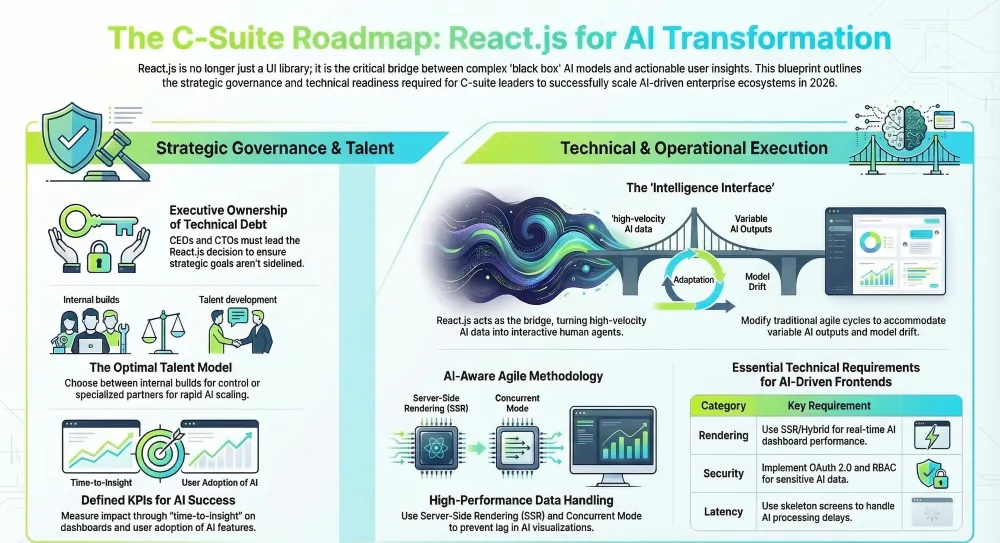
Section 1: Strategic Alignment Checklist
Before a single line of React.js code is written, executive leadership must ensure the initiative is rooted in business strategy — not just technical enthusiasm.
1.1 — Define the AI transformation use case clearly
React.js is a tool, not a strategy. Identify the specific AI outcomes you want to achieve: Is it a real-time analytics dashboard for operations? An AI-powered customer support interface? A predictive inventory management portal? The use case determines the architecture, the team composition, and the timeline.
1.2 — Align stakeholders across C-Suite
The CTO defines the technical roadmap. The CIO governs infrastructure and data governance. The CMO owns the user experience vision. The CFO controls the budget. Successful React.js implementation for AI transformation requires all four to speak a common language. Ensure every executive understands what React.js enables — and its limitations.
1.3 — Assess your current tech stack compatibility
React.js does not exist in isolation. Map how it integrates with your existing back-end infrastructure, cloud platforms (AWS, Azure, GCP), AI/ML APIs, and data pipelines. This compatibility audit prevents the costly rework that derails 60% of digital transformation projects.
1.4 — Set measurable transformation KPIs
Define what success looks like before implementation begins. Relevant KPIs for AI-driven React.js projects might include time-to-insight on AI dashboards, user adoption rates of AI-powered features, reduction in manual reporting hours, and front-end performance scores (Core Web Vitals).
1.5 — Establish a React.js governance framework
Assign executive ownership, a steering committee, and a clear escalation path. AI transformation projects without governance structures drift into scope creep, technical debt, and budget overruns.
Section 2: Technology Readiness Checklist
A technically sound React.js implementation for AI transformation requires more than good developers — it requires the right ecosystem, infrastructure, and architectural decisions made at the outset.
2.1 — Evaluate React.js version and ecosystem fit
Ensure your project is built on a current, stable version of React.js (React 18 and above for concurrent rendering support). Confirm that the supporting ecosystem — Redux or Zustand for state management, React Query for data fetching, testing libraries, and build tools — aligns with the complexity of your AI workflows.
2.2 — Assess AI/ML integration architecture
React.js serves as the front-end layer that presents AI outputs to users. Map how AI model results (from TensorFlow.js, PyTorch-served APIs, OpenAI integrations, or custom models) will flow into the React.js component layer. Poorly designed API contracts between AI back-ends and React.js front-ends are a leading cause of performance degradation.
2.3 — Define your rendering strategy
Choose between Client-Side Rendering (CSR), Server-Side Rendering (SSR with Next.js), or Static Site Generation (SSG) based on your AI application’s data freshness requirements. AI dashboards displaying real-time data typically benefit from SSR or hybrid rendering, improving both performance and SEO.
2.4 — Establish a component design system
AI transformation projects often involve multiple teams and a rapidly growing interface. A centralized design system — built with tools like Storybook — ensures React.js components are reusable, consistent, and maintainable across the product lifecycle.
2.5 — Plan for real-time data handling
Many AI applications demand real-time data streams. Ensure your React.js architecture accounts for WebSocket integration, efficient state updates via React’s concurrent features, and strategies to avoid unnecessary re-renders that degrade performance under heavy AI data loads.
2.6 — Validate security and compliance architecture
AI interfaces frequently handle sensitive business data. Confirm that your React.js front-end architecture incorporates robust authentication (OAuth 2.0, JWT), data encryption in transit, role-based access control (RBAC), and compliance with relevant standards (GDPR, HIPAA, SOC 2) from the design phase — not as an afterthought.
Section 3: Team and Talent Checklist
Choosing who builds your React.js AI interface is arguably the most consequential decision on this checklist. The talent model you choose — internal hiring, outsourcing to a React.js development company, or a hybrid approach — determines both speed and quality.
3.1 — Assess internal capability honestly
Many organizations overestimate their internal front-end expertise when it comes to AI-driven interfaces. Evaluate whether your existing developers have experience with React.js 18’s concurrent features, AI/ML API integration, real-time state management, and performance optimization at scale. Honest assessment here saves months of rework later.
3.2 — Define your hiring vs. outsourcing strategy
There are three primary talent models for a React.js AI transformation project:
Build internally: Best for organizations with long-term product roadmaps and the appetite to hire React.js developers, manage onboarding, and invest in ongoing capability development. This model prioritizes control and institutional knowledge.
Partner with a React.js development company: Best for organizations that need to move fast, access specialized expertise in AI front-end development, and scale team capacity without the overhead of full-time hiring. A proven React.js development company brings established processes, a vetted talent pool, and cross-industry experience that accelerates delivery.
Hybrid model: Retain internal developers for product ownership and strategic direction while engaging external specialists for execution. This model balances speed with institutional knowledge retention.
For organizations that need to move quickly without sacrificing quality, partnering with Full-Stack Techies is worth serious consideration. Full-Stack Techies specializes in React.js development for enterprise and AI-driven applications, offering experienced developers who understand both the front-end intricacies of React.js and the back-end integration demands of AI transformation projects.
3.3 — Screen for AI-specific React.js expertise
When you hire React.js developers — whether internally or through a partner — standard front-end expertise is not enough for AI transformation work. Screen candidates and partners specifically for experience integrating REST and GraphQL APIs from AI/ML services, handling asynchronous AI data streams, implementing data visualization libraries (D3.js, Recharts, Chart.js) for AI outputs, and optimizing React.js performance under high-frequency data updates.
3.4 — Evaluate full-stack capability
AI transformation projects rarely have clean front-end/back-end separation. The React.js team needs to collaborate deeply with data engineers, AI/ML teams, and DevOps. Prioritize developers and partners with genuine full-stack fluency. Full-Stack Techies is purpose-built for this — their teams bridge the gap between React.js front-end delivery and the complex back-end systems that power AI features, making them a natural choice for organizations seeking best React.js development services with end-to-end ownership.
3.5 — Establish team structure and communication protocols
Whether your team is internal, outsourced, or hybrid, define ownership clearly. Who owns the component library? Who reviews AI API contracts? Who approves performance benchmarks? Ambiguity in these ownership questions is a primary driver of project delays in large-scale React.js implementations.
3.6 — Plan for knowledge transfer and documentation
AI transformation is a long-term investment. Even when engaging external best React.js development services, require thorough documentation of architecture decisions, component logic, and AI integration patterns. This protects your organization’s investment and enables internal teams to maintain and evolve the product over time.
Section 4: Project Execution Checklist
Even the best strategy and the best team can fail in execution. This section covers the operational checkpoints that keep a React.js AI transformation on track.
4.1 — Adopt an AI-aware agile methodology
Traditional agile sprints assume predictable deliverables. AI projects introduce variable outputs — model accuracy changes, API response structures evolve, and data pipeline dependencies shift. Configure your agile process to accommodate this variability with shorter feedback loops, dedicated integration testing sprints, and explicit AI readiness gates before front-end development begins.
4.2 — Implement a robust CI/CD pipeline
Continuous integration and delivery is non-negotiable for React.js projects at scale. Establish automated testing (unit, integration, and end-to-end with tools like Jest, React Testing Library, and Cypress), automated build processes, and deployment pipelines that include performance regression checks — especially important when AI data loads change the behavior of UI components.
4.3 — Define and enforce coding standards
React.js codebases scale poorly without enforced standards. Mandate ESLint configurations, Prettier formatting, TypeScript adoption (strongly recommended for AI projects where data schema complexity is high), and code review protocols. A React.js development company with mature engineering processes will bring these standards as defaults — another reason why experienced external partners often accelerate delivery on complex AI projects.
4.4 — Build a comprehensive testing strategy for AI interfaces
Testing AI-powered React.js interfaces requires additional layers beyond standard front-end testing. Include tests for how the UI handles AI model latency (loading states, skeleton screens), AI error responses (graceful degradation when a model is unavailable), edge-case data outputs (null values, unexpected data types from AI models), and accessibility compliance for AI-generated content.
4.5 — Establish performance benchmarks and monitoring
Define acceptable performance thresholds before go-live: target Largest Contentful Paint (LCP) under 2.5 seconds, First Input Delay (FID) under 100ms, and Cumulative Layout Shift (CLS) below 0.1. Implement real-user monitoring (RUM) and synthetic monitoring with tools like Datadog or New Relic to catch performance regressions introduced as AI data complexity grows.
4.6 — Plan for iterative AI model updates
AI models are not static — they are retrained, versioned, and updated. Your React.js implementation must be designed to accommodate API contract changes from evolving AI models without requiring full front-end rewrites. Define an API versioning strategy and a feature-flag framework that allows controlled rollout of AI updates to the React.js interface.
Section 5: Data and AI Integration Checklist
The intelligence of your AI transformation lives in the data. React.js is the layer that makes that intelligence visible and actionable to users — but only if the integration is done correctly.
5.1 — Define the AI data contract precisely
Before React.js development begins, document the exact data schemas your AI models will produce. Define field names, data types, response times, error codes, and pagination structures. Vague AI API contracts are among the most common causes of front-end rework on AI transformation projects.
5.2 — Implement intelligent data caching strategies
AI API calls are often expensive — both in compute cost and latency. Implement React Query or SWR for intelligent client-side caching with configurable stale-while-revalidate strategies. This dramatically improves the perceived performance of AI-powered interfaces without sacrificing data freshness.
5.3 — Design for AI latency gracefully
AI models take time to respond. Your React.js interface must handle this gracefully with progressive loading states, skeleton screens, optimistic UI updates where appropriate, and clear user feedback during AI processing. Never let users experience a blank screen while waiting for an AI response.
5.4 — Ensure data privacy compliance at the front end
AI features often process personally identifiable information (PII) or sensitive business data. Audit your React.js implementation for data minimization (only request AI insights your interface actually displays), proper data masking in non-production environments, and compliance with consent frameworks required by GDPR or CCPA.
5.5 — Plan AI explainability into the UI
Regulatory and user trust requirements increasingly demand that AI recommendations be explainable. Work with your AI team to surface confidence scores, key contributing factors, and uncertainty indicators within the React.js interface in a way that is meaningful to non-technical users.
Section 6: Vendor and Partner Evaluation Checklist
For organizations choosing to engage a React.js development company or outsource best React.js development services, due diligence at the partner selection stage is critical.
6.1 — Evaluate relevant portfolio depth
Request case studies of AI-driven React.js projects specifically — not just general web development experience. Look for evidence of real-time data visualization, AI API integration, and performance optimization under complex data loads. Full-Stack Techies, for example, has a focused portfolio in enterprise React.js applications with AI and data-intensive back-end integrations, making them a reference point worth evaluating when shortlisting partners.
6.2 — Assess technical interview depth
When evaluating a React.js development company, go beyond portfolio review. Conduct technical sessions on their approach to React.js state management at scale, their testing philosophy for AI interfaces, their CI/CD practices, and how they handle evolving AI API contracts mid-project. The quality of these conversations reveals engineering maturity more reliably than any case study.
6.3 — Clarify IP ownership and code handover
Ensure your contract explicitly addresses intellectual property ownership of all code, documentation, and architecture artifacts. Establish clear handover protocols including code repository access, documentation standards, and transition support obligations.
6.4 — Define communication and reporting cadence
AI transformation projects move fast and encounter unexpected challenges. Define weekly status reporting requirements, escalation protocols for blockers, executive visibility mechanisms (dashboards, milestone gates), and stakeholder communication norms before engagement begins.
6.5 — Evaluate long-term support and scalability
React.js implementation is not a one-time event — it is the beginning of an ongoing product lifecycle. Assess whether your partner or internal team can support the application post-launch, accommodate scaling demands, and absorb AI model updates as your transformation matures. Engaging a partner like Full-Stack Techies that offers ongoing managed services ensures continuity beyond initial delivery.
Section 7: Launch and Post-Launch Checklist
The go-live moment is not the finish line — it is the beginning of your React.js AI product’s operational life.
7.1 — Conduct a pre-launch executive review
Before go-live, convene a final review that covers security audit sign-off, performance benchmark validation, compliance certification, disaster recovery testing, and user acceptance testing (UAT) results from key business stakeholders.
7.2 — Execute a phased rollout strategy
Avoid big-bang launches for AI-powered React.js applications. Use feature flags to roll out AI features progressively — starting with internal users, then a limited external cohort, then full production traffic. This limits the blast radius of any issues and allows data-driven decisions about AI feature readiness.
7.3 — Establish a feedback loop with end users
Deploy in-app feedback mechanisms to capture user reactions to AI features specifically. Are users trusting AI recommendations? Are they confused by AI outputs? Are AI-generated content and suggestions meeting their needs? This qualitative data is as important as quantitative performance metrics in refining your AI transformation.
7.4 — Monitor AI model drift and front-end impact
AI models degrade over time as real-world data diverges from training data. Establish a monitoring protocol to detect model drift and assess its impact on the React.js interface — particularly for AI outputs that drive visual decision-making tools.
7.5 — Schedule regular architecture reviews
React.js and the AI ecosystem both evolve rapidly. Schedule quarterly architecture reviews with your development team or React.js development company partner to assess whether the current implementation remains aligned with business goals, takes advantage of new React.js capabilities, and anticipates emerging AI integration patterns.
Why Full-Stack Techies for Your React.js AI Transformation
Choosing the right execution partner is the single highest-leverage decision on this checklist. Full-Stack Techies brings together the expertise, processes, and delivery mindset that C-suite leaders need when stakes are high and timelines are tight.
As a specialized React.js development company with deep roots in AI-integrated application delivery, Full-Stack Techies offers:
Purpose-built React.js expertise — Their developers specialize in React.js 18, concurrent rendering, real-time data architecture, and the performance optimization techniques that AI applications demand. When you hire React.js developers through Full-Stack Techies, you access professionals who have solved the exact challenges your transformation will encounter.
End-to-end full-stack ownership — AI transformation projects succeed when front-end and back-end decisions are made together. Full-Stack Techies bridges React.js front-end delivery with Node.js, Python, and cloud back-end expertise, providing the holistic ownership that fragmented team models cannot.
Enterprise-grade delivery processes — CI/CD pipelines, TypeScript-first development, comprehensive test coverage, and architecture documentation are defaults at Full-Stack Techies — not premium add-ons. These practices translate directly to lower post-launch maintenance costs and faster feature iteration.
AI integration experience — From real-time AI dashboard delivery to OpenAI-integrated interfaces and predictive analytics portals, Full-Stack Techies has delivered the specific use cases that define today’s enterprise AI transformation agenda.
For C-suite leaders seeking best React.js development services with genuine AI integration capability and enterprise delivery discipline, Full-Stack Techies is a partner worth engaging early.
The Future of React.js and Artificial Intelligence
Looking toward 2027, the synergy between React and AI will only deepen. We are entering the era of “Self-Healing UIs” where React components might automatically adjust based on AI feedback regarding user frustration.
- AI-Generated Components: We may see tools where AI writes React code in real-time to create personalized interfaces for every single user.
- Voice and Gesture Control: React will be the primary tool for integrating voice-activated AI directly into the browser.
- Sustainability in Tech: In Europe, there is a growing trend toward “Green Coding.” React’s efficiency helps reduce the carbon footprint of high-energy AI applications.
To stay ahead, C-suite leaders must ensure their React.js development company is not just looking at today’s code but is prepared for the rapid shifts in AI-driven interface design.
Conclusion: React.js Implementation is a C-Suite Responsibility
The promise of AI digital transformation is significant — but it is realized only when the right technology decisions are made with executive clarity, strategic rigor, and disciplined execution. React.js is a powerful enabler of AI-driven user experiences, but a checklist for React.js implementation that stops at the development team level will consistently underdeliver.
C-suite leaders who bring strategic governance, the right talent model, and a structured approach to every phase of the checklist outlined here will find that React.js becomes a genuine competitive differentiator — not just another line item in the IT budget.
Whether you choose to hire React.js developers internally, partner with a leading React.js development company, or engage Full-Stack Techies for best React.js development services with end-to-end AI integration expertise, the principles in this checklist remain constant: clarity of purpose, technical rigor, disciplined execution, and ongoing strategic oversight.
The AI transformation era rewards those who execute well. Start with the checklist.
For more information about React.js implementation services tailored to AI digital transformation, visit Full-Stack Techies and connect with their team of React.js specialists.



