

CI/CD vs DevOps (2025–2026): Which Delivers More Value?
Developer reviewing CI/CD pipeline and automation scripts while analyzing CI/CD vs DevOps workflows for modern software deployment. This 2025–2026 guide explains the differences, benefits, and use cases to help IT leaders determine which approach delivers the most business value.


Introduction: The $81 Billion Question
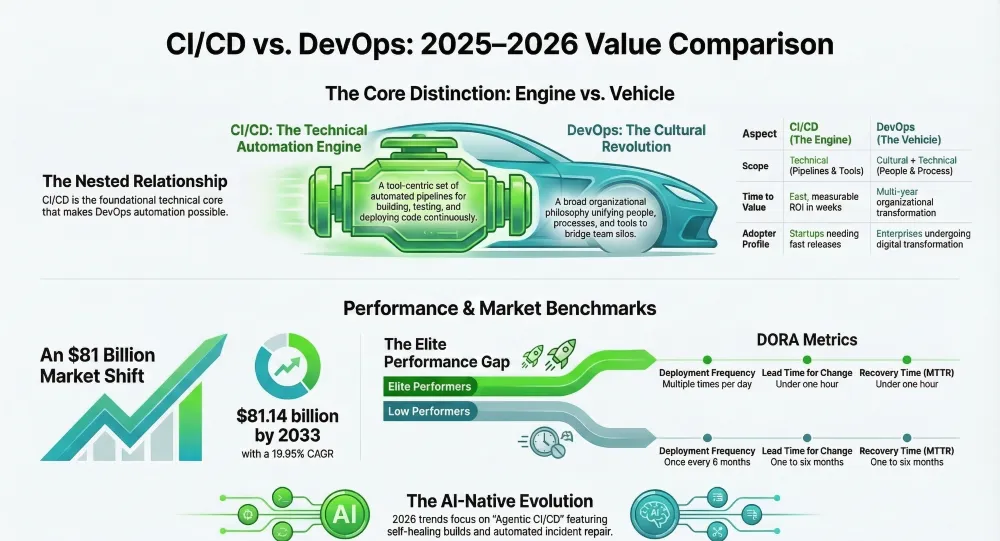
The global DevOps market was valued at $13.16 billion in 2024 and is on a trajectory to reach a staggering $81.14 billion by 2033, growing at a compound annual growth rate (CAGR) of 19.95% (IMARC Group, 2024). Simultaneously, the CI/CD tools market alone is projected to surge from $1.73 billion in 2025 to $4.53 billion by 2030 at a CAGR of 21.18% (Mordor Intelligence, 2025). These are not just impressive numbers — they represent a fundamental shift in how the world builds and delivers software.
Yet one of the most persistent sources of confusion in enterprise technology circles remains the debate around CI/CD vs DevOps. Are they the same thing? Is one a subset of the other? Should your organization pursue one over the other, or do you need both? These questions are not merely academic — the answers directly influence how you structure your engineering organization, allocate budget, hire DevOps engineer talent, evaluate DevOps as a service providers, and ultimately, how quickly and reliably you ship software to customers.
This article delivers a comprehensive, data-backed comparison of CI/CD and DevOps — what they are, how they differ, where they overlap, and which delivers more value for different types of organizations. We also explore the latest industry trends, real-world implementation considerations, and how partnering with Full-Stack Techies can accelerate your journey.

At a Glance: CI/CD vs DevOps Quick Comparison
| Aspect | CI/CD | DevOps |
|---|---|---|
| Definition | A set of automated pipelines for building, testing, and deploying code continuously | A cultural philosophy and set of practices unifying Dev and Ops for faster, higher-quality software delivery |
| Scope | Technical (pipeline, tooling, automation) | Cultural + Technical (people, process, and tools) |
| Primary Goal | Automate code integration and deployment | Bridge organizational silos and optimize the full SDLC |
| Implementation | Tool-centric: Jenkins, GitHub Actions, GitLab CI, CircleCI | Practice-centric: culture change, IaC, monitoring, collaboration |
| Time to Value | Faster to implement initially | Longer transformation, but broader organizational impact |
| Key Metrics | Deployment frequency, build success rate, lead time | MTTR, change failure rate, team velocity, deployment frequency |
| Team Focus | Development teams primarily | Cross-functional: Dev, Ops, QA, Security |
| Market Size (2025) | $1.73B (CI tools market) | $13.16B+ (DevOps market) |
| Scalability | Scales with pipeline complexity | Scales with organizational maturity |
| Typical Adopters | Startups, agile teams needing fast releases | Mid-to-large enterprises undergoing digital transformation |
Key Takeaways
1. CI/CD and DevOps are not the same thing — and confusing them costs organizations time and money. CI/CD is a technical practice focused on automating the build, test, and deploy pipeline. DevOps is a broader cultural and organizational philosophy. One is the engine; the other is the vehicle. Understanding this distinction is the first step to investing in the right place at the right time.
2. The market has spoken — both are exploding in adoption. The DevOps market is on track to hit $81.14 billion by 2033 (CAGR of 19.95%), while the CI/CD tools market is growing at 21.18% annually. Organizations are not choosing between them — they are investing in both as part of a unified software delivery strategy.
3. CI/CD delivers fast ROI; DevOps delivers lasting transformation. If your goal is to reduce deployment risk, increase release frequency, and improve code quality within weeks, start with CI/CD. If your goal is to fundamentally change how your engineering organization operates, eliminate silos, and build long-term competitive resilience, invest in a full DevOps transformation. The two are sequential, not competing.
4. You cannot have effective DevOps without CI/CD at its core. Gartner explicitly defines DevOps platforms as those built around the CI/CD pipeline. CI/CD is not optional within a DevOps practice — it is foundational. Every DevOps maturity model, from DORA to Gartner, lists pipeline automation as a prerequisite for organizational transformation.
5. Elite DevOps performers operate at a fundamentally different level. DORA research shows that top-performing organizations deploy multiple times per day with lead times under one hour and recover from incidents in under 60 minutes. Low performers deploy once every six months with change failure rates as high as 60%. The gap is not incremental — it is existential for competitive positioning.
6. AI is reshaping both CI/CD and DevOps faster than most organizations expect. From GitLab Duo’s AI-assisted pipelines to Harness’s self-healing deployments, AI is moving from a buzzword to a functional component of modern delivery pipelines. Organizations that ignore this shift risk falling behind peers who are already using AI to reduce MTTR, automate test generation, and proactively detect vulnerabilities.
7. DevOps as a Service is the fastest path to value for most organizations. 37% of IT leaders cite DevOps skills as their top talent gap. Building internal capability from scratch takes 18–36 months. Partnering with a dedicated DevOps as a Service provider like Full-Stack Techies compresses that timeline significantly, reduces risk, and gives teams access to battle-tested playbooks and tooling from day one.
8. Hiring DevOps engineers is increasingly expensive and competitive. The median DevOps engineer salary reached $177,500 in H2 2025, with 70.6% of roles now remote — meaning you are competing with every employer globally, not just locally. Organizations must weigh the true fully-loaded cost of a hire against the speed, flexibility, and expertise of a service partner for each project context.
9. Security is no longer separate from CI/CD or DevOps — it is embedded in both. DevSecOps is now a mandate, not a trend. CISA, FDA, and PCI DSS regulations are driving SBOM generation and automated security gates directly into pipelines. Organizations that treat security as a post-deployment checkpoint are already behind regulatory expectations and competitive peers.
10. The four-stage implementation roadmap is a practical path, not a theoretical one. Foundation → Automation → Culture → Optimization is not a consulting abstraction. It is the sequence that high-performing organizations actually follow. Start by measuring your DORA baselines, build a basic CI pipeline, and iterate deliberately. The organizations that struggle are those that try to skip stages or attempt cultural transformation without technical foundations already in place.
The bottom line: CI/CD and DevOps are two sides of the same coin. Lead with CI/CD for speed, layer in DevOps culture for durability, and partner with Full-Stack Techies to accelerate every stage of the journey.
Understanding CI/CD — The Automation Engine
What Is CI/CD?
Continuous Integration and Continuous Delivery/Deployment (CI/CD) is a software engineering methodology and toolchain that automates the processes of integrating code changes, running tests, and deploying applications. It is the technical backbone of modern software delivery — a pipeline that transforms lines of code into production-ready releases with minimal human intervention.
- Continuous Integration (CI) refers to the practice where developers frequently merge their code changes into a shared repository — often multiple times a day. Each merge triggers an automated build and testing sequence. This dramatically reduces integration conflicts and identifies bugs early in the development cycle, when they are cheapest to fix.
- Continuous Delivery (CD) extends CI by automatically preparing code changes for release to a production-like staging environment. A human operator still makes the final decision to push to production, ensuring a controlled gate in the release process.
- Continuous Deployment takes this one step further — every code change that passes all automated tests is deployed directly to production without human intervention. This is the model adopted by organizations like Amazon, Netflix, and Google, where deployment frequency can reach thousands of times per day.
Key Components of a CI/CD Pipeline
- Source Code Management: Git repositories (GitHub, GitLab, Bitbucket)
- Build Automation: Compiling code and packaging artifacts
- Automated Testing: Unit tests, integration tests, performance tests, security scans
- Artifact Repository: Storing built packages (JFrog Artifactory, Nexus)
- Environment Management: Provisioning staging and production environments
- Deployment Automation: Automated rollout strategies (blue-green, canary)
- Monitoring & Feedback: Observability dashboards and alerting
Industry Snapshot: CI/CD Adoption in 2025
Industry Stat — Continuous Delivery Foundation (2024): 83% of developers report involvement in DevOps-related activities. The use of CI/CD tools is strongly correlated with better deployment performance across all DORA (DevOps Research and Assessment) framework metrics — meaning organizations using CI/CD pipelines deploy more frequently, recover faster from failures, and maintain higher quality.
The CI/CD market is experiencing exceptional growth momentum. According to Mordor Intelligence (2025), the continuous integration tools market is expected to reach $4.53 billion by 2030, fueled by enterprises compressing release cycles to hours, adopting multi-cloud architectures, and embedding security checks earlier in the pipeline.
A pivotal finding from the State of CI/CD 2024 Report by the Continuous Delivery Foundation reveals that organizations adopting both managed and self-hosted CI/CD tools together achieve the highest deployment performance — demonstrating that the strategic combination of CI/CD tooling matters as much as adoption itself.
Key Market Statistics:
- 21.18% — CI Tools Market CAGR 2025–2030
- $15B — CI/CD Market Estimated Size in 2025
- 83% — Developers Actively Using CI/CD (CDF, 2024)
Leading CI/CD Tools in 2026
According to JetBrains’ 2025 State of CI/CD survey, GitHub Actions has emerged as the dominant choice for teams already on GitHub due to its native integration and generous free tier. Enterprise organizations, however, continue to maintain more complex multi-tool environments — 32% use two different CI/CD tools, and 9% use three or more.
- GitHub Actions — Most popular for GitHub-native teams; serverless, marketplace-driven
- GitLab CI/CD — End-to-end DevSecOps platform, strong enterprise adoption
- Jenkins — Open-source incumbent with rich plugin ecosystem, popular for on-premises
- Azure DevOps Pipelines — Preferred for Microsoft stack organizations
- CircleCI — Known for test automation excellence and ease of use
- AWS CodePipeline / CodeCatalyst — Gaining traction in cloud-native AWS environments
- TeamCity (JetBrains) — Strong in organizations needing advanced customization
Understanding DevOps — The Cultural Revolution
What Is DevOps?
DevOps is far more than a technology choice — it is a cultural and organizational transformation. The term, coined by Patrick Debois in 2009, combines Development (Dev) and Operations (Ops) into a unified philosophy that breaks down the traditional silos between software engineers who write code and system administrators who deploy and maintain it.
According to Gartner’s definition, DevOps platforms provide “fully integrated and orchestrated capabilities to enable continuous delivery of software using agile and DevOps practices.” The capabilities span the entire development and delivery lifecycle — built around the CI/CD pipeline — and include planning, creation, artifact management, security, quality engineering, change management, compliance, environment management, deployment, and monitoring.
DevOps is not a product you buy or a tool you install. It is a mindset that organizations must cultivate, supported by processes and technologies that enable faster, more reliable, and more secure software delivery.
The Five Pillars of DevOps
- Culture: Shared responsibility, blameless post-mortems, cross-functional team ownership
- Automation: CI/CD pipelines, Infrastructure as Code (IaC), automated testing, deployment automation
- Lean/Flow: Reducing work-in-progress, eliminating waste, optimizing end-to-end flow
- Measurement: DORA metrics, SLAs, SLOs, observability, feedback loops
- Sharing: Knowledge sharing, open communication, transparent tooling, inner source practices
DevOps Market Growth: Industry Data Points
Gartner Forecast (2024–2027): Gartner estimates that by 2027, 80% of organizations will incorporate a DevOps platform into their development toolchains to streamline software delivery and reduce complexity — a remarkable leap from just 25% in 2023. Furthermore, organizations that invest in Developer Experience (DevEx) are expected to achieve twice the developer retention rate by 2027 compared to those that do not.
IMARC Group Market Analysis (2024): The global DevOps market, valued at $13.16 billion in 2024, is projected to reach $81.14 billion by 2033, representing a CAGR of 19.95%. North America leads with a 37% market share, driven by strong technological infrastructure, early adoption of advanced IT solutions, and significant investments in digital transformation.
These numbers underscore an important truth: organizations that have fully embraced DevOps culture are not just deploying software faster — they are fundamentally reorganizing around software delivery as a core business competency.
DevOps in Practice: Real-World Benchmarks
The DORA (DevOps Research and Assessment) State of DevOps framework defines four key metrics that distinguish high-performing DevOps organizations from low performers. Elite performers — typically large technology companies and digitally native businesses — achieve:
- Deployment Frequency: Multiple times per day (vs. once per six months for low performers)
- Lead Time for Changes: Under one hour (vs. one to six months for low performers)
- Mean Time to Recover (MTTR): Under one hour (vs. one to six months for low performers)
- Change Failure Rate: 0–15% (vs. 46–60% for low performers)
Amazon’s DevOps Achievement: Within one year of implementing a comprehensive DevOps approach on AWS, Amazon’s engineering teams were able to deploy code on average every 11.7 seconds — a benchmark that continues to define what’s possible when CI/CD pipelines are embedded within a mature DevOps culture.
CI/CD vs DevOps — The Core Differences
Scope and Philosophy
The most fundamental distinction between CI/CD and DevOps lies in their scope. CI/CD is a methodology and toolset — a technical solution to the problem of reliably automating software builds, tests, and deployments. DevOps is an organizational philosophy — a cultural and structural transformation that encompasses not just the technical pipeline, but also the people, teams, incentives, and processes that surround it.
Think of it this way: CI/CD is the engine; DevOps is the vehicle. You can have a high-performance CI/CD pipeline without having implemented DevOps culture. But you cannot have truly effective DevOps without CI/CD as one of its enabling technical components. The relationship is nested, not parallel.
Implementation Approach
Implementing CI/CD is primarily a technical and tooling exercise. An organization can stand up a Jenkins pipeline, configure GitHub Actions workflows, or deploy GitLab CI in a matter of days or weeks. The scope is bounded, the tools are mature, and the ROI is measurable and fast.
Implementing DevOps, by contrast, is a multi-year organizational transformation. It requires leadership alignment, changes to team structures, shifts in incentive systems, investment in training and culture, and the gradual adoption of practices like Infrastructure as Code, observability, and blameless incident reviews. Gartner reports that organizations undergoing DevOps transformation typically take 18 to 36 months to see meaningful improvements across their DORA metrics.
Measuring Value: CI/CD Metrics vs DevOps Metrics
| CI/CD Metrics | DevOps Metrics |
|---|---|
| Build success rate | Deployment frequency (DORA) |
| Test coverage and pass rate | Lead time for changes (DORA) |
| Pipeline execution time | Mean time to recover (DORA) |
| Deployment lead time | Change failure rate (DORA) |
| Code quality gates passed | Team collaboration index |
| Security scan results (DevSecOps) | Employee satisfaction / Developer NPS |
| Artifact promotion rate | Operational cost reduction |
| Rollback frequency | Customer-impacting incident rate |
Where CI/CD and DevOps Intersect
CI/CD as the Technical Foundation of DevOps
While CI/CD and DevOps are distinct concepts, they are deeply and inextricably linked. Gartner explicitly defines DevOps platforms as those built around the CI/CD pipeline. In other words, CI/CD is not just related to DevOps — it is the technical core that makes DevOps automation possible.
The Continuous Delivery Foundation’s 2024 report found a strong correlation between the number of DevOps technologies developers use and the likelihood of being a top performer. This is powerful evidence that CI/CD adoption, when done within a broader DevOps cultural context, creates compounding improvements in software delivery performance.
The DevSecOps Convergence
One of the most significant trends blurring the lines between CI/CD and DevOps is the rise of DevSecOps — the integration of security practices directly into the CI/CD pipeline and DevOps workflow. According to N-ix (2024), DevSecOps is now identified as a critical DevOps trend, where application development, operations, infrastructure-as-code, and cybersecurity are combined within the CI/CD pipeline.
This means that the best CI/CD implementations are no longer just about speed — they incorporate automated vulnerability scanning, software composition analysis (SCA), static application security testing (SAST), and compliance checks as first-class pipeline stages. When CI/CD meets DevOps culture, security becomes everyone’s responsibility, not a bottleneck at the end of the release cycle.
AI and Machine Learning: Reshaping Both
Artificial intelligence is rapidly transforming both CI/CD and DevOps practices. Large language models can now identify root causes during incidents, machine learning algorithms automatically generate test scenarios in response to code updates, and AI-powered pipelines can self-heal builds and deployments without human intervention.
Industry Update — GitLab Duo (2024): GitLab launched an enterprise edition of its AI add-on for its CI/CD platform, enabling DevOps teams to proactively detect and fix security vulnerabilities, summarize issue discussions and merge requests, eliminate bottlenecks, and enhance team collaboration. This represents the next evolution of CI/CD — pipelines that don’t just automate, but intelligently optimize.
Harness AI Automation (September 2024): Harness launched multi-agent AI automation capable of self-healing builds, tests, and deployments — marking a new era where CI/CD pipelines can autonomously respond to failures, reducing Mean Time to Detect (MTTD) and Mean Time to Resolve (MTTR) significantly.
Which Delivers More Value? A Framework for Decision-Making
The Value Equation
The question “which delivers more value?” is ultimately the wrong question — because CI/CD and DevOps are not competing alternatives. The right question is: “What level of transformation are we ready for, and what will deliver the greatest ROI given our current organizational maturity?”
That said, both approaches have distinct value propositions that manifest differently depending on organizational size, industry, team structure, and strategic goals.
The Case for Leading with CI/CD
For many organizations — particularly startups, small engineering teams, and enterprises with established culture challenges — leading with CI/CD delivers fast, measurable value. The investment is bounded, the tools are mature, and the benefits are immediately visible in deployment metrics.
- Faster time to production: Automated pipelines reduce manual steps and human error
- Higher code quality: Automated testing catches defects before they reach customers
- Reduced integration risk: Frequent merges prevent “big bang” integration failures
- Audit trails and compliance: Automated logs provide evidence for regulatory requirements
- Developer productivity: Less time firefighting = more time building features
McKinsey & Company Research: Organizations with high CI/CD maturity achieve deployment frequencies up to 200 times higher than their peers, with 2,555 times faster lead times from commit to deploy. These are not marginal improvements — they represent order-of-magnitude competitive advantages in the ability to respond to market changes.
The Case for DevOps Transformation
For organizations with sufficient scale, complexity, and strategic ambition, DevOps transformation delivers broader and more durable value — touching not just deployment velocity but also talent retention, organizational resilience, and customer experience.
- Organizational alignment: DevOps breaks down the Dev vs Ops blame culture that creates production incidents
- Higher retention: Gartner forecasts 2x developer retention rates by 2027 for organizations investing in Developer Experience
- Operational resilience: MTTR improvements mean customers experience fewer and shorter outages
- Innovation capacity: Teams freed from firefighting have capacity to build differentiated products
- Security posture: DevSecOps integration reduces time to remediate critical vulnerabilities
- Total cost of ownership: Automation reduces toil, freeing engineers for higher-value work
Which Should You Choose? A Decision Framework
| Your Situation | Recommended Approach |
|---|---|
| You’re a startup needing rapid deployment | CI/CD first — establish pipelines and iterate quickly |
| Manual deployments causing release delays | CI/CD — automate the build/test/deploy cycle immediately |
| Dev and Ops teams in active conflict | DevOps cultural transformation — address root cause |
| Scaling from 20 to 200 engineers | DevOps — prevent the organizational debt that accumulates at scale |
| Regulatory/compliance requirements | CI/CD with DevSecOps gates embedded in your pipeline |
| Digital transformation initiative | DevOps — this is the organizational model for digital business |
| Legacy infrastructure holding you back | DevOps + IaC — modernize infrastructure alongside culture |
| Inconsistent deployment quality/frequency | CI/CD — standardize and automate the delivery process |
| Multiple global engineering teams | DevOps — standardize practices and culture globally |
| Vendor tool sprawl and pipeline chaos | DevOps platform (GitLab/GitHub) — consolidate tooling |
DevOps as a Service — The Emerging Adoption Model
What Is DevOps as a Service?
For organizations that recognize the value of DevOps but lack the internal expertise or bandwidth to drive transformation, DevOps as a Service (DaaS) has emerged as a powerful model. Under DaaS, organizations partner with specialized service providers who bring pre-built tooling, proven processes, experienced engineers, and cultural change management expertise — delivering DevOps capabilities without requiring organizations to build everything from scratch internally.
DevOps as a service encompasses a spectrum of offerings — from managed CI/CD pipeline setup and maintenance, to full-stack DevOps consulting, Infrastructure as Code implementation, security pipeline integration, and ongoing operational support.
Why DevOps as a Service Is Growing
- Skills shortage: 37% of IT leaders report DevOps/DevSecOps skills as their top technical gap
- Speed to value: DaaS providers reduce time-to-production from months to weeks
- Cost efficiency: Eliminates the overhead of hiring, training, and retaining niche specialists
- Access to best practices: Leverage battle-tested patterns from practitioners across industries
- Scalability: Elastically scale DevOps capacity with business demand
- Risk reduction: Experienced providers have seen and solved common failure patterns
Full-Stack Techies offers comprehensive DevOps as a Service solutions designed for organizations at every stage of the DevOps maturity curve. From establishing your first CI/CD pipeline to driving enterprise-wide DevOps transformation, Full-Stack Techies brings deep expertise in modern tooling (GitHub Actions, GitLab, Jenkins, Kubernetes, Terraform, AWS/Azure/GCP), cultural change management, and measurable outcomes aligned to your DORA metrics.
Get scalable, fast, and user-friendly DevOps solutions tailored to your needs.
Get Free ConsultationThe Decision to Hire — Build vs Buy vs Partner
Hire DevOps Engineers: The In-House Route
Building internal DevOps capabilities by hiring dedicated DevOps engineers remains the preferred model for large technology organizations and enterprises with complex, ongoing infrastructure needs. The in-house route provides the deepest domain knowledge of your specific systems, fastest response to internal needs, and the ability to build proprietary tooling tailored to your architecture.
DevOps Engineer Market — H2 2025 Data: According to DevOpsProjectsHQ (H2 2025), analysis of 832 DevOps job postings from 648 companies reveals a median salary of $177,500 — with 70.6% of positions offering remote work. The market shows clear specialization, with DevOps Engineers (36.7%), Site Reliability Engineers (18.7%), and Platform Engineers (16.3%) dominating demand. Job postings have grown 18% annually since 2020.
Key Considerations When You Hire DevOps Engineers
- Define specialization: DevOps Engineer, SRE, or Platform Engineer? The roles have distinct focuses
- Tool expertise: Prioritize AWS/Kubernetes/Terraform as foundational — these dominate 2025 job specs
- Culture fit: The best DevOps engineers are systems thinkers with strong communication skills
- Certifications: AWS, Kubernetes (CKA/CKS), and Terraform certifications provide competitive edge
- Assessment rigor: 37% of IT leaders report skills gaps — use technical assessments to verify claims
- Salary benchmarks: Entry-level engineers earn ~$85K; experienced professionals earn $130K–$185K+
When to Partner with Full-Stack Techies Instead
While hiring dedicated DevOps engineers is the right choice for many organizations, partnering with Full-Stack Techies offers compelling advantages in specific scenarios:
- Immediate need: Projects cannot wait 3–6 months for a DevOps engineer hire to onboard and ramp up
- Budget constraints: The fully-loaded cost of a senior DevOps engineer ($200K+ including benefits, equity, and management overhead) exceeds project budget
- Knowledge transfer: Full-Stack Techies can build your pipelines, document everything, and train your team
- Multi-skill needs: Your project needs CI/CD, IaC, security hardening, and cloud migration expertise simultaneously
- Pilot projects: Validate DevOps ROI with a scoped engagement before committing to organizational transformation
- Fractional DevOps: Ongoing support without a full-time hire for smaller organizations
2025–2026 Industry Trends Shaping the CI/CD vs DevOps Landscape
1. AI-Native DevOps (AIOps)
Artificial intelligence is no longer an add-on to DevOps — it is becoming native to DevOps platforms. AI capabilities are being used for smarter test case generation, predictive infrastructure provisioning, anomaly detection, automated root cause analysis, and intelligent monitoring. Gartner’s 2024 analysis of DevOps platform vendors specifically highlights advanced AI collaboration and reporting capabilities as a key differentiator for Leaders in the Magic Quadrant.
2. Platform Engineering: DevOps 2.0
Platform Engineering is emerging as the next evolution beyond DevOps. While DevOps focused on breaking down Dev/Ops silos, Platform Engineering goes further — building internal developer platforms (IDPs) that abstract infrastructure complexity and provide self-service tooling to application teams. According to the 2025 DevOps job market data, Platform Engineering roles now represent 16.3% of all DevOps job postings — the third-largest category after DevOps Engineers and SREs.
3. Serverless CI/CD
The rise of serverless CI/CD — where teams deploy applications without managing the underlying infrastructure — is eliminating one of the traditional barriers to CI/CD adoption. Platforms like AWS Lambda, Azure Functions, and Google Cloud Functions handle scaling and resource management automatically, enabling smaller teams to achieve enterprise-grade deployment pipelines with minimal operational overhead.
4. GitOps: Infrastructure as Code Meets CI/CD
GitOps — where infrastructure and application deployments are managed declaratively through Git repositories as the single source of truth — is becoming the standard model for CI/CD in Kubernetes-native environments. Tools like Argo CD are gaining significant traction, providing automated deployment workflows, advanced synchronization, and the auditability and transparency that regulated industries demand.
5. DevSecOps and Supply Chain Security
Security is now a first-class citizen in CI/CD pipelines. The CISA (Cybersecurity and Infrastructure Security Agency) released software acquisition guidelines mandating CI/CD security checks for U.S. federal buyers in August 2024. The FDA and PCI DSS rules are driving the adoption of SBOM (Software Bill of Materials) generation and traceability, particularly in healthcare and financial services — sectors expected to show the strongest CI/CD growth through 2030.
6. Multi-Cloud and Hybrid CI/CD
Organizations are increasingly moving away from single-cloud strategies. Regulated industries, in particular, are piloting hybrid models that keep sensitive workloads on-premises while maintaining cloud scalability. This trend is driving demand for CI/CD platforms that can orchestrate deployments across multiple cloud providers and on-premises environments with consistent governance and observability.
How Full-Stack Techies Helps You Win with CI/CD and DevOps
Full-Stack Techies is a technology services partner specializing in helping organizations accelerate their software delivery capabilities through tailored CI/CD and DevOps implementations. Whether you’re a startup establishing your first automated pipeline or an enterprise driving organization-wide DevOps transformation, Full-Stack Techies brings the expertise, tools, and processes to deliver real, measurable outcomes.
Core Service Areas
- CI/CD Pipeline Design & Implementation: Architecting and building high-performance pipelines using GitHub Actions, GitLab CI, Jenkins, CircleCI, and Azure DevOps — optimized for your tech stack, team size, and deployment targets
- DevOps Transformation Consulting: Assessing your current DevOps maturity, defining a roadmap for cultural and technical transformation, and guiding your organization through the change management process
- Infrastructure as Code (IaC): Building reproducible, version-controlled infrastructure using Terraform, Pulumi, and Ansible — eliminating configuration drift and enabling self-service environments
- Kubernetes & Container Orchestration: Designing, migrating to, and operating Kubernetes environments, complete with GitOps workflows (Argo CD/Flux) and advanced deployment strategies
- DevSecOps Integration: Embedding security into your pipelines with automated vulnerability scanning (Snyk, Trivy), SAST/DAST, secrets management, and compliance-as-code
- Cloud Migration & Optimization: Migrating workloads to AWS, Azure, or GCP with CI/CD pipelines from day one and ongoing cost optimization
- DevOps as a Service (DaaS): Ongoing managed DevOps support, including pipeline maintenance, incident response, capacity planning, and platform engineering
Why Full-Stack Techies? Full-Stack Techies brings a unique combination of deep technical expertise, cross-industry experience, and a commitment to knowledge transfer. We don’t just build pipelines — we build your team’s capability. Our engagements are structured to deliver fast time-to-value while building the internal confidence and competence that makes DevOps transformation stick.
Implementation Roadmap — From Zero to DevOps Maturity
Stage 1: Foundation (Months 1–3)
- Implement source control best practices: branching strategy, code review, merge policies
- Set up a basic CI pipeline: automated build and unit test on every commit
- Establish artifact management: versioned builds stored in a repository
- Define DORA baselines: measure current deployment frequency, lead time, MTTR, CFR
Stage 2: Automation (Months 3–6)
- Extend CI to full test suite: integration tests, end-to-end tests, security scans
- Build a continuous delivery pipeline: automated promotion to staging environments
- Implement Infrastructure as Code: Terraform or Pulumi for environment management
- Introduce feature flags for controlled production rollouts
- Containerize applications with Docker and begin Kubernetes adoption
Stage 3: Culture (Months 6–12)
- Conduct blameless post-mortems after incidents and share learnings company-wide
- Establish on-call rotations and SLO/SLA definitions for production services
- Form a DevOps enablement team or Platform Engineering team to support other squads
- Implement centralized observability: Prometheus/Grafana or Datadog for metrics, logs, traces
- Begin measuring Developer Experience (DevEx) with regular engineering surveys
Stage 4: Optimization (12+ Months)
- Achieve continuous deployment: automated production releases for low-risk changes
- Implement advanced deployment patterns: blue-green, canary, traffic splitting
- Integrate AI-powered testing and intelligent pipeline optimization
- Build an Internal Developer Platform (IDP) for self-service infrastructure
- Benchmark against DORA Elite performers and close remaining performance gaps
Conclusion: It’s Not Either/Or — It’s Both, in the Right Sequence
The CI/CD vs DevOps debate is ultimately a false dichotomy. The organizations that deliver the most value are not those that chose CI/CD over DevOps or DevOps over CI/CD — they are the ones that understood the relationship between the two and pursued them in the right sequence, at the right pace, with the right support.
CI/CD delivers immediate, measurable value — automated pipelines that reduce deployment risk, increase developer productivity, and establish the foundation for everything that follows. DevOps delivers transformational, durable value — organizational alignment, cultural resilience, and the compounding competitive advantage that comes from having development, operations, security, and quality teams working as a unified system.
The path most organizations should take is to start with CI/CD — because it’s faster to implement, delivers visible ROI, and builds the technical muscle memory that makes DevOps culture adoption more natural. Then, as pipeline maturity increases, invest in the broader DevOps transformation: culture change, DORA measurement, observability, IaC, and platform engineering.
For organizations that want to move faster, avoid common pitfalls, and get expert guidance on both the technical and cultural dimensions, Full-Stack Techies is your strategic partner. Whether you need help designing your first CI/CD pipeline, modernizing a legacy deployment process, hiring and onboarding top DevOps talent, or building a full-stack DevOps transformation program, Full-Stack Techies brings the expertise to accelerate your journey and the commitment to make the outcomes last.
Ready to Accelerate Your DevOps Journey? Schedule a Free DevOps Assessment
Why Trust This Comparison?
This guide was built using the latest 2025–2026 industry benchmarks from Gartner, Forbes, and the DORA (DevOps Research and Assessment) reports. We prioritize factual accuracy and real-world application over hype. Our methodology involves analyzing the top-performing software delivery teams globally to see what actually works in production today.



