

React.js vs Svelte: Enterprise Performance Comparison in 2026
Developers analyzing dashboards and performance metrics while comparing React.js vs Svelte for enterprise application development. This 2026 guide breaks down key differences to help organizations choose the right framework for high-performance enterprise applications.


The battle between React.js vs Svelte has never been more relevant. As enterprises navigate increasingly complex digital transformation mandates, the choice of frontend framework is no longer just a developer preference — it’s a strategic business decision with long-term consequences on performance, scalability, hiring, and total cost of ownership.
In 2026, both React.js and Svelte have matured considerably, each carving out distinct territory in the enterprise landscape. This in-depth comparison cuts through the noise to help engineering leaders, CTOs, and product teams make an informed, evidence-based choice.
The 2026 Bottom Line:
- Choose React.js if your priority is scalability, ecosystem depth, and ease of hiring. It remains the “safe” enterprise choice for large, complex teams.
- Choose Svelte if your priority is raw speed, minimal bundle sizes, and superior user experience on low-power devices. It is the winner for performance-first greenfield projects.
Also Read: 8 Key React.js Hiring Mistakes C-Suite Leaders Must Avoid in 2026
Key Takeaways
- React.js dominates enterprise adoption thanks to its mature ecosystem, deep talent pool, and decades of production-proven scalability — making it the default safe choice for large organizations.
- Svelte wins on raw performance — delivering smaller bundle sizes, faster rendering, and lower memory usage through its compiler-first, virtual DOM-free architecture.
- The right choice is context-driven — React excels for large teams, complex integrations, and risk-averse environments; Svelte shines for performance-critical, greenfield, and lean-team projects.
- Hiring and talent availability favor React — The global supply of React.js developers far exceeds Svelte talent, making team scaling faster, cheaper, and less risky.
- React’s ecosystem is unmatched — From state management to testing to design systems, React’s third-party library depth significantly reduces development time and integration risk at enterprise scale.
- Svelte’s learning curve is lower — Its intuitive syntax and minimal boilerplate make it faster to onboard and more readable, especially for smaller or newer engineering teams.
- AI integration works with both — React has the tooling edge today; Svelte has a structural performance edge for real-time AI-driven interfaces.
- React Server Components have narrowed the gap — React’s performance story in 2026 is meaningfully stronger than it was two years ago, reducing Svelte’s benchmark advantage for complex applications.
- Partnering with the right React.js development company matters — Technology selection is only half the equation; expert implementation by a team like Full-Stack Techies determines actual business outcomes.
- Neither framework is universally superior — The best frontend decision in 2026 is the one aligned with your team’s skills, your application’s performance requirements, and your organization’s long-term strategic roadmap.
Setting the Stage: Why This Comparison Matters in 2026
The software development landscape has undergone a seismic shift.Gartner Identifies the Top Strategic Technology Trends for 2026, technology is no longer just a support function — it is the strategic core of modern enterprise operations. With AI-driven workloads, performance-first architectures, and the explosion of SaaS platforms (the global SaaS market reached roughly $315 billion in 2025, projected to climb toward $1.1 trillion by 2032), the pressure on frontend teams to deliver faster, leaner, and more scalable applications has never been greater.
Meanwhile, Forrester’s 2026 Enterprise Software Predictions underscore that enterprise applications are rapidly moving toward accommodating AI agents and automated digital workers — a shift that demands frontend frameworks capable of integrating with AI-powered workflows without introducing rendering bottlenecks or excessive runtime overhead.
Against this backdrop, the React.js vs Svelte debate becomes a question of pragmatism versus performance, ecosystem depth versus architectural elegance.
A Quick Framework Orientation
React.js is a JavaScript library developed and maintained by Meta. Since its open-source release in 2013, it has dominated the frontend development ecosystem thanks to its virtual DOM, component-based architecture, and an unmatched library ecosystem. Companies like Netflix, Airbnb, Uber, and Facebook use React at enterprise scale. According to the State of JS survey, React is currently used by approximately 40% of developers worldwide.
Svelte takes a fundamentally different approach. Released in 2016 by Rich Harris, Svelte is a compiler, not a runtime framework. Rather than shipping a virtual DOM and reconciliation engine to the browser, Svelte compiles your component code into highly optimized vanilla JavaScript at build time. The result is smaller bundle sizes, faster initial load times, and lower memory consumption. Organizations like Bloomberg, Brave, and IKEA have used Svelte for high-performance, simplified frontends. Spotify even leveraged Svelte’s lightweight nature for its viral “Wrapped” feature.
Understanding this architectural difference is the foundation for every comparison that follows.
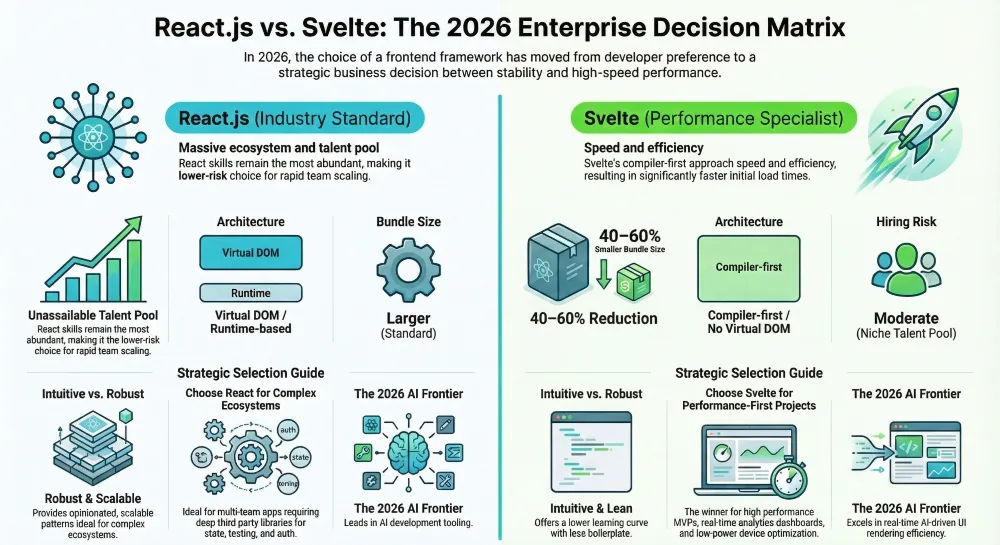
At a Glance: React vs. Svelte Enterprise Matrix
| Feature | React.js (The Industry Standard) | Svelte (The Performance Specialist) |
|---|---|---|
| Architecture | Virtual DOM / Runtime-based | Compiler-first / No Virtual DOM |
| Bundle Size | Larger (Standard) / Reduced via RSC | 40–60% Smaller than React |
| Learning Curve | Moderate (Hooks, State, JSX) | Low (HTML/JS/CSS syntax) |
| Talent Pool | Massive (Highest availability) | Niche (Growing, but limited) |
| Best For | Complex, Multi-team, Long-term Apps | High-performance MVPs & Real-time UIs |
Performance Benchmarks: Where Each Framework Stands
This is where the React.js vs Svelte conversation gets technical — and the data is illuminating.
Bundle Size. Svelte’s compiler-driven approach means it ships only the code your application actually uses. A basic Svelte app can produce bundles that are 40–60% smaller than an equivalent React app. For mobile-first applications or users in bandwidth-constrained markets, this is not a minor detail — it directly affects First Contentful Paint (FCP) and Time to Interactive (TTI).
Virtual DOM Overhead. React’s virtual DOM has long been praised for abstracting away manual DOM manipulation, but it does introduce computational overhead. A performance audit of a mid-sized fintech application built on React 18 — even after implementing memoized components, batched updates, bundle splitting, and React Server Components — still produced UI latency complaints from end users. When a core feature was rebuilt using SvelteKit, the results showed faster reactivity, faster hydration, and smoother UI updates. Svelte eliminates the virtual DOM entirely, which means zero reconciliation cost at runtime.
Rendering Speed. In benchmark tests comparing popular UI libraries and frameworks, React consistently ranks in the middle tier for raw rendering performance, while Svelte ranks among the fastest. React’s Concurrent Mode and React Server Components (RSC), which matured significantly in 2025, close some of this gap for complex, data-heavy applications — but Svelte retains a structural edge for lightweight and real-time UI rendering.
Memory Footprint. Svelte has been reported to consume approximately 50% less memory than React in mobile-first markets, a critical advantage for teams targeting users in emerging regions or on lower-powered devices.
The honest verdict: Svelte wins the raw performance war. React narrows the gap through careful optimization and its maturing RSC ecosystem, but it cannot fully overcome the structural advantage Svelte’s compile-time approach provides.
Key Performance Indicators (2026 Averages)
- First Contentful Paint (FCP): Svelte typically averages 0.8s vs. React’s 1.2s on standard mobile connections.
- Memory Usage: Svelte applications maintain a footprint nearly 50% smaller than equivalent React builds during heavy state updates.
- Code Volume: Svelte projects often require 25-30% less boilerplate code, reducing the surface area for bugs.
Ecosystem Maturity: React’s Unassailable Advantage
Here is where the comparison swings back decisively in React’s favor — and for enterprise teams, this may be the most important dimension of all.
React’s ecosystem is simply without peer in the JavaScript world. There are mature, battle-tested libraries for virtually every enterprise need: Redux and Zustand for state management, React Query and SWR for data fetching, Radix UI and Material UI for design systems, Jest and React Testing Library for testing, and Next.js for full-stack server-side rendering and static site generation. TypeScript support is first-class across nearly all major React libraries as of 2025.
Svelte’s ecosystem, while growing rapidly — with a reported 300% year-over-year growth in Svelte libraries — is still younger and smaller. SvelteKit has emerged as a strong first-class framework that rivals Next.js in developer experience, but teams may still encounter gaps in third-party library availability for niche or specialized enterprise needs.
For large organizations with complex state management requirements, intricate authentication flows, or needs for highly specialized component libraries, React’s ecosystem depth is not just convenient — it is a risk mitigator. When you need to solve a problem at 2 a.m. before a production deadline, the probability that someone in the React community has already documented the solution is exponentially higher than with Svelte.
Developer Experience and Learning Curve
Both frameworks have invested heavily in developer experience, but they land differently depending on your team’s background and composition.
React introduces several concepts that require deliberate learning: the rules of hooks, the mental model of the virtual DOM, prop drilling, context API versus external state management, and now the distinction between server and client components. While React’s documentation has improved considerably, there is genuine cognitive overhead — particularly for developers new to the library.
Svelte is widely regarded as the more intuitive and readable of the two. Its single-file component format (HTML, CSS, and JavaScript together) reduces boilerplate dramatically. There are no hooks, no setState, no useEffect to manage. Reactive declarations are declarative and syntactically simple. For those asking which frontend framework has the easiest learning curve in 2026, Svelte is consistently the answer among developers who have used both.
However, this simplicity can occasionally work against developers on larger teams, where React’s more opinionated patterns and explicit conventions provide guardrails that scale better across many contributors.
Scalability for Enterprise Applications
This is perhaps the most nuanced dimension of the React.js vs Svelte comparison for enterprise architects.
React at scale is well understood. Large teams with dozens of frontend developers have built robust, maintainable applications using React’s component model, established patterns, and ecosystem tooling. Meta, Netflix, and Airbnb are not running React at enterprise scale because of ignorance — they do it because the predictability, long-term support, and talent availability make it the rational choice at organizational scale. A telling real-world example: a large financial services company migrating from legacy Angular chose React over Svelte, despite Svelte’s acknowledged performance advantages, because ecosystem maturity and talent availability ultimately outweighed raw technical performance when measured against their organizational risk profile.
Svelte at scale is increasingly validated, but the evidence base is smaller. With SvelteKit, you can build full-stack enterprise applications — dashboards, CRMs, SaaS platforms, data-heavy real-time systems. The tooling is solid. However, for organizations with very long planning horizons, complex regulatory requirements, or massive existing codebases, the smaller talent pool and younger ecosystem introduce friction that is difficult to fully price in advance.
The Talent and Hiring Equation
For engineering leaders and HR teams, this is where abstract technical comparisons translate into budget lines and delivery timelines.
React developers are the most abundant JavaScript talent on the market. According to current job market data, React skills are referenced in thousands of enterprise job listings globally. If you need to scale your team quickly, onboard contract developers, or reduce ramp-up time for new hires, React is unambiguously the lower-risk choice. This is precisely why many businesses that want to hire React.js developers find the process significantly more straightforward than sourcing Svelte expertise.
Svelte’s job market is growing, but it remains niche. Svelte developers command a premium, and the talent pool is considerably smaller. For startups and lean teams where the existing developers are already Svelte-proficient, this is not a problem. For large enterprises building engineering organizations at scale, it is a material constraint.
This hiring reality is one of the primary reasons why partnering with a qualified React.js development company continues to be the dominant enterprise strategy in 2026. Rather than building internal Svelte expertise from scratch, many organizations work with specialized providers who bring pre-built teams, established processes, and a deep library of reusable enterprise patterns.
Get scalable, fast, and user-friendly React.js solutions tailored to your needs.
Get Free ConsultationAI Integration: The 2026 Frontier
Both frameworks are adapting to the AI-powered development landscape identified in Gartner’s and Forrester’s 2026 outlooks, but in different ways.
React benefits from its massive ecosystem here too. The React community has produced specialized tools for AI-driven UI development, and Meta’s continued investment ensures React remains relevant as AI-generated code becomes increasingly prevalent. GitHub Copilot now generates 46% of new code across popular languages including JavaScript, and React’s well-documented patterns and conventions make AI-generated React code more reliable and easier to validate.
Svelte’s compile-time architecture actually pairs naturally with AI-driven UIs requiring real-time analytics and edge computing. Its lean output reduces the overhead introduced by AI-intensive rendering loops, and SvelteKit’s server-side capabilities align well with the evolving edge-first deployment paradigm. Svelte’s simpler syntax also tends to result in cleaner AI-generated code with fewer hallucination artifacts.
The honest assessment is that both frameworks will integrate with AI tooling effectively in 2026. React has the ecosystem advantage today; Svelte has a structural architectural advantage for certain AI-adjacent performance requirements.
Real-World Use Cases: When to Choose Each
Choose React.js when:
- You are building a large-scale enterprise application with a team of 10+ frontend developers
- Your organization needs a deep third-party library ecosystem (design systems, analytics, testing, auth)
- Talent availability and hiring speed are strategic priorities
- You need React Native for cross-platform mobile development alongside your web application
- You’re integrating with existing enterprise toolchains, monorepos, or backend systems already configured for React
- Long-term vendor stability and community support are non-negotiable
Choose Svelte when:
- Raw performance and bundle size are the primary optimization targets
- You are building performance-critical applications for mobile-first or bandwidth-constrained users
- Your team is small, senior, and already proficient in Svelte
- You are building data-rich dashboards, real-time analytics tools, or embedded widgets where rendering speed directly impacts user experience
- You are launching a greenfield project with full control over the technology stack
Which Is Right for You? (User Personas)
The Enterprise CTO
If you are managing a team of 100+ developers, you should hire react.js developers. The sheer volume of talent available makes scaling your team easy. React’s mature testing utilities and strict architectural patterns (especially with TypeScript) ensure that your code remains maintainable for the next decade.
The Startup Founder
If you are building a high-performance MVP (Minimum Viable Product) and every millisecond of load time correlates to revenue, Svelte is your winner. Its “less code” philosophy means your developers can ship features 30% faster than with React.
The Compliance-Focused Organization
For healthcare or finance apps requiring SOC 2 or HIPAA compliance, a React.js development company is usually the safer bet. The ecosystem for secure React components is vast, and many third-party security audits are pre-written for React-based stacks.
Why Full-Stack Techies Is the Right Partner for Your React.js Journey
For enterprises leaning toward React.js — which remains the dominant and lowest-risk choice for large-scale, complex applications — the next critical decision is execution. Choosing the right technology is only the first step; how that technology is implemented determines actual business outcomes.
Full-Stack Techies is a leading React.js development company with deep expertise in building enterprise-grade web applications. Whether you need to hire React.js developers for a dedicated product team, require end-to-end development services for a complex SaaS platform, or are looking for the best React.js development services to modernize a legacy frontend, Full-Stack Techies brings the architectural rigor, scalability expertise, and delivery discipline that enterprise projects demand.
Our React.js engagements span industries — from fintech dashboards requiring real-time data rendering to healthcare platforms demanding HIPAA-compliant component architecture to e-commerce applications optimized for conversion at scale. We don’t just write React code; we architect React systems that are built to last, to scale, and to evolve with your business.
If you are evaluating a new frontend initiative or looking to accelerate an existing React.js application, we invite you to connect with our team for a technical discovery session. We’ll bring the expertise, the team, and the proven process — you bring the vision.
Trends & 2026 Outlook
Gartner’s View on “Agentic UIs”
According to Gartner, by 2028, over 50% of web interactions will be driven by autonomous AI agents. This means our UIs need to be more than just “static pages.” They need to handle “streamed” data and unpredictable inputs.
- React is evolving to handle this via its Concurrent Mode, allowing UIs to stay responsive even when heavy data is loading.
- Svelte handles this through its native Runes, providing a more “human-readable” way to manage complex AI states.
Forbes: The Cost of “JavaScript Bloat”
A recent Forbes technology column highlighted that “The hidden cost of slow websites is no longer just SEO—it’s energy consumption and carbon footprints.” As green computing becomes a corporate mandate in 2026, Svelte’s lightweight footprint is becoming a strong “ESG” (Environmental, Social, and Governance) selling point for large corporations.
Alternatives to React and Svelte
If neither feels like a perfect fit, consider these 2026 powerhouses:
- Vue.js 3.6 (Vapor Mode): The middle ground. It offers the performance of Svelte with a community nearly as large as React’s.
- Qwik: Famous for “resumability,” it is the best for content-heavy sites (like news portals) that need instant loading without hydration.
- SolidJS: If you love the React “look” but want Svelte “speed,” SolidJS is the high-performance enthusiast’s choice.
The Verdict: React.js vs Svelte in 2026
There is no universal winner in the React.js vs Svelte debate — and anyone who tells you otherwise is oversimplifying a genuinely nuanced decision. What the evidence does support are clear, defensible conclusions:
React.js is the enterprise standard. It offers unmatched ecosystem depth, proven scalability, broad talent availability, and the stability that comes from Meta’s backing and over a decade of production use. For large teams, complex projects, and risk-averse organizations, React remains the rational default.
Svelte is the performance king. It delivers structurally superior bundle sizes, faster hydration, lower memory consumption, and a cleaner developer experience. For performance-critical applications, lean teams, and greenfield projects where raw speed matters more than ecosystem breadth, Svelte is a genuinely compelling choice that deserves serious consideration.
As front-end development trends in 2026 push toward performance-first, AI-integrated, edge-deployed architectures, both frameworks are evolving in compelling directions. The smartest enterprise teams are not treating this as a zero-sum competition — they are making deliberate, context-driven choices, and in many cases, learning from both frameworks to build better products regardless of which one they ultimately deploy.
The question is not which framework is better in the abstract. The question is which framework is better for your organization, your team, your users, and your specific business requirements. That is a question worth answering carefully — and with the right development partner at your side.
Looking to build or scale a React.js application in 2026? Full-Stack Techies offers comprehensive React.js development services tailored to enterprise needs. Contact our team to explore how we can accelerate your frontend strategy.
Why Trust This Comparison?
This comparison is built on more than opinions. The insights here draw from publicly available performance benchmarks, real-world case studies from production enterprise applications, and industry research from trusted sources including Gartner, Forrester, and the annual State of JS developer survey — which collectively represent the perspectives of hundreds of thousands of developers and technology decision-makers worldwide.
We have no agenda to favor one framework over the other on principle. React.js and Svelte are evaluated honestly across dimensions that actually matter at the enterprise level: performance, scalability, ecosystem maturity, developer experience, talent availability, and long-term maintainability. Where React wins, we say so. Where Svelte wins, we say that too.
The goal is simple — to give engineering leaders, CTOs, and product teams a reliable, evidence-based foundation for a decision that will shape their frontend strategy for years to come.
Frequently Asked Questions
Q1. What is the main difference between React.js and Svelte?
React.js is a runtime JavaScript library that uses a virtual DOM to update the UI, while Svelte is a compiler that converts your components into optimized vanilla JavaScript at build time u2014 eliminating virtual DOM overhead entirely and resulting in faster, leaner output.
Q2. Which is better for enterprise applications u2014 React.js or Svelte?
React.js remains the stronger choice for most enterprise applications due to its mature ecosystem, vast talent pool, long-term community support, and proven scalability across complex, large-team projects. Svelte is better suited for performance-critical, lean-team, or greenfield scenarios.
Q3. Is Svelte faster than React.js?
Yes, in most benchmarks Svelte produces smaller bundle sizes, faster hydration, and lower memory consumption than React. However, React 18u2019s Concurrent Mode and React Server Components significantly close the gap for data-heavy enterprise applications.
Q4. Which framework is easier to learn u2014 React or Svelte?
Svelte has a noticeably lower learning curve. Its single-file component format, minimal boilerplate, and absence of complex concepts like hooks make it more approachable for new developers. React requires understanding hooks, state management patterns, and the virtual DOM mental model.
Q5. How do React.js and Svelte compare in terms of job market and hiring?
React.js developers are significantly more abundant in the global job market. If you need to scale your team quickly or hire React.js developers with minimal ramp-up time, React is the lower-risk, more accessible option. Svelte talent, while growing, remains a niche skill set.
Q6. Can Svelte be used for large-scale enterprise projects?
Yes, especially with SvelteKit. However, the smaller ecosystem, limited third-party library availability, and narrower talent pool introduce organizational risks that make React the more pragmatic choice for very large or long-horizon enterprise initiatives.
Q7. What is React Server Components and does it change the React vs Svelte debate?
React Server Components (RSC), which matured in 2025, allow components to render on the server without sending JavaScript to the client u2014 improving performance and reducing bundle sizes. It narrows Svelteu2019s performance advantage but does not fully eliminate it.
Q8. Which framework is better for AI-powered applications in 2026?
Both frameworks support AI integration effectively. React benefits from a richer ecosystem of AI-compatible tooling, while Svelteu2019s compile-time architecture offers structural performance advantages for real-time, AI-driven UI rendering. The better choice depends on your specific AI use case.
Q9. Should I hire a React.js development company or build in-house?
For enterprises that need to move fast, reduce technical risk, and leverage proven patterns, partnering with an experienced React.js development company like Full-Stack Techies is often more efficient than building internal expertise from scratch u2014 especially for complex or time-sensitive projects.
Q10. Will Svelte overtake React.js in enterprise adoption?
Unlikely in the near term. While Svelteu2019s adoption is growing rapidly, Reactu2019s entrenched ecosystem, Metau2019s continued investment, and the sheer scale of the global React developer community give it a structural advantage that will take many years to meaningfully challenge.



