

Top 10 React.js Outsourcing Models for Enterprise Cost Control 2026
React.js Outsourcing Models help enterprises balance cost, scalability, and development speed. From dedicated teams to project-based and hybrid models, each approach offers unique advantages. This guide explores the top 10 outsourcing models in 2026 to help you optimize budgets while maintaining high-quality React development.


Introduction: Why React.js Outsourcing Is the Enterprise Strategy of 2026
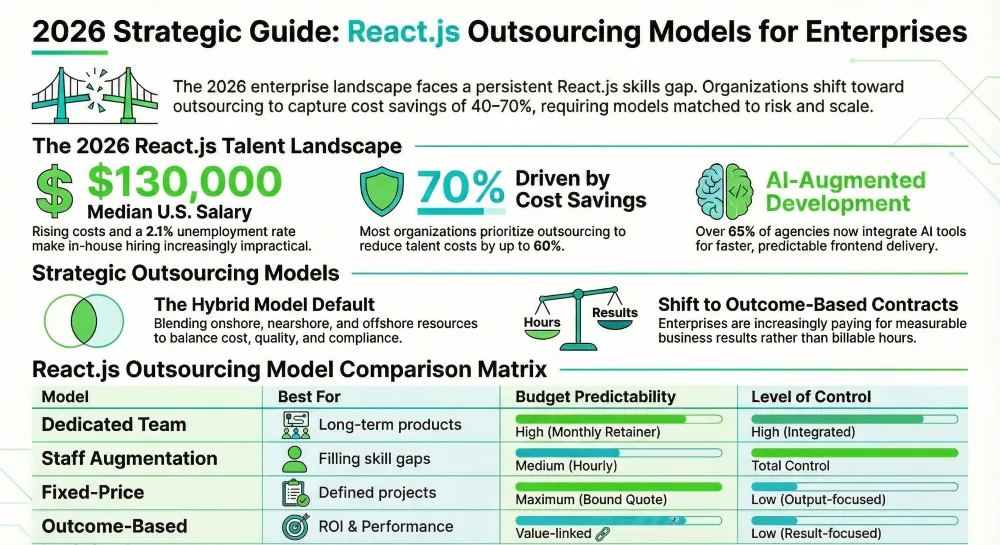
The economics of enterprise software development have shifted dramatically. Building and maintaining a full in-house React.js team is no longer just expensive — it is increasingly impractical. Median U.S. software engineer salaries climbed to $130,000 in 2025 while unemployment in computer occupations hovered near 2.1%, underscoring a persistent skills gap. Meanwhile, React.js itself has cemented its position as the dominant force in enterprise frontend development. React powers 42.8% of the top 10,000 websites and boasts over 236,000 GitHub stars.
Enterprises are responding to this pressure by outsourcing, and the market is exploding to match that demand. The global IT outsourcing market was valued at $618 billion in 2025 and is projected to reach $638 billion in 2026, growing steadily toward $752 billion by 2031. More telling is the primary motivation behind this surge. A staggering 70% of organizations point to cost savings as their primary reason for outsourcing, and companies can reduce talent costs by up to 60% compared to hiring locally.
But not all React.js outsourcing models are created equal. Choosing the wrong engagement structure can erode the very savings you’re chasing. This definitive guide breaks down the top 10 React.js outsourcing models enterprises are deploying in 2026 — with real-world cost implications, use cases, and strategic guidance for each.
Also Read: 8 Key React.js Hiring Mistakes C-Suite Leaders Must Avoid in 2026
Key Takeaways
React.js Outsourcing Is a Strategic Decision, Not Just a Cost Play. The right outsourcing model directly impacts product quality, team velocity, and long-term scalability — not just your monthly development bill. Choose based on business goals, not cost alone.
There Is No One-Size-Fits-All Model. Each of the 10 React.js outsourcing models serves a distinct enterprise scenario. Dedicated teams suit long-term products. Fixed-price suits defined deliverables. Outcome-based suits accountability-first buyers. Match the model to your context.
Cost Savings Are Real — But Only With the Right Partner. Enterprises can reduce React.js development costs by 40–70% through outsourcing. However, those savings evaporate quickly with poor communication, misaligned expectations, or low-quality talent. Partner selection matters as much as model selection.
The Hybrid Model Is Emerging as the Enterprise Default. More enterprises in 2026 are blending onshore, nearshore, and offshore resourcing into a single coordinated delivery structure — balancing cost efficiency, quality control, and compliance requirements simultaneously.
Outcome-Based Contracting Is the Future of React.js Outsourcing. The shift from paying for hours to paying for results is accelerating. Enterprises that adopt outcome-based models gain vendor accountability, tighter ROI visibility, and stronger long-term partnerships.
React.js Talent Demand Far Outpaces Supply. With 12,470+ open React.js roles globally and U.S. salaries averaging $130,000, building entirely in-house is increasingly impractical. Outsourcing is no longer a fallback — it is the primary talent strategy for forward-thinking enterprises.
AI Is Reshaping React.js Outsourcing Delivery. By 2026, over 65% of frontend development agencies are integrating AI tools into their workflows. The best React.js development companies are already delivering faster, smarter, and more predictable outcomes through AI-augmented pipelines.
Compliance Requirements Should Drive Location Decisions. Regulated industries must factor data residency, legal jurisdiction, and security clearance requirements into their outsourcing model choice — often making onshore or hybrid models non-negotiable despite higher costs.
Vendor Transparency Is Non-Negotiable at Enterprise Scale. Weekly time reports, sprint-level dashboards, shared Jira boards, and executive summaries are not nice-to-haves — they are baseline requirements for any React.js outsourcing engagement operating at enterprise scale.
Full-Stack Techies Bridges Every Model. Whether you need to quickly hire React.js developers for a short sprint or build a multi-year managed frontend capability, a proven React.js development company like Full-Stack Techies eliminates the trade-off between cost control and delivery excellence.
Quick Comparison: React.js Outsourcing Models at a Glance
| Model | Best For | Budget Predictability | Level of Control |
|---|---|---|---|
| Dedicated Team | Long-term products | High (Monthly Retainer) | High (Integrated) |
| Staff Augmentation | Filling skill gaps | Medium (Hourly) | Total Control |
| Fixed-Price | Defined projects | Maximum (Bound Quote) | Low (Output-focused) |
| Outcome-Based | ROI & Performance | Value-linked | Low (Result-focused) |
| Nearshore | Agile collaboration | High Savings (30-50%) | High (Same Time Zone) |
| BOT | Building in-house capability | Strategic Investment | Gradual Ownership |
The Top 10 React.js Outsourcing Models Explained
1. Dedicated Development Team Model
Best For: Long-term product development requiring deep institutional knowledge
The dedicated development team model is the gold standard of React.js outsourcing models for enterprises running sustained, evolving products. Under this arrangement, you hire React.js developers who work exclusively on your project, operating as a fully integrated extension of your in-house team — but under the management and infrastructure of a React.js development company.
This model thrives when your roadmap is continuous rather than project-based. Your outsourced React developers attend stand-ups, participate in sprint planning, and accumulate institutional knowledge over months and years. The team typically includes senior React engineers, a QA specialist, a technical lead, and sometimes a project manager.
Cost Implications: Enterprises typically pay a flat monthly retainer rather than hourly billing. Depending on the geography of your outsourcing partner, dedicated React.js teams can cost 40-60% less than building an equivalent in-house team in the U.S. or Western Europe. Outsourcing React.js development can result in 45% lower salary costs compared to hiring U.S.-based talent and 55% faster time-to-hire versus average U.S. recruitment cycles.
Full-Stack Techies Advantage: At Full-Stack Techies, the dedicated team model is one of our most popular engagement structures. We assemble React.js squads with complementary skill sets — from component architecture to performance optimization — so enterprises get a cohesive unit that ships, not just code.
2026 Industry Trend: The managed service segment is projected to account for the highest share of the IT outsourcing market in 2025, offering long-term, end-to-end IT management with predictable costs and innovation. The dedicated team model is the frontend-specific embodiment of this macro trend.
Ideal Profile: Series B+ startups, digital transformation initiatives, enterprises rebuilding legacy frontend architectures.
2. Staff Augmentation Model
Best For: Filling specific skill gaps without restructuring internal teams
Staff augmentation is the most agile of all React.js outsourcing models. Instead of handing off a project, you bring in external React.js developers to work alongside your existing engineering team — filling gaps in capacity, expertise, or both — without the overhead of permanent hiring.
This model is particularly powerful for enterprises that have strong product ownership and engineering culture in-house but need React.js specialists for a specific initiative: a new component library, a performance overhaul, an accessibility audit, or a design system rebuild. You control the work. You manage the developers. The React.js development company handles contracts, compliance, and talent sourcing.
Cost Implications: Staff augmentation is billed hourly or monthly per developer, with no long-term commitment unless you want one. In India, the hourly rate of React developers ranges between $12–40 per hour based on experience, compared to $60–$120+ per hour for U.S.-based contractors. The arbitrage is significant.
When It Goes Wrong: The biggest risk is integration friction. Augmented developers who aren’t deeply embedded in your engineering culture can create more coordination overhead than value. The best React.js development companies mitigate this by matching developers to your stack, methodology, and communication style before placement.
Full-Stack Techies Advantage: Full-Stack Techies offers staff augmentation with a two-week trial period so enterprises can validate fit before committing. Our developers are pre-vetted for React hooks mastery, TypeScript integration, and Next.js expertise — precisely the skills U.S. enterprises rank as top requirements.
2026 Industry Trend: 40–50% of new outsourcing agreements in 2025 include AI automation clauses, meaning augmented React developers are increasingly expected to work alongside AI-assisted development tools like GitHub Copilot and Tabnine.
3. Project-Based (Fixed-Price) Model
Best For: Well-defined deliverables with a clear scope and deadline
The fixed-price outsourcing model is exactly what it sounds like: you define the scope of work, the React.js development company provides a cost estimate, and both parties sign off on a binding agreement. The vendor delivers. You pay. End of engagement — unless you extend.
This model delivers the highest budget predictability of any React.js outsourcing model. There are no surprise invoices, no scope creep billing, and no uncertainty about total cost. For CFOs and procurement teams, it’s the cleanest engagement from an accounting standpoint.
Cost Implications: Fixed-price engagements work best for discrete projects: building a new React-based dashboard, migrating a legacy application to React 19, implementing a design system, or developing a client portal. Project-based collaboration offers a fixed-cost method for clearly defined projects with precise specifications, deadlines, and deliverables, reducing your administrative load and guaranteeing consistent budgeting.
The Hidden Risk: Fixed-price models demand exceptional requirement documentation. Ambiguity in specs leads to change requests, which lead to cost overruns — negating the very certainty you sought. Enterprises that struggle to define requirements upfront often find the T&M model less expensive in practice.
Full-Stack Techies Advantage: Full-Stack Techies runs a structured discovery phase before any fixed-price contract is signed. We help enterprises translate business goals into granular technical specifications, so the quote reflects reality — not optimism.
2026 Industry Trend: Fixed-price deals represented 43.71% of the U.S. outsourcing market in 2025; outcome-based contracts are the fastest-growing model at a 5.21% CAGR. The future of fixed-price is evolving toward milestone-based payments tied to measurable outcomes — not just delivery dates.
4. Time-and-Materials (T&M) Model
Best For: Evolving projects where scope cannot be fully defined upfront
The Time-and-Materials model is the anti-fixed-price: maximum flexibility, minimum upfront commitment. You pay for actual hours worked and resources consumed. Scope can shift based on market feedback, leadership direction, or technical discovery without penalty.
For enterprises undergoing digital transformation or building genuinely novel products, T&M is often the more honest engagement model. React.js development is rarely linear. Requirements change. Designs iterate. APIs evolve. A model that accommodates this reality protects enterprise velocity better than an artificially constrained scope.
Cost Implications: T&M billing requires active oversight. Without a disciplined project manager on your side tracking hours against milestones, costs can drift. The best practice is to combine T&M billing with sprint-based delivery — you review and approve work each sprint, maintaining budget control while preserving flexibility.
Full-Stack Techies Advantage: Full-Stack Techies provides transparent weekly time reports, Jira-integrated sprint tracking, and monthly budget reviews on all T&M engagements. Our clients maintain full cost visibility without micromanaging the engineering process.
When to Choose T&M Over Fixed-Price: If your product roadmap changes quarterly, if your stakeholders are still discovering what “done” looks like, or if your React.js project involves AI integration, CMS complexity, or custom design systems — T&M is the model that won’t punish you for learning.
5. Offshore Outsourcing Model
Best For: Maximum cost reduction with access to large React.js talent pools
Offshore outsourcing — engaging a React.js development company located in a geographically distant, lower-cost country — remains the dominant React.js outsourcing model by volume. Offshore centers held 47.15% share of the IT outsourcing market in 2025, with Asia-Pacific hubs like India and the Philippines remaining preferred destinations.
India, in particular, is the largest supplier of React.js talent globally. Globally, it is estimated there will be 500,000 to 600,000 React jobs in 2025, with Indian developers available at $12–40 per hour based on experience. For enterprises building complex React applications at scale, offshore engagement with the best React.js development services can reduce frontend development costs by 50-70% compared to equivalent onshore resourcing.
Cost Implications: Beyond labor arbitrage, offshore React.js development also lowers infrastructure costs — many offshore React.js development companies absorb development tooling, security, and HR overhead into their billing rates.
The Challenge: Time zone gaps, communication overhead, and quality variance are real concerns. The enterprises that succeed with offshore React.js outsourcing invest in strong async communication protocols, detailed documentation, and regular video reviews. They treat the offshore team as a real part of the organization — not a vendor to be managed at arm’s length.
2026 Industry Trend: Asia-Pacific hubs like India and the Philippines remain preferred destinations for enterprises balancing affordability with expertise, while hybrid models supplement collaboration for sensitive or strategic projects.
Full-Stack Techies Advantage: Full-Stack Techies operates with offshore delivery centers staffed by senior React.js engineers with experience across enterprise-grade applications. We overlay structured communication frameworks — daily async updates, weekly video reviews, and monthly executive summaries — to close the offshore coordination gap.
6. Nearshore Outsourcing Model
Best For: Enterprises prioritizing time zone alignment and cultural affinity
Nearshore outsourcing engages React.js development companies in geographically adjacent countries — for U.S. enterprises, this typically means Latin America (Colombia, Mexico, Argentina, Brazil). For European enterprises, it means Eastern Europe (Poland, Romania, Ukraine, Czech Republic).
Nearshoring captures much of the cost advantage of offshoring while dramatically reducing the communication friction. When your React.js developers are working in overlapping business hours, you can hold synchronous daily stand-ups, conduct real-time code reviews, and resolve blockers the same day rather than waiting for the next business day.
Cost Implications: Nearshore React.js development typically costs 30-50% less than onshore U.S. rates — less savings than pure offshore, but the productivity gains from real-time collaboration often close the gap. Nearshore arrangements are progressing at a 5.12% CAGR through 2031, the fastest growth rate of any sourcing location — a signal that enterprises are increasingly valuing proximity.
The Latin America Surge: Expert guidance on target outsourcing destinations recommends Argentina, Peru, and Colombia as strong nearshore choices, with companies reporting 45% lower salary costs compared to U.S. talent.
Full-Stack Techies Advantage: Full-Stack Techies maintains nearshore delivery capabilities for clients who need real-time collaboration without sacrificing cost efficiency. Our nearshore React.js teams operate within a 1-3 hour time zone overlap with U.S. enterprise clients, enabling true agile delivery.
7. Onshore Outsourcing Model
Best For: Regulated industries, security-sensitive projects, and stakeholder-intensive engagements
Onshore outsourcing — hiring a React.js development company within your own country — is the most expensive React.js outsourcing model, but it offers capabilities the others cannot: same time zone, shared regulatory context, easier in-person collaboration, and no data residency concerns.
For industries like financial services, healthcare, and government — where data sovereignty, compliance, and security clearances are non-negotiable — onshore React.js outsourcing is often the only viable model. HIPAA, SOC 2, and PCI-DSS compliance are far easier to manage when your vendor is subject to the same legal framework you are.
Cost Implications: Onshore React.js development companies charge at or near market rate — but enterprises trade cost savings for risk reduction, compliance simplicity, and communication efficiency. For regulated industries, the compliance overhead of managing an offshore vendor can cost more than the wage arbitrage saves.
2026 Industry Trend: Gartner predicts that by 2030, more than 75% of European and Middle Eastern enterprises will geopatriate their virtual workloads into solutions designed to reduce geopolitical risk, up from less than 5% in 2025. This trend is pushing more security-sensitive React.js projects back onshore or toward trusted nearshore partners.
Full-Stack Techies Advantage: Full-Stack Techies provides onshore engagement managers and solutions architects for clients in regulated verticals, ensuring compliance requirements are built into the React.js development lifecycle from day one — not retrofitted at the end.
8. Hybrid Outsourcing Model
Best For: Enterprises balancing cost optimization with quality control and security
The hybrid model combines onshore, nearshore, and offshore resourcing into a single coordinated delivery structure. A senior technical lead and product manager might sit onshore, working directly with enterprise stakeholders. Core React.js development happens in a nearshore location for real-time collaboration. QA, documentation, and lower-complexity work goes to an offshore center for maximum cost efficiency.
This model has become the preferred structure for sophisticated enterprise buyers in 2026. Clients are shifting toward hybrid delivery that combines offshore centers with domestic integration hubs, a pattern spurred by incentives that reward on-shore value creation.
Cost Implications: The hybrid model requires more coordination overhead than a single-location model, but it can deliver the optimal cost-quality ratio — especially for large React.js projects where different workstreams have different requirements and risk profiles.
How to Structure It: Define which components of your React.js project require the highest quality control and stakeholder interaction — those go onshore or nearshore. Define which components are well-specified and repeatable — those go offshore. The hybrid model works best when the outsourcing partner has genuinely integrated delivery centers, not just relationships with multiple vendors.
Full-Stack Techies Advantage: Full-Stack Techies was designed around the hybrid model. Our integrated delivery structure means our clients work with a unified team — same Jira boards, same Slack channels, same quality standards — regardless of where individual developers are located. There’s no “offshore team” and “onshore team.” There’s one team, distributed intelligently.
9. Build-Operate-Transfer (BOT) Model
Best For: Enterprises planning to internalize React.js capability over 2-4 years
The Build-Operate-Transfer model is a longer-horizon React.js outsourcing model designed for enterprises that want external help to build a React.js capability — but intend to own it outright eventually. The outsourcing partner builds the team, establishes the processes, recruits the talent, and operates the development center for a defined period. Then, control transfers to the enterprise.
This model is popular among enterprises entering new markets where local React.js talent is available but where the enterprise lacks the relationships and infrastructure to recruit effectively. It’s also used by enterprises building offshore development centers in India, Eastern Europe, or Latin America without the risk of building from scratch.
Cost Implications: The BOT model involves higher upfront costs — the outsourcing partner charges a management fee during the build and operate phases — but the total cost of ownership over a 5-10 year horizon is typically lower than maintaining a permanent outsourcing relationship. Once transferred, you own the team, the IP, and the processes outright.
2026 Relevance: As React.js becomes more central to enterprise digital strategy, more organizations are treating frontend engineering as a core capability rather than a commodity service. The BOT model is the structured path from outsourced dependency to in-house excellence.
Full-Stack Techies Advantage: Full-Stack Techies has executed BOT engagements for enterprise clients across the SaaS, fintech, and e-commerce sectors. We handle the full build phase — hiring, onboarding, tooling, documentation — and operate the team under your brand before executing a clean transfer.
10. Outcome-Based (Managed Services) Model
Best For: Enterprises that want accountability tied to business results, not hours delivered
The outcome-based model is the most sophisticated — and increasingly the most sought-after — of all React.js outsourcing models in 2026. Instead of billing for time spent or resources deployed, the React.js development company is compensated based on measurable business outcomes: page load time targets, feature delivery milestones, conversion rate improvements, defect rates, or uptime SLAs.
This model flips the traditional outsourcing dynamic. The vendor has skin in the game. They’re incentivized to be efficient, innovative, and proactive — because their revenue depends on results, not hours. For enterprise procurement teams under pressure to demonstrate ROI from technology spending, outcome-based contracting provides a direct link between vendor performance and business value.
Cost Implications: Outcome-based contracts can appear more expensive on a per-hour basis than T&M models, but the total cost — accounting for outcome quality, rework rates, and time-to-market — is often lower. Outcome-based deals grew to 43% of new contracts in 2025, with buyers wanting vendor fees tied to metrics like uptime and resolution time.
What Gets Measured: Common outcome metrics for React.js development engagements include Core Web Vitals (LCP, FID, CLS), sprint velocity and backlog burn rate, defect escape rate to production, feature adoption rates, and accessibility compliance scores.
2026 Industry Trend: Outcome-based models compel vendors to embed telemetry and AI-driven anomaly detection, which raises upfront investment but deepens long-term relationships. Providers that master this model differentiate through proactive governance dashboards visible to client CIOs.
Full-Stack Techies Advantage: Full-Stack Techies is one of the few React.js development companies offering genuine outcome-based engagements backed by contractual SLAs. We deploy observability tooling — Lighthouse CI, Datadog RUM, Sentry — at project outset so both parties have shared visibility into the metrics that determine success. Our clients don’t just get React.js development. They get measurable progress.
Get scalable, fast, and user-friendly ReactJS solutions tailored to your needs.
Get Free ConsultationHow to Choose the Right React.js Outsourcing Model for Your Enterprise?
Selecting among these React.js outsourcing models isn’t about finding the universally “best” option — it’s about matching model characteristics to your specific enterprise context. Here’s a simplified decision framework:
Start with your time horizon. Short-term, discrete projects point toward fixed-price. Long-term product development points toward dedicated teams or managed services. Planning to build internal capability? Consider BOT.
Consider your risk profile. Regulated industries and security-sensitive projects push toward onshore or hybrid models. Cost-sensitive enterprises with mature governance capabilities can extract maximum value from offshore or nearshore models.
Evaluate your own internal capability. Enterprises with strong product management can manage staff augmentation effectively. Enterprises without robust PM functions need dedicated teams or fully managed models.
Factor in team continuity. Projects where institutional knowledge compounds over time — complex React application architectures, proprietary design systems, performance-sensitive consumer products — benefit from dedicated teams. One-off projects don’t require that investment.
Also Read: The Ultimate Checklist for Outsourcing AI-Powered React.js Development in 2025
The React.js Talent Landscape in 2026: Why Now Is the Time to Outsource
The case for outsourcing React.js development has never been stronger from a pure talent economics perspective. There are currently 12,470+ React job openings, with U.S. companies ranking React Hooks, TypeScript integration, and Next.js expertise as their top requirements. Hiring for all three simultaneously in a tight labor market is slow, expensive, and increasingly competitive.
Meanwhile, the React.js ecosystem continues to evolve rapidly. React currently powers approximately 5.8% of all websites worldwide, and the transition from React 18 to React 19 marks one of the most significant technical shifts in the library’s history, fundamentally changing how developers approach frontend development. Keeping an in-house team current with Server Components, concurrent rendering, and WebAssembly integration requires continuous training investment. The best React.js development services providers make this investment at scale — distributing the cost across many clients.
By 2026, over 65% of front-end development agencies will integrate AI tools like Copilot, Tabnine, and test generators in their workflow, with React.js outsourcing increasingly focusing on AI-powered delivery pipelines, predictive debugging, component scaffolding, and design-to-code conversion. When you hire React.js developers through a forward-thinking partner, you’re not just getting human talent — you’re getting an AI-augmented development pipeline.
Why Full-Stack Techies Across Every Outsourcing Model
No single React.js outsourcing model fits every enterprise scenario. What remains consistent across all ten models is the quality of your outsourcing partner. Full-Stack Techies has been designed from the ground up to support enterprise React.js development across every engagement structure — from short-term staff augmentation to multi-year outcome-based managed services.
Our React.js developers are assessed not just for technical proficiency but for the communication skills, documentation discipline, and async collaboration capabilities that make distributed teams work at enterprise scale. We cover the full React.js stack: React 19, Next.js, TypeScript, React Native, Redux Toolkit, React Query, Storybook, and emerging patterns like React Server Components and Suspense-driven data fetching.
Whether you need to hire React.js developers on a trial basis, engage a dedicated React.js team for a transformation initiative, or establish a fully managed frontend development capability with outcome-based accountability — Full-Stack Techies has the structure, the talent, and the track record to deliver.
Conclusion
The global pressure on enterprise technology budgets is not easing. Geopolitical tensions are prompting enterprises to diversify sourcing footprints in response to sovereign-cloud mandates and data-residency rules, leading many buyers to blend offshore, nearshore, and onshore centers for risk mitigation. React.js outsourcing models are evolving to match this complexity — moving from simple cost arbitrage toward sophisticated, outcome-aligned partnerships that deliver measurable business value.
The ten React.js outsourcing models outlined in this guide represent the full spectrum of what’s available in 2026: from the cost-first logic of offshore engagement to the accountability-first logic of outcome-based managed services. The right model for your enterprise depends on your timeline, risk tolerance, internal capabilities, and strategic ambitions.
What’s clear across all ten models is this: enterprises that partner with the right React.js development company — one that aligns its incentives with your outcomes, invests in talent quality, and operates with genuine transparency — will consistently outperform those that treat React.js outsourcing as a pure cost transaction.
To explore which React.js outsourcing model is the right fit for your enterprise in 2026, connect with the team at Full-Stack Techies for a no-commitment discovery call.
Why Trust This List?
This list was built on research, not guesswork. Here’s what went into it:
Real Market Data: Every outsourcing model featured here is backed by verified industry data from globally recognized sources — including Gartner, Mordor Intelligence, Coherent Market Insights, and Tecla.io. The cost figures, market share percentages, and growth projections cited throughout reflect 2025–2026 reporting, not outdated assumptions.
Enterprise-Focused Lens: This isn’t a generic “outsourcing tips” roundup. Each model has been evaluated specifically through the lens of enterprise React.js development — accounting for compliance requirements, team scalability, budget predictability, and long-term product strategy.
Practitioner Perspective: The insights here draw from Full-Stack Techies’ direct experience structuring React.js engagements across dedicated teams, staff augmentation, fixed-price, and outcome-based models for clients spanning fintech, SaaS, healthcare, and e-commerce verticals.
No Filler, No Padding: Every model on this list represents a genuinely distinct engagement structure with different cost profiles, risk characteristics, and ideal use cases. We didn’t inflate the list with variations of the same idea. If it’s here, it earns its place.
Current as of 2026: The React.js ecosystem moves fast. React 19, AI-augmented development pipelines, and the shift toward outcome-based contracting are all developments from the past 12–18 months — and all are reflected in this guide.
Frequently Asked Questions (FAQs)
Q1. What is the most cost-effective React.js outsourcing model for enterprises?
The offshore outsourcing model offers the highest cost savings u2014 typically 50u201370% compared to onshore hiring u2014 making it the most budget-efficient choice for enterprises with mature remote collaboration processes.
Q2. How do I choose between staff augmentation and a dedicated React.js team?
Choose staff augmentation for short-term skill gaps within an existing team. Choose a dedicated team when your project requires long-term commitment, deep product knowledge, and a self-sufficient development squad.
Q3. What is the average hourly rate to hire React.js developers through outsourcing?
Rates vary by region u2014 $12u201340/hour in India, $25u201355/hour in Latin America, and $60u2013120+/hour for U.S.-based contractors. The right rate depends on your model, location preference, and seniority requirements.
Q4. Is the fixed-price model risky for complex React.js projects?
Yes, if requirements arenu2019t clearly defined upfront. Fixed-price works best for well-scoped, discrete projects. For evolving or complex builds, the Time-and-Materials model offers safer budget management.
Q5. What React.js skills should I look for when outsourcing in 2026?
Prioritize React 19, TypeScript, Next.js, React Hooks, React Query, and Server Components expertise. Familiarity with AI-assisted development tools like GitHub Copilot is increasingly valuable.
Q6. How does the Build-Operate-Transfer model benefit enterprises long-term?
BOT lets enterprises build offshore React.js capability with expert guidance, then own it outright u2014 reducing long-term outsourcing dependency while controlling total cost of ownership over a 5u201310 year horizon.
Q7. Can regulated industries like healthcare or fintech safely outsource React.js development?
Yes, but onshore or hybrid models are strongly recommended. They simplify HIPAA, SOC 2, and PCI-DSS compliance by keeping development within a shared legal and regulatory framework.
Q8. What makes outcome-based outsourcing different from traditional models?
Vendors are paid based on measurable results u2014 such as Core Web Vitals scores, uptime SLAs, or feature delivery milestones u2014 rather than hours worked. This aligns vendor incentives directly with your business goals.
Q9. How quickly can I scale a React.js outsourcing team up or down?
With staff augmentation or dedicated team models through an established React.js development company, most enterprises can scale resources within 1u20133 weeks u2014 significantly faster than traditional hiring cycles.
Q10. Why is Full-Stack Techies a reliable React.js outsourcing partner for enterprises?
Full-Stack Techies supports all major outsourcing models u2014 from staff augmentation to fully managed outcome-based engagements u2014 with pre-vetted senior React.js developers, transparent reporting, and contractual SLAs tied to measurable delivery outcomes.



