

DevOps for Fintech: How Financial Teams Ship Faster Without Breaking Compliance
Discover how DevOps for Fintech enables financial teams to accelerate software delivery without compromising compliance. This guide explores best practices, security strategies, and automation techniques to build reliable, scalable, and compliant fintech systems in 2026.


At a Glance
DevOps for Fintech is a specialized framework that integrates automated compliance (SOC 2, PCI-DSS, HIPAA) directly into the software delivery pipeline. By using “Compliance as Code,” financial teams can eliminate manual security gates, reducing audit preparation time by up to 75% while maintaining high-velocity deployment cycles.
The Speed vs. Compliance Dilemma in Financial Technology
Every fintech team knows the feeling. A competitor drops a new feature. Regulators push an updated compliance directive. Customers demand faster, smarter experiences. And somewhere in the middle, your engineering team is stuck between two seemingly impossible demands: ship fast and stay compliant.
This is the defining challenge of modern financial technology — and it’s why DevOps for Fintech has moved from a nice-to-have to an absolute strategic necessity.
Traditional software delivery in finance was built for a different era. Quarterly release cycles, manual testing gates, siloed security reviews, and overnight deployment windows were the norm. That worked when financial software moved slowly. It doesn’t work now.
Today, the fintech landscape moves at software speed. Neobanks push multiple product updates per week. Payment platforms roll out fraud models in real time. Lending platforms adapt underwriting logic based on live regulatory signals. The organizations that can do this while remaining audit-ready aren’t just winning — they’re pulling away from the competition entirely.
DevOps for Fintech is how they do it.
Also Read: The Ultimate Guide to DevOps as a Service (DaaS) in 2026
Key Takeaways
1. Compliance and Speed Are No Longer Mutually Exclusive. The biggest myth in financial technology is that moving fast means breaking compliance. DevOps for Fintech proves otherwise — when compliance controls are embedded directly into the CI/CD pipeline, teams ship faster and stay audit-ready simultaneously. Speed and safety reinforce each other when the infrastructure is built correctly from the start.
2. Compliance as Code Is the Game-Changer. Manually reviewing compliance before every release is slow, error-prone, and unsustainable at scale. DevOps compliance, SOC2, HIPAA frameworks work best when regulatory requirements are encoded into the pipeline itself — triggering automated checks, collecting evidence continuously, and flagging gaps before code ever reaches production.
3. The Cost of Inaction Is Rising. With fraud losses exceeding $12.5 billion in 2024 and regulators tightening requirements across the board, fintech companies that delay DevOps for Fintech adoption are accumulating both technical debt and compliance risk simultaneously. Every quarter without automation is a quarter your competitors are pulling further ahead.
4. Managed DevOps Unlocks Enterprise-Grade Capability Without Enterprise-Level Overhead. Building a world-class DevOps function in-house requires rare, expensive talent and years of institutional knowledge. Managed DevOps for Fintech and DevOps as a Service for Fintech give growing financial technology companies access to proven pipelines, compliance expertise, and ongoing operational support — at a fraction of the cost of building it internally.
5. Early Adoption Pays Compounding Dividends. Fintech companies that invest in DevOps for Fintech infrastructure early — before their first major audit, before scaling their engineering team, before regulatory complexity increases — build on a solid foundation. Those who wait spend far more time and money retrofitting compliance into systems that were never designed for it.
6. The Four DORA Metrics Tell the Truth About Your Pipeline. Deployment frequency, lead time for changes, mean time to recovery, and change failure rate are the four metrics that cut through assumptions and reveal actual DevOps maturity. High-performing fintech teams use these as a continuous feedback loop — not a one-time benchmark — to drive ongoing improvement across engineering and compliance functions.
7. DevSecOps Is Not Optional in Financial Services. Security cannot be a final gate in a fintech delivery pipeline — it must be woven into every stage from development through deployment. Teams that adopt DevSecOps reduce vulnerabilities by up to 50% and dramatically lower the risk of the kind of security incidents that trigger regulatory scrutiny and erode customer trust.
8. Cloud-Native Infrastructure Is the Foundation Everything Else Is Built On. Modern DevOps for Fintech lives in the cloud. Ephemeral test environments, managed compliance services, multi-region disaster recovery, and automated secrets management are all cloud-native capabilities that underpin compliant, high-velocity financial software delivery. Fintech teams not operating cloud-natively are working with one hand tied behind their back.
9. AI Is Beginning to Reshape What DevOps Can Automate. From intelligent test generation to predictive compliance gap detection, artificial intelligence is extending the reach of DevOps for Fintech automation into areas that previously required human judgment. The fintech teams investing in AI-augmented pipelines today are positioning themselves for a significant operational advantage in the next two to three years.
10. The Right Partner Accelerates Everything. Technology is only part of the equation. A specialist partner like Full-Stack Techies — with deep expertise in both DevOps engineering and fintech regulatory frameworks — compresses the timeline from current state to compliant, high-performance pipeline by months. The right DevOps as a Service partnership doesn’t just solve today’s delivery problem; it builds the infrastructure foundation your business will scale on for years to come.
The Market Reality: Why This Matters Right Now
The numbers tell a compelling story.
The global DevOps market was valued at USD 13.16 billion in 2024 and is projected to reach USD 81.14 billion by 2033, growing at a CAGR of 19.95%. That’s not the growth curve of a trend — it’s the growth curve of infrastructure.
According to a 2026 industry report, 80% of financial organizations using DevOps have accelerated their product delivery cycles and can respond to market changes more quickly. A McKinsey study found that 33% of fintech projects miss deadlines without DevOps, while those that adopt it see a 52% faster recovery time from incidents and a 41% reduction in defect rates.
And the stakes of getting compliance wrong are climbing fast. U.S. consumers reported losing more than $12.5 billion to fraud in 2024, with the Federal Trade Commission receiving around 6.5 million total reports that year. Regulators have noticed. Reports indicate that 80% of fintech firms are increasing their compliance budgets in 2024, with new directives demanding stricter requirements for business continuity and data integrity.
The pressure isn’t easing. The question is whether your engineering infrastructure can absorb it — or whether it breaks under the weight.
What “DevOps for Fintech” Actually Means
DevOps in a general sense is the cultural and technical practice of unifying software development and IT operations to shorten delivery cycles and improve reliability. In fintech, it means something more specific and more demanding.
DevOps for Fintech involves building continuous integration and continuous delivery (CI/CD) pipelines that don’t just move code fast — they move compliant code fast. Every release in a financial environment must navigate a web of regulatory requirements that general-purpose DevOps tooling doesn’t handle by default.
Here’s what that looks like in practice:
Continuous Integration with Compliance Gates: Every code commit triggers automated checks — not just unit tests, but security scans, policy enforcement validations, and regulatory control checks. A vulnerability or a policy drift gets caught at the pull request stage, not in a post-deployment audit.
Infrastructure as Code (IaC) with Audit Trails: Instead of manually configuring servers and cloud environments, financial teams use tools like Terraform and Pulumi to define infrastructure in version-controlled code. Every change is recorded, reviewable, and reproducible — exactly what auditors need.
Automated Evidence Collection: Rather than scrambling to assemble documentation before a SOC 2 or PCI-DSS audit, mature DevOps compliance SOC2 HIPAA implementations collect evidence continuously. Control checks, access logs, configuration states — all captured automatically throughout the year.
Immutable Deployment Patterns: Financial systems use blue-green and canary deployments that allow instant rollback without data loss or service disruption. If something breaks in production, recovery happens in minutes, not hours.
DevSecOps Integration: Security isn’t a final gate before release — it’s embedded at every stage of the pipeline. DevSecOps has been shown to reduce security vulnerabilities by 50% in financial environments, and 63% of mature DevSecOps teams in finance have automated compliance and governance in their pipelines.
Get scalable, fast, and user-friendly DevOps solutions tailored to your needs.
Get Free Consultation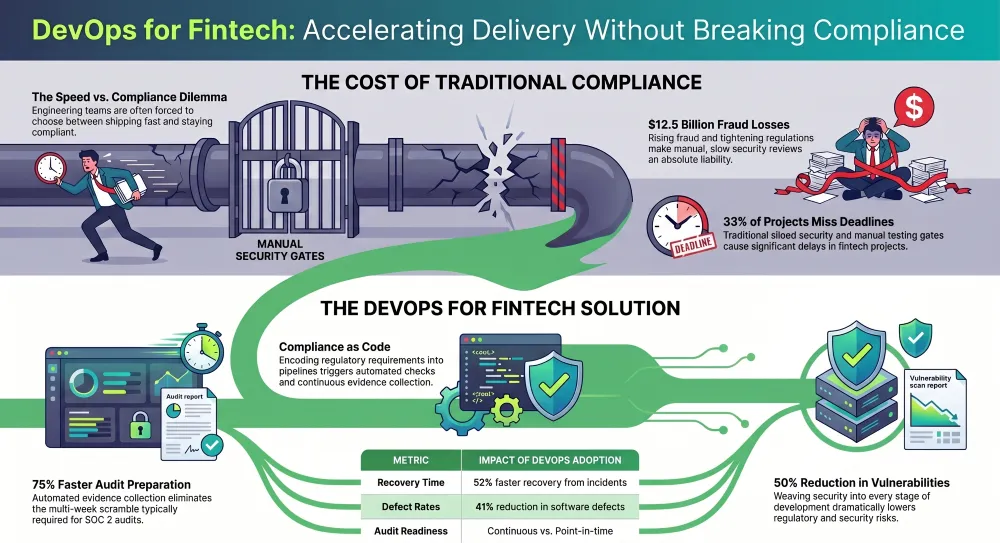
The Compliance Stack: SOC 2, PCI-DSS, HIPAA, and Beyond
One of the most common misconceptions about DevOps compliance SOC2 HIPAA is that compliance slows you down. Done right, it’s the opposite.
The key insight is “compliance as code” — encoding regulatory requirements directly into your pipeline so that every deployment is automatically checked against the relevant standards. This removes the need for manual compliance reviews, which are not only slow but notoriously error-prone.
Here’s how the major frameworks map to DevOps practices:
SOC 2 is built around five trust service criteria: security, availability, processing integrity, confidentiality, and privacy. A mature DevOps pipeline automates evidence collection across all five — tracking access controls, system uptime metrics, encryption states, and data handling records continuously rather than at audit time. By 2025, SOC 2 compliance has become the new baseline for doing business for SaaS, cloud services, fintech, and digital health vendors, making it non-negotiable for any fintech operating at scale.
PCI-DSS governs how payment data is handled, stored, and transmitted. DevOps helps here by enforcing network segmentation through Infrastructure as Code, automating vulnerability scans against cardholder data environments, and maintaining immutable audit logs of every system interaction touching payment data.
HIPAA is less commonly associated with pure fintech but is highly relevant to health-fintech, insurance platforms, and benefits administration software. DevOps pipelines can enforce HIPAA technical safeguards — encryption at rest, access controls, audit controls — at the infrastructure level, making them consistent and audit-ready by default.
GDPR and state-level privacy laws increasingly require documented data flows, retention policies, and right-to-erasure capabilities. DevOps automation can track data lineage across services and enforce retention rules through automated data lifecycle management.
The result is what compliance experts call “continuous compliance” — not a point-in-time audit exercise, but an always-on verification that your systems meet regulatory requirements at every moment.
Managed DevOps for Fintech: The Case for Outsourcing the Pipeline
Building all of this in-house is genuinely hard. You need senior DevOps engineers with fintech-specific experience — people who understand not just Kubernetes and Terraform, but also PCI scope reduction, SOC 2 control mapping, and the specific audit evidence requirements of financial regulators. This talent is expensive, scarce, and often pulled in multiple directions.
This is why Managed DevOps for Fintech and DevOps as a Service for Fintech have become serious strategic options for financial technology companies at every stage of growth.
Managed DevOps for Fintech means partnering with a specialist provider who owns the design, implementation, and ongoing operation of your DevOps infrastructure. Instead of hiring a team of DevOps engineers and building institutional knowledge from scratch, you get an experienced team that has already solved the problems you’re facing — across dozens of similar financial technology environments.
DevOps as a Service extends this further, providing on-demand access to DevOps capabilities as a scalable, subscription-based model. Rather than maintaining a full-time headcount for infrastructure work that fluctuates in intensity, fintech teams get consistent access to expertise that scales with their needs.
The business case is strong. When you consider the combined cost of senior DevOps salaries, tooling licenses, training, and the opportunity cost of delayed releases, DevOps as a Service often delivers better outcomes at lower total cost — particularly for Series A through Series C fintech companies that need enterprise-grade infrastructure without the overhead of a large internal platform team.
This is exactly where a partner like Full-Stack Techies provides differentiated value. With deep experience across CI/CD pipeline architecture, compliance automation, cloud infrastructure for financial services, and regulatory framework integration, Full-Stack Techies delivers the kind of financial-grade DevOps capability that most teams spend years building internally — in a fraction of the time.
DevOps Case Study Fintech: Real-World Patterns That Work
Understanding how DevOps for Fintech works in practice requires looking at the patterns that consistently deliver results. The following represent composite patterns drawn from how high-performing fintech teams structure their DevOps transformations.
Pattern 1: The Compliance-First Pipeline
A lending platform operating across multiple U.S. states faced an annual SOC 2 audit cycle that consumed six to eight weeks of engineering time. By rebuilding their CI/CD pipeline with automated evidence collection — using tools integrated directly into their GitHub Actions workflow — they reduced audit preparation time to under two weeks. Every deployment automatically generated timestamped logs of change approvals, testing outcomes, and security scan results. Auditors received a pre-packaged evidence bundle rather than having to chase engineers for documentation.
Pattern 2: Zero-Downtime Deployments for Payment Infrastructure
A payment processing platform couldn’t afford downtime during deployments — every minute of unavailability had direct financial consequences. By implementing blue-green deployments on AWS with automated health checks and instant rollback capability, they moved from four-hour maintenance windows to continuous deployment with no user-facing downtime. According to the 2025 State of DevOps report, fintechs that excel in these metrics are 208x more frequent in deployments and recover from incidents 2,600x faster than low performers.
Pattern 3: Regulatory Change Response
When a new directive required changes to data retention policies across a neobank’s infrastructure, traditional approaches would have required a manual audit of every service to identify where data was stored and for how long. With Infrastructure as Code and centralized configuration management, the same change was pushed across all environments in a single pull request, with automated verification that every service met the new retention requirement before deployment was allowed to proceed.
These patterns illustrate a consistent theme in DevOps case study fintech literature: the teams that respond fastest to regulatory change are the ones that made compliance automation a first-class engineering concern from the start — not an afterthought.
Building a DevOps Culture in Financial Teams
Technology is only half the equation. DevOps for Fintech requires cultural change that many financial organizations underestimate.
Traditional financial software organizations are built around separation of duties — a compliance requirement that often becomes a collaboration barrier. Developers write code, security reviews it, operations deploys it, and compliance audits the result. Each handoff introduces friction, delay, and miscommunication.
DevOps doesn’t eliminate separation of duties — it automates it. Automated security gates replace manual security reviews. Automated compliance checks replace periodic audits. Automated deployment pipelines replace manual operations runbooks. The controls are still there; they’re just not bottlenecks anymore.
For financial teams making this shift, the cultural journey typically moves through several stages:
Stage 1 — Awareness: Leadership recognizes that the current release process is a competitive liability. Teams begin measuring deployment frequency, lead time for changes, mean time to recovery, and change failure rate — the DORA metrics that define DevOps maturity.
Stage 2 — Tooling: CI/CD pipelines are introduced or modernized. Infrastructure as Code replaces manual configuration. Automated testing expands beyond unit tests to include integration, security, and compliance checks.
Stage 3 — Integration: Security and compliance teams are embedded into the development process rather than acting as gates at the end. Shared dashboards give everyone visibility into the compliance posture of every service in real time.
Stage 4 — Optimization: The team iterates on pipeline performance, reducing build times, expanding test coverage, and tuning automated compliance evidence collection to minimize overhead.
According to Gartner’s forecast, organizations that focus on improving developer experience are expected to achieve twice the developer retention rate by 2027 compared to those that do not make similar investments. In fintech, where engineering talent is highly competitive, this is a retention strategy as much as a technical one.
The Cloud Foundation: Where DevOps for Fintech Lives
Modern DevOps for Fintech is inseparable from cloud infrastructure. The elasticity, security tooling, and managed services available from AWS, Azure, and GCP give financial teams capabilities that would have required enormous on-premise investment a decade ago.
Global end-user spending on public cloud services is projected to reach $723.4 billion in 2025, up from $595.7 billion in 2024, reflecting continued expansion of cloud adoption according to Gartner. This growth is fueled by demand for distributed, hybrid, cloud-native, and multicloud environments.
For fintech specifically, the cloud enables several critical DevOps capabilities:
- Ephemeral Environments: Spin up a complete, isolated copy of your production environment for testing, run your suite, and tear it down — all automatically as part of your CI pipeline. This gives every feature branch a realistic testing environment without the cost of maintaining permanent test infrastructure.
- Managed Compliance Services: Cloud providers offer managed services like AWS Config, Azure Policy, and GCP Security Command Center that continuously evaluate your cloud resources against compliance benchmarks. These integrate directly into DevOps pipelines as policy-as-code enforcement layers.
- Multi-Region Disaster Recovery: Financial regulators increasingly require documented, tested disaster recovery capabilities. Cloud-native DevOps makes multi-region active-passive and active-active architectures achievable for fintech companies that previously couldn’t justify the cost.
- Secrets Management: Financial systems handle API keys, database credentials, encryption keys, and third-party service tokens at scale. Cloud-native secrets managers integrated into CI/CD pipelines ensure credentials are never hardcoded in code or configuration files — a common source of audit findings.
AI and Automation: The Next Frontier of DevOps for Fintech
The DevOps for Fintech landscape is evolving rapidly, with artificial intelligence beginning to reshape what’s possible.
The AI in fintech market is worth $30 billion in 2025 and is expected to rise to $83.1 billion by 2030. Much of this growth is driven by the operational efficiency gains that AI delivers across the financial services stack — and DevOps is no exception.
AI is beginning to influence fintech DevOps in several ways:
- Intelligent Test Generation: AI models analyze code changes and automatically generate relevant test cases, improving coverage without requiring manual test authorship for every feature.
- Predictive Pipeline Optimization: Machine learning models analyze historical build and deployment data to identify bottlenecks, predict build failures before they happen, and optimize the order of pipeline stages.
- Anomaly Detection in Production: AI-powered monitoring identifies unusual patterns in financial transaction data, system performance metrics, and security logs — triggering automated responses before human operators would detect the issue.
- Compliance Gap Prediction: Emerging tools use AI to analyze infrastructure configurations and predict compliance gaps before audits, allowing teams to remediate proactively rather than reactively.
In June 2025, Opsera — a leading AI-driven DevOps platform — introduced a DevOps for DataOps feature enabling customers to enhance and protect data processes through automation, governance, and intelligence, ensuring enterprise-level compliance. This is a signal of where the market is heading: AI-native governance built directly into the DevOps toolchain.
How Full-Stack Techies Approaches DevOps for Fintech
At Full-Stack Techies, we’ve built our financial technology DevOps practice around a single belief: compliance and velocity are not in conflict. They reinforce each other when the infrastructure is designed correctly from the start.
Our approach to DevOps as a Service for Fintech begins with a comprehensive audit of your current delivery pipeline — not just the technical architecture, but the organizational practices that determine how quickly changes move from idea to production. We identify the specific compliance frameworks relevant to your business, map your current controls, and design a target-state pipeline that automates as much compliance evidence collection as possible.
From there, Full-Stack Techies implements the tooling and processes — CI/CD pipelines configured for your specific cloud environment, IaC templates built for compliance from day one, automated security scanning integrated at every stage, and monitoring dashboards that give your compliance team real-time visibility into your regulatory posture.
Our Managed DevOps for Fintech offering then maintains and evolves this infrastructure on your behalf, handling on-call response, pipeline maintenance, tooling upgrades, and compliance framework updates as regulations change. Your engineering team focuses on building financial products. We handle the infrastructure that ships them safely.
Whether you’re a seed-stage fintech building your first compliant pipeline, a growth-stage company preparing for your SOC 2 Type II audit, or an established financial services firm modernizing legacy delivery processes, Full-Stack Techies brings the fintech-specific expertise to move you forward without compliance risk.
Key Metrics: How to Measure DevOps Maturity in Fintech
If you’re evaluating your organization’s DevOps for Fintech maturity, or making the case for investment internally, these are the metrics that matter:
Deployment Frequency measures how often your team successfully releases to production. High-performing fintech teams deploy daily or multiple times per week. Lower performers deploy monthly or quarterly. The gap in competitive responsiveness is enormous.
Lead Time for Changes measures the time from a code commit to that code running in production. In compliant fintech environments, this includes all automated security and compliance gates. Top performers achieve lead times measured in hours; laggards measure in weeks or months.
Mean Time to Recovery (MTTR) measures how long it takes to restore service after an incident. For financial systems, this directly impacts customer trust, regulatory standing, and revenue. Fintech companies that adopt DevOps see a 52% faster recovery time from incidents.
Change Failure Rate measures the percentage of deployments that cause a production incident requiring remediation. Best-in-class financial DevOps organizations maintain change failure rates below 15%.
Compliance Coverage Automation is a fintech-specific metric: what percentage of required compliance controls are verified automatically rather than manually? High performers achieve 80%+ automation, transforming audits from expensive fire drills into routine reporting exercises.
Common Mistakes Fintech Teams Make with DevOps
Understanding what works requires also understanding what doesn’t. These are the patterns that consistently undermine DevOps for Fintech initiatives:
- Treating Compliance as a Post-Development Concern: Security and compliance reviews added at the end of a development cycle create massive delays and often require rework. By the time a compliance gap is found at the audit stage, fixing it may require rewriting significant portions of a feature. Compliance belongs in the pipeline from day one.
- Under-Investing in Observability: You cannot manage what you cannot see. Fintech teams that deploy without comprehensive logging, distributed tracing, and real-time alerting are flying blind. Regulators increasingly expect demonstrable monitoring capabilities, and operational incidents in financial systems require rapid, evidence-based response.
- Manual Secrets Management: Hardcoded credentials and manually rotated API keys are a persistent source of both security incidents and audit findings. In a properly configured DevOps pipeline, secrets are never stored in code — they’re injected at runtime from managed secret stores with automated rotation.
- Skipping Environment Parity: When production behaves differently from development or staging, compliance testing results don’t reliably predict production behavior. Infrastructure as Code ensures that every environment is a consistent, reproducible replica of production — critical for both reliability and compliance.
- Neglecting the Human Side: DevOps transformations that focus entirely on tooling without addressing organizational culture, team structure, and incentive alignment consistently underperform. The technology enables the practice; the culture sustains it.
Industry Outlook: Where DevOps for Fintech Is Heading
The trajectory is clear. DevOps for Fintech is moving from a differentiator to a baseline expectation — for investors, for customers, for regulators, and for engineering talent.
According to the World Economic Forum, cloud solutions were ranked the fifth most important topic in the fintech industry in 2025, exceeded only by AI/ML, regional interoperability, open banking, and embedded finance. Cloud-native DevOps is the infrastructure layer that makes all of these capabilities possible.
Regulatory environments globally are also converging toward requirements that effectively mandate DevOps-style practices. Continuous monitoring, documented change management, automated audit trails, rapid incident response capabilities — these are no longer just engineering best practices. They’re regulatory expectations.
According to Gartner, over 85% of organizations will be adopting a cloud computing strategy by 2025, and 95% of new digital workloads will take place on cloud platforms. Fintech organizations that haven’t built the DevOps infrastructure to operate effectively in cloud-native environments will find themselves at a structural disadvantage as this shift accelerates.
The fintech companies that will lead the next decade are the ones that have made DevOps for Fintech a core organizational capability — not just a technical project. That means treating deployment pipelines as a strategic asset, investing in compliance automation as a competitive advantage, and partnering with specialists who understand both the engineering and the regulatory landscape.
Getting Started: A Practical Roadmap
If your organization is beginning or accelerating its DevOps for Fintech journey, here is a practical sequence that consistently works:
Step 1 — Baseline Current State: Measure your DORA metrics honestly. Understand your current deployment frequency, lead time, MTTR, and change failure rate. Identify the specific regulatory frameworks that apply to your business and map your current compliance controls.
Step 2 — Identify the Highest-Leverage Changes: Not every pipeline improvement has equal impact. Identify whether your biggest constraint is slow testing, manual compliance reviews, deployment risk, or incident response capability — and prioritize accordingly.
Step 3 — Build or Engage: Decide whether to build DevOps capability in-house, engage a Managed DevOps for Fintech partner, or some hybrid of both. Consider your timeline to next audit, your current engineering capacity, and the strategic importance of owning this capability internally.
Step 4 — Implement Incrementally: The most successful DevOps for Fintech transformations don’t attempt to rebuild everything at once. They identify one value stream — one product or service — and build a model pipeline that demonstrates what’s possible. Then they expand.
Step 5 — Measure, Iterate, and Sustain: DevOps is not a project with an end date. It’s an ongoing practice of measurement, learning, and improvement. Establish regular retrospectives that evaluate not just technical metrics but compliance posture, audit readiness, and team health.
Conclusion: Speed and Safety Are Not a Trade-Off
The core premise of DevOps for Fintech — that financial teams can ship faster and maintain compliance — is no longer theoretical. It’s proven, documented, and increasingly expected.
The question is no longer whether your organization should invest in DevOps for Fintech. It’s whether you’re going to build that capability faster than your competitors, and whether you’re going to do it before your next audit, your next incident, or your next regulatory change puts the gap in capability on full display.
Full-Stack Techies exists to help financial technology teams close that gap — with the technical depth, compliance expertise, and delivery speed that modern fintech demands. From initial pipeline assessment through full Managed DevOps for Fintech engagement, we partner with financial teams to build infrastructure that ships fast, stays compliant, and scales with confidence.
The fintech teams that move fastest without breaking compliance aren’t lucky. They built the right foundation. Start building yours.
Also Read: DevOps for Healthcare: Compliance, Speed & Security Considerations in 2026



