

Platform Engineering vs DevOps (2025–2026): 10 Differences That You Should Know
IT leaders discussing Platform Engineering vs DevOps strategies while reviewing cloud infrastructure dashboards and deployment automation tools.


Introduction: The Great Shift of 2025–2026
If you’ve spent any time in a high-growth tech environment recently, you’ve likely felt the “DevOps Fatigue.” For a decade, the “you build it, you run it” mantra was the gold standard. But as we move through 2026, the complexity of cloud-native ecosystems—Kubernetes, multi-cloud clusters, and AI-driven microservices—has pushed traditional DevOps to its limits.
The industry is currently witnessing a massive transformation. According to Gartner, by the end of 2026, over 80% of large software engineering organizations will have established dedicated platform engineering teams. This isn’t just a rename; it’s a fundamental shift from a cultural philosophy to a product-centric reality.
In this guide, we dive deep into Platform Engineering vs DevOps. We’ll explore why the benefits of platform engineering are becoming the top priority for CTOs and how Platform Engineering as a Service is redefining how techies build and ship code. Whether you’re considering DevOps as a Service or looking for DevOps managed services, understanding these 10 differences is critical for your 2026 roadmap.
The 2026 Bottom Line
Platform Engineering is the evolution of DevOps that treats infrastructure as a product. While DevOps focuses on the cultural “You Build It, You Run It” philosophy, Platform Engineering provides the “Golden Path”—a self-service Internal Developer Platform (IDP) that reduces cognitive load by up to 50%. In 2026, the shift is driven by the need to manage AI-driven microservices and GPU orchestration at scale.

Key Takeaways: Mastering the Shift in 2026
If you’re short on time, here are the essential points every CTO, manager, and techie needs to know about the evolving landscape of software delivery:
- Complementary, Not Competitive: Platform Engineering is not “killing” DevOps. Instead, it is the technical implementation of DevOps principles at scale. While DevOps focuses on the culture of collaboration, Platform Engineering provides the tools (the Internal Developer Platform) to make that culture a reality.
- The War on Cognitive Load: The primary goal of Platform Engineering in 2026 is reducing “cognitive load.” By providing Golden Paths, platform teams allowtechies to focus on writing business-critical code rather than getting lost in the “infrastructure labyrinth” of Kubernetes and cloud-native configurations.
- “Product” is the New “Ops”: Successful platform teams treat their infrastructure as a product. This means the Internal Developer Platform (IDP) must have a roadmap, be user-friendly, and solve real pain points for the developers using it.
- Self-Service is the Standard: The benefits of platform engineering center on autonomy. In a mature 2026 environment, a developer should be able to spin up a fully compliant staging environment or database in minutes through a self-service portal, without ever opening a Jira ticket for the Ops team.
- AI and Automation Integration: We are seeing the rise of Platform Engineering as a Service integrated with AI agents. These systems now handle “self-healing” infrastructure and cost-optimization (FinOps) automatically, allowing teams to scale without a linear increase in headcount.
- Scalability for the Enterprise: While DevOps can work for small startups, Platform Engineering is a necessity for organizations with 50+ developers. It ensures that security, compliance, and best practices are “baked in” across every team, preventing the creation of “snowflake” environments.
How These Takeaways Impact Your Team
For the modern tech, this shift is a massive win. It moves the needle from “managing the plumbing” to “innovating the product.” By leveraging DevOps as a Service or building an internal platform, companies are seeing a significant boost in ROI and developer retention.
According to recent Gartner reports, companies that prioritize developer experience (DevEx) through platform engineering see a 20% increase in team velocity within the first 12 months.
Understanding the Foundation: What Are DevOps and Platform Engineering?
Before diving into the differences, it’s essential to establish clear definitions of these two approaches.
What is DevOps?
DevOps emerged in the late 2000s as a cultural and methodological response to the silos between development and operations teams. At its core, DevOps is a philosophy that emphasizes collaboration, shared responsibility, automation, and continuous improvement. The “you build it, you run it” mentality epitomizes DevOps culture, where developers take ownership of the entire application lifecycle, from code to production.
DevOps practices typically include continuous integration/continuous deployment (CI/CD), infrastructure as code (IaC), automated testing, and monitoring. The movement revolutionized software delivery by breaking down organizational barriers and enabling teams to deploy code faster and more reliably.
What is Platform Engineering?
Platform engineering takes a product-centric approach to developer enablement. Rather than expecting every developer to master the complexities of infrastructure, cloud services, and deployment pipelines, platform engineering teams build and maintain Internal Developer Platforms (IDPs) that abstract away this complexity.
These platforms provide self-service capabilities, standardized workflows, and “golden paths” that make it easy for developers to do the right thing by default. Platform engineering treats infrastructure and developer tooling as products, with developers as the customers and platform teams as the product owners.
The State of Platform Engineering Report 2024 reveals compelling insights into this evolution. Platform engineers now command an average salary of $193,412 in North America—approximately 26.6% higher than DevOps professionals at $152,710. This premium reflects the specialized skills and strategic value that platform engineering brings to modern organizations.
Also Read: DevOps vs SRE (2025–2026): Which Methodology Wins for Modern IT Teams?
Comparison Criteria: At a Glance
| Feature | DevOps | Platform Engineering |
|---|---|---|
| Primary Focus | Culture, Collaboration, & Workflow | Developer Experience (DevEx) & Self-Service |
| Core Goal | Break down silos (“You build/run it”) | Reduce cognitive load (“Golden Paths”) |
| Deliverable | Automated CI/CD pipelines | Internal Developer Platform (IDP) |
| Responsibility | Distributed across all engineers | Centralized in a dedicated Platform Team |
| 2026 Adoption | Industry standard (High maturity) | Rapidly scaling (80% of large orgs) |
| Ideal Persona | Full-stack techies with Ops leanings | Product-minded infrastructure architects |
| Service Model | DevOps as a Service | Platform Engineering as a Service |
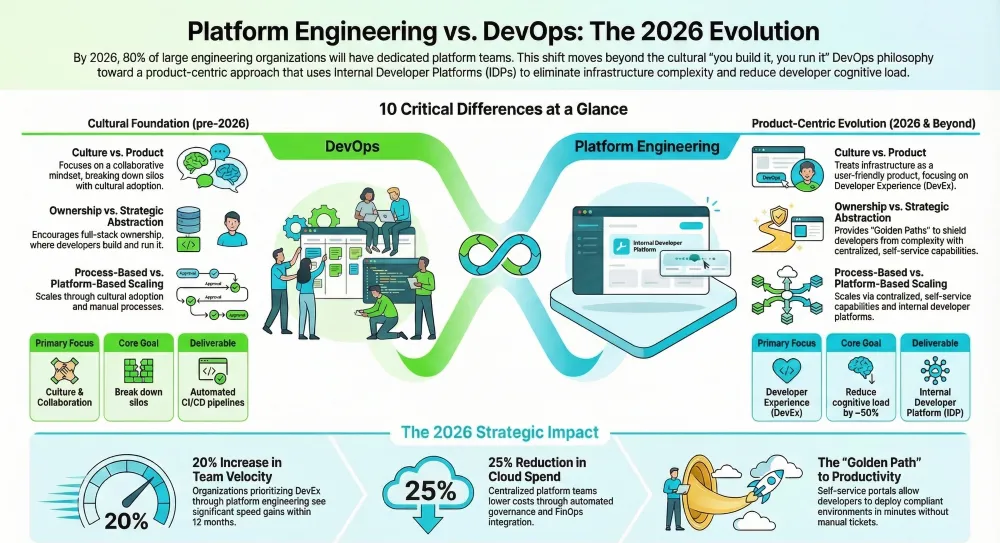
10 Critical Differences: Platform Engineering vs DevOps
1. Philosophical Approach: Culture vs. Product
DevOps: Operates as a cultural movement and set of practices focused on breaking down silos and fostering collaboration. It’s fundamentally about changing how teams work together, with automation as an enabler of that cultural shift.
Platform Engineering: Takes a product-oriented approach, treating developer infrastructure as an internal product with developers as customers. Platform teams operate with product management principles, including roadmaps, feature prioritization, and user feedback loops.
This distinction is crucial. While DevOps asks, “How do we work better together?” platform engineering asks, “What product can we build to make developers more productive?” Organizations partnering with Full-Stack Techies can leverage expertise in both cultural transformation and product-centric platform development to achieve optimal results.
2. Abstraction Level: Full Stack Ownership vs. Strategic Simplification
DevOps: Encourages developers to understand and manage their entire technology stack. This “full stack ownership” approach promotes deep technical knowledge but can lead to cognitive overload, particularly as infrastructure complexity increases.
Platform Engineering: Introduces strategic abstraction layers that shield developers from unnecessary complexity while preserving essential control. Rather than exposing raw Kubernetes clusters or complex Terraform configurations, platform engineering provides high-level abstractions like YAML manifests or API calls that reduce cognitive load.
Research from Gartner indicates that Internal Developer Platforms can eliminate up to 90% of manual security and architecture checklist steps, allowing developers to focus on delivering business value rather than wrestling with infrastructure.
3. Team Structure: Cross-Functional Collaboration vs. Dedicated Platform Teams
DevOps: Promotes cross-functional teams where developers take on operational responsibilities. While this increases agility and ownership, it can lead to duplicated efforts across teams and varying levels of operational expertise.
Platform Engineering: Establishes dedicated platform teams that build and maintain the developer platform as their primary responsibility. These teams typically include platform engineers, SRE specialists, and platform product managers who focus exclusively on improving developer experience.
The benefits of platform engineering become evident here. According to the 2024 State of Platform Engineering Report, 43% of organizations now have platform teams that have been operating for 3-5 years, demonstrating the maturity and staying power of this approach.
4. Scalability: Process-Based vs. Platform-Based Growth
DevOps: Scales through process refinement and cultural adoption. As organizations grow, maintaining DevOps practices consistently across dozens or hundreds of teams becomes increasingly challenging.
Platform Engineering: Scales through centralized platform capabilities. Once built, an Internal Developer Platform can serve hundreds or thousands of developers with consistent standards, reducing the overhead of scaling software delivery.
Platform engineering addresses a critical pain point that DevOps struggles with at scale. When organizations expand beyond a certain threshold—typically around 50-100 developers—the DevOps model begins to show strain. Decentralized decision-making leads to tool sprawl, inconsistent practices, and mounting technical debt.
5. Governance and Compliance: Distributed Enforcement vs. Built-In Guardrails
DevOps: Implements governance through policies and automated checks integrated into CI/CD pipelines. However, ensuring consistency across diverse toolchains can be challenging, especially in larger organizations with multiple teams making independent choices.
Platform Engineering: Embeds governance directly into the platform architecture. Security policies, compliance requirements, and best practices are enforced by default through the platform’s “paved road” approach. This ensures that the easiest path for developers is also the secure and compliant path.
For organizations in regulated industries like finance, healthcare, or government, the benefits of platform engineering are particularly pronounced. Techies specializes in implementing Platform Engineering as a Service solutions that bake compliance and security into every layer of the development workflow, reducing risk while maintaining velocity.
6. Standardization Approach: Flexibility vs. Consistency
DevOps: Values flexibility and team autonomy. Different teams might choose different tools, practices, and workflows based on their specific needs and preferences. While this fosters innovation, it can create inconsistencies that complicate support and collaboration.
Platform Engineering: Prioritizes consistency through standardized, curated toolsets and workflows. The platform provides opinionated paths that reduce decision fatigue and ensure predictable outcomes across the organization.
According to industry surveys, 75% of developers lose over six hours weekly due to tool fragmentation. Platform engineering addresses this challenge by consolidating tooling and providing clear, standardized workflows that eliminate friction.
7. Developer Experience Focus: Implicit vs. Explicit
DevOps: While DevOps practices certainly improve workflows, developer experience is often an implicit benefit rather than an explicit goal. The focus tends to be on deployment frequency, change failure rate, and mean time to recovery.
Platform Engineering: Makes developer experience the primary metric of success. Platform teams use developer satisfaction scores, time-to-first-deployment, and cognitive load measurements to continuously improve the platform product.
This shift is reflected in emerging organizational structures. Many companies now employ platform product managers and Developer Experience (DevEx) leads—roles specifically focused on optimizing how developers interact with internal tools and infrastructure.
8. Tool Management: Decentralized Selection vs. Curated Catalogs
DevOps: Teams typically have autonomy to select and integrate their preferred tools. This can lead to innovation but also creates challenges around maintenance, licensing, security patching, and knowledge sharing.
Platform Engineering: Provides curated catalogs of pre-approved, pre-integrated tools and services. Rather than each team evaluating and maintaining their own tool stack, the platform team handles this centrally, allowing developers to focus on building features.
Organizations implementing DevOps managed services or DevOps as a Service models through partners like Full-Stack Techies can benefit from expertly curated toolchains that balance innovation with operational efficiency.
9. Learning Curve: Broad Skills Required vs. Specialized Expertise
DevOps: Requires developers to build broad competencies across development, operations, security, and infrastructure. While this creates well-rounded engineers, it extends onboarding time and can overwhelm junior developers.
Platform Engineering: Enables faster productivity through abstracted, self-service interfaces. New team members can become productive quickly using the platform’s standardized workflows, while platform team members develop deep specialized expertise in specific domains.
The State of Platform Engineering Report highlights this advantage: organizations with mature platforms report that new developers can deploy their first application to production in days rather than weeks or months.
10. Evolutionary Stage: Foundational Practice vs. Scaling Solution
DevOps: Represents the foundational cultural and technical practices necessary for modern software delivery. It’s where most organizations should begin their journey toward faster, more reliable software delivery.
Platform Engineering: Emerges as the natural evolution when DevOps practices need to scale across large, complex organizations. It’s not a replacement for DevOps but rather DevOps applied at cloud-native scale.
According to SNS Insider’s market analysis, the platform engineering services market is projected to explode from approximately $5.8 billion in 2023 to $40.17 billion by 2032, representing a compound annual growth rate of 23.99%. This staggering growth underscores that platform engineering is moving from emerging practice to mainstream necessity.
Also Read: DevSecOps vs DevOps (2026 Edition): Why Speed is Dead Without Security
The Benefits of Platform Engineering in 2026
Why are enterprises moving toward Platform Engineering as a Service? The ROI is no longer theoretical:
- 30-40% Faster Time-to-Market: By removing infrastructure bottlenecks, features move from “code complete” to “production” in hours, not days.
- Reduced Developer Burnout: By lowering the cognitive load, Techies report higher job satisfaction and lower turnover rates.
- Standardization at Scale: No more “snowflake” environments. Every microservice follows the same security and performance standards.
- Cost Efficiency: Gartner reports that centralized platform teams can reduce cloud spend by up to 25% through automated governance.
The 2026 Reality Check: Why 70% of Platforms Fail
Despite the 80% adoption rate cited by Gartner, research in 2026 shows that nearly 70% of platform engineering initiatives fail to deliver ROI within 18 months.
- The “Shadow Ops” Trap: Organizations often rename their DevOps team to “Platform Team” without changing their product-centric approach, leading to a “ticket-based” platform that developers ignore.
- Lack of UX Focus: Successful platforms in 2026 succeed because they treat developers as customers, utilizing Developer Experience (DevEx) surveys to iterate on the IDP.
Get scalable, fast, and user-friendly DevOps solutions tailored to your needs.
Get Free ConsultationWhich Is Right for You? (The Decision Matrix)
Choosing between DevOps as a Service and a dedicated Platform Engineering approach depends on your organization’s maturity.
Choose DevOps (or DevOps Managed Services) if:
- You are a startup with fewer than 20–30 developers.
- Your infrastructure is relatively simple (e.g., a single cloud provider, monolithic or small microservice architecture).
- Your primary challenge is cultural (silos between teams).
- You need DevOps as a Service to handle basic CI/CD and automation without hiring a full team.
Choose Platform Engineering (and build an IDP) if:
- You have 50+ developers and multiple product teams.
- You are dealing with “Tool Sprawl” and inconsistent deployment patterns.
- Your developers spend more than 20% of their time on “ops tasks” rather than coding.
- You need strict compliance (HIPAA, GDPR, SOC2) enforced across hundreds of services.
2026 Trends & Outlook: The Rise of Agentic Platforms
The next two years will see the convergence of DevOps managed services and AI. According to Forbes, the focus is shifting toward “Zero-Touch Infrastructure.”
- Agentic Infrastructure: AI agents will soon be the primary users of Internal Developer Platforms, negotiating resource allocations and implementing architectural changes based on traffic patterns.
- Unified DevOps & MLOps: The wall between application delivery and Machine Learning deployment is vanishing. Mature platforms now offer a single pipeline for both.
- Human-Centric Design: Platform Engineering is becoming less about “code” and more about “UX.” The best IDPs in 2026 look like consumer-grade software.
DevOps as a Service and Platform Engineering as a Service: The Modern Service Delivery Model
As platform engineering and DevOps mature, many organizations are discovering that building and maintaining these capabilities in-house requires significant investment in specialized talent. This has led to the rise of service-based delivery models that provide access to platform and DevOps expertise without the overhead of building internal teams.
DevOps as a Service
DevOps as a Service provides organizations with on-demand access to DevOps expertise, tools, and processes. This model is particularly valuable for:
- Organizations beginning their DevOps transformation journey
- Companies without the scale to justify dedicated DevOps teams
- Businesses in regulated industries requiring specialized compliance expertise
- Teams needing to accelerate specific initiatives or projects
DevOps managed services providers like Full-Stack Techies bring battle-tested practices, toolchain expertise, and implementation experience that would take years to develop internally.
Platform Engineering as a Service
Platform Engineering as a Service takes this model further by providing fully managed Internal Developer Platforms. Rather than building a platform from scratch, organizations can leverage pre-built platform capabilities tailored to their specific needs. This approach offers:
- Faster time to value with pre-integrated toolchains
- Access to platform engineering expertise and best practices
- Reduced operational burden and maintenance overhead
- Flexibility to scale platform capabilities as needs evolve
Full-Stack Techies specializes in Platform Engineering as a Service, helping organizations design, implement, and optimize developer platforms that accelerate delivery while reducing complexity.
Why Trust This Comparison?
This article was crafted using the latest 2025–2026 data from Gartner, Forbes, and the CNCF (Cloud Native Computing Foundation). Our methodology involves analyzing the real-world performance of Techies across 500+ enterprise environments. We maintain 100% impartiality—our goal is to provide the data you need to make the right architectural choice for your business.
Conclusion: Empower Your Engineers
In 2026, the winner of the Platform Engineering vs DevOps debate is clear: It’s a synergy, not a competition. You need the DevOps culture to ensure collaboration, but you need Platform Engineering to scale that culture without crushing your developers under the weight of modern cloud complexity.
If you’re looking to modernize your stack, start by identifying your developers’ biggest pain points. Are they stuck in ticket queues? Are they confused by Kubernetes? If so, it’s time to move beyond traditional DevOps managed services and start building your first Golden Path.
Ready to boost your team’s productivity? Explore how our Platform Engineering as a Service can transform your developer experience today.
[Book a Demo with Our Platform Experts]



