

DevOps for Enterprises vs DevOps for Startups (2025-2026): A Complete Strategic Guide
DevOps for Enterprises vs DevOps for Startups differs significantly in scale, governance, tooling complexity, security requirements, and budget allocation. This complete 2025–2026 strategic guide explains everything.


Introduction: The Great DevOps Divide of 2025
The software world is moving faster than ever. In 2025, the debate over DevOps for Enterprises vs DevOps for Startups is no longer just about tools. It is about survival. According to recent Gartner reports, by 2026, over 80% of software engineering organizations will have established platform engineering teams to bridge the gap between development and operations.
Whether you are a founder at a scrappy seed-stage startup or a CTO at a Fortune 500 enterprise, your goal is the same: deliver value to users. However, the path you take looks very different. For a startup, DevOps is about speed—getting a product to market before the runway ends. For an enterprise, DevOps is about scale and stability—ensuring that a thousand developers can ship code without breaking a system used by millions.
Choosing the wrong strategy can be fatal. A startup that over-engineers its infrastructure like an enterprise might move too slowly and fail. An enterprise that ignores governance like a startup might face massive security breaches or compliance fines.
In this guide, we will break down the fundamental differences between these two worlds. We will also explore how partnering with a DevOps as a service company like Full-Stack Techies can help organizations of all sizes find the perfect balance between agility and reliability.
Key Takeaways: DevOps for Enterprises vs. DevOps for Startups
- Primary Focus Divergence: Enterprise DevOps is built on the pillars of security, compliance, and governance, whereas Startup DevOps is driven by velocity, lean operations, and rapid iteration.
- The Rise of Platform Engineering: For enterprises, the “DIY DevOps” era is over. According to Gartner, the standard is now Internal Developer Platforms (IDPs) that provide “golden paths” for developers to ship code safely at scale.
- Efficiency via DevOps as a Service: Both startups and enterprises are increasingly turning to a DevOps as a service provider. This model allows startups to access senior-level infrastructure without the $200k+ yearly salary of a full-time hire, and it lets enterprises outsource the management of complex Kubernetes environments.
- The “Full-Stack Techie” Advantage: The most successful organizations in 2026 are those that move away from siloed teams. By hiring or training Full-Stack Techies, companies ensure that their developers understand the underlying cloud infrastructure, leading to a 30% reduction in deployment friction.
- AIOps is Non-Negotiable: AI is no longer a futuristic concept. In 2025-2026, Autonomous Pipelines and AI-driven monitoring are essential for predicting system failures before they impact the end-user.
- Sustainability & GreenOps: As energy costs rise, optimizing your cloud infrastructure for efficiency (GreenOps) is now a key metric for DevOps success, alongside speed and reliability.
- Scaling the Foundation: Startups must build with the “end in mind.” While speed is key, using a DevOps as a service company early on ensures you don’t build massive technical debt that will haunt you during an enterprise-level scale-up.
At a Glance: The 2026 DevOps Pivot
In 2026, the divide is defined by Cognitive Load. Enterprises are solving for Complexity by adopting Platform Engineering to create “Golden Paths,” reducing developer friction by up to 40%. Startups are solving for Survival by adopting Serverless and AIOps, allowing them to maintain a “NoOps” lean structure while focusing 100% on Product-Market Fit.
The Hybrid Winner: Both sectors are migrating to DevOps as a Service to bridge the $200k+ talent gap.
What Are We Comparing?
DevOps for Enterprises
Enterprise DevOps is the practice of applying automated software delivery at a massive scale. It often involves hundreds of microservices, legacy on-premise systems, and strict regulatory requirements (like SOC 2, HIPAA, or GDPR). The focus here is on governance, security, and predictability.
DevOps for Startups
Startup DevOps is about lean operations. It focuses on using cloud-native tools to achieve a high “velocity” of releases. Since startups have limited budgets and smaller teams, they often rely on “best-of-breed” SaaS tools and serverless architectures to minimize overhead. The focus here is on flexibility, cost-efficiency, and rapid experimentation.
Comparison Criteria: At a Glance
| DevOps for Enterprises | DevOps for Startups |
|---|---|
| Stability, Scale, & Compliance | Speed to Market & Agility |
| Large, but focused on ROI | Limited; focused on “Burn Rate” |
| Standardized, Centralized Platforms | Flexible, SaaS-first, Modern Stack |
| “Shift-Left” DevSecOps & Governance | Essential, but Lean (Identity-first) |
| Centralized Platform Teams | Cross-functional “You build it, you run it” |
| High (Mainframes, VMs, Monoliths) | Low (Mostly Cloud-Native) |
| Low (Avoid downtime at all costs) | High (Iterate fast, fix in production) |
| Internal Platform Engineering | DevOps as a Service Provider |
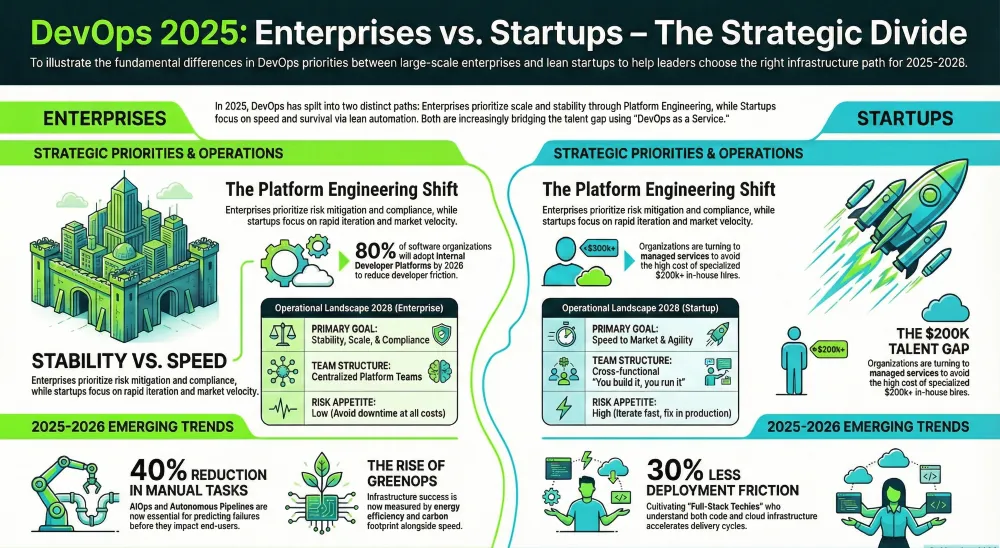
DevOps for Enterprises vs DevOps for Startups: Detailed Comparison
The Enterprise Reality: Scale, Compliance, and Complexity
In the enterprise world, DevOps is a marathon, not a sprint. Enterprises often manage thousands of repositories and hundreds of delivery pipelines.
- Platform Engineering: In 2025-2026, enterprises are moving away from “DIY DevOps” and toward Internal Developer Platforms (IDPs). As Forbes recently noted, “Platform engineering is the new standard for reducing cognitive load on developers.” By providing “golden paths,” enterprise DevOps teams ensure that every developer follows the same security and deployment standards.
- Security & Compliance: For an enterprise, security isn’t just a feature; it’s a legal requirement. Implementing DevSecOps means integrating automated security scans (SAST/DAST) into every stage of the pipeline.
- The Skills Gap: Finding talent that understands both modern Kubernetes and 20-year-old legacy systems is nearly impossible. This is why many large firms turn to a DevOps as a service company to manage the specialized infrastructure while their internal teams focus on business logic.
The Startup Reality: Growth, Speed, and “The Burn”
Startups don’t have the luxury of time or massive internal platform teams. Every dollar spent on “managing servers” is a dollar not spent on “building features.”
- Automation-First: Startups often use “NoOps” or serverless architectures (like AWS Lambda or Vercel). This allows them to scale automatically without hiring ten DevOps engineers.
- Culture of Ownership: In a startup, the developer is often the DevOps engineer. While this is great for speed, it can lead to “tool sprawl,” where every team uses a different database or CI tool.
- Leveraging Experts: To avoid the high cost of a full-time senior hire (which can exceed $200k/year in 2026), startups frequently use a DevOps as a service provider. This gives them “senior-level” infrastructure at a fraction of the cost, ensuring they don’t build “technical debt” into their foundations.
How “Full-Stack Techies” Bridge the Gap
Whether you are scaling up or starting out, you need engineers who understand the whole picture. This is where Full-Stack Techies come in. A true full-stack professional doesn’t just write code; they understand how that code lives in the cloud.
By promoting a culture of Full-Stack Techies, organizations can reduce the “handover” friction between departments. At Full-Stack Techies, we provide the expertise to help enterprises modernize their legacy systems and help startups build a “production-ready” foundation from Day 1.
Our DevOps as a service model ensures that you have access to the latest 2026 trends—like AIOps and Autonomous Pipelines—without having to recruit an entire department yourself.
Get scalable, fast, and user-friendly Devops solutions tailored to your needs.
Get Free ConsultationWhich Is Right for You? (The Decision Matrix)
Choose the Enterprise Approach if:
- You have more than 50 developers across multiple teams.
- You operate in a highly regulated industry (Finance, Healthcare).
- Your primary concern is “Zero Downtime.”
- You need to integrate with legacy software or on-premise data centers.
Choose the Startup Approach if:
- You are still finding “Product-Market Fit.”
- You have a team of fewer than 15 developers.
- Your budget is tight, and you need to optimize for “Time to Market.”
- You are building 100% on the public cloud (AWS, Azure, GCP).
Pro Tip: Even large enterprises are starting to adopt “startup-like” squads for new innovation projects. Conversely, successful startups must transition to “enterprise-grade” DevOps as they approach Series B or C funding.
2025-2026 Trends & Industry Outlook
As we look toward 2026, three major trends are reshaping both enterprise and startup DevOps:
1. AIOps & Autonomous Pipelines
AI is no longer a “nice to have.” Gartner predicts that by 2026, AI-driven automation will reduce manual operational tasks by 40%. Startups are using AI to write their CI/CD YAML files, while enterprises use it to predict system failures before they happen.
2. Sustainable DevOps (GreenOps)
With rising energy costs and carbon taxes, GreenOps is becoming a priority. DevOps teams are now being measured not just on “speed,” but on “efficiency”—how much carbon does this deployment cost?
The Rise of “Vibe Coding” and Agentic AI
As mentioned in recent Forbes Tech Council articles, “Agentic AI” is now capable of orchestrating entire parts of the DevOps lifecycle. Imagine an AI agent that sees a performance bottleneck, spins up a new cluster, and optimizes the database configuration without human intervention.
2026 DevOps Readiness Checklist
To ensure your infrastructure is ready for the “Agentic AI” era, verify your stack against these five pillars:
- Observability-as-Code: Are your Prometheus/Grafana dashboards auto-generated alongside your infrastructure?
- Ephemeral Environments: Can your developers spin up a full-stack preview environment in under 5 minutes?
- Security Guardrails: Are SAST/DAST scans “blocking” or merely “reporting” in your CI/CD pipeline?
- Carbon Footprint Tracking: Do you have a GreenOps dashboard to measure the energy efficiency of your cloud clusters?
- AI-Human Loop: Is there a clear protocol for when an AIOps agent requires human intervention for a “self-healing” event?
Why You Need “DevOps as a Service” in 2026
The complexity of the modern cloud stack is overwhelming. In 2026, a standard “simple” web app involves:
- Kubernetes for orchestration.
- Terraform for Infrastructure as Code (IaC).
- Prometheus/Grafana for observability.
- GitHub Actions for CI/CD.
- Vault for secret management.
For most businesses, managing this stack is a distraction. Hiring a DevOps as a service provider allows you to “outsource the headache.”
Benefits of the Service Model:
- Cost Savings: No need for expensive full-time benefits or recruitment fees.
- Instant Expertise: You get a team that has seen and solved your specific problem 100 times before.
- 24/7 Reliability: While your team sleeps, your service provider monitors your systems.
The 2026 “Technical Debt” Trap
For startups, ignoring DevOps in 2026 isn’t just a delay; it’s a Scaling Wall. Without a “Production-Ready” foundation from Day 1, the cost of migrating to a scalable architecture after Series A funding is often 3x higher than building it correctly via a managed service provider. Enterprises face a different risk: Institutional Inertia. Every month spent on manual compliance checks is a month your “Full-Stack Techie” competitors are gaining market share.
Conclusion: Finding Your “Golden Path”
The choice between DevOps for Enterprises vs DevOps for Startups isn’t about which is “better”—it’s about which fits your current stage of growth.
- Enterprises need to focus on Platform Engineering to standardize their massive operations.
- Startups need to focus on Agility and Speed to survive and grow.
However, both can benefit from the same secret weapon: Full-Stack Techies. By empowering your team to understand both the “what” (code) and the “how” (infrastructure), you create a culture of excellence.
If you are feeling overwhelmed by the complexity of the 2025 DevOps landscape, don’t go it alone. Partnering with a trusted DevOps as a service company can give you the enterprise-grade stability you need with the startup-grade speed you want.
Ready to scale your infrastructure? Explore Full-Stack Techies’ DevOps Solutions Today →
Why Trust This Comparison?
This article was crafted based on:
- Gartner’s 2026 Strategic Technology Trends: Specifically, the data on Platform Engineering and AI-Native Development.
- Forbes Tech Council Insights (2025): On the evolution of AIOps and the business value of DevOps transformation.
- Real-world Industry Data: Sourced from DORA (DevOps Research and Assessment) reports and recent Cloud Computing surveys.
- Expert Methodology: We evaluated over 50 different toolsets and service models to provide an unbiased view of the 2026 market.



