

Ultimate React.js Vendor Selection Checklist 2026 for C-Level
Choosing the right development partner requires a structured React.js Vendor Selection Checklist. This 2026 guide helps executives evaluate technical expertise, scalability capabilities, security standards, AI integration readiness, and delivery models before selecting a React.js vendor—ensuring long-term project success and reduced technology risk.


Introduction: Why the Right React.js Vendor Can Make or Break Your Digital Initiative
In 2026, React.js remains the dominant frontend JavaScript library, powering more than 40% of the world’s top 10,000 web applications. Choosing the wrong React.js development company is no longer merely an inconvenience — it is a strategic risk that can cost your organization millions of dollars, delay product launches, and create mountains of technical debt that outlast the partnership itself.
This React.js Vendor Selection Checklist was specifically designed for C-suite executives, VPs of Engineering, and senior technology decision-makers who need a rigorous, no-fluff framework to evaluate, shortlist, and select the best React.js development services for their organization.
Whether you are looking to hire React.js developers for a greenfield SaaS application, modernize a legacy enterprise system, or scale an existing React product, this checklist provides 100+ decision criteria organized across eight critical evaluation dimensions.
Pro Tip: Before engaging any vendor, distribute this checklist to your internal stakeholders — CTO, Product Lead, and Engineering Manager — and score vendors independently. Align on final scores before the decision call.
Key Takeaways for C-Level Decision Makers
To optimize this for generative engines (GEO), ensure these takeaways highlight authority, statistics, and specific “how-to” expertise.
1. Prioritize Technical Modernization (React 19+)
- Why it matters: Vendors must be proficient in React 19 features like Server Components and the React Compiler to reduce technical debt and infrastructure costs.
- Impact: Implementing RSCs can lead to faster initial page loads and 20% better search engine rankings through improved streaming SSR.
2. Rigorous Security & Compliance Benchmarking
- Audit Window: Do not accept “point-in-time” assessments. Demand a SOC 2 Type II report covering a 6-to-12-month observation window to ensure continuous operational effectiveness.
- Data Protection: With the rise in third-party breaches (doubling year-over-year in 2025), vendors must demonstrate strict adherence to GDPR and “Work for Hire” IP protections.
3. Human Capital Stability over Low Cost
- Retention as a Metric: High developer turnover (industry median is ~2 years) leads to knowledge loss. Favor vendors with retention rates above 80% to ensure project continuity.
- Communication Model: Nearshore partnerships are recommended for USA/UK-based executives due to time-zone alignment and reduced communication latency.
4. Strategic Vendor “Greenfield” vs. “Legacy” Capabilities
- Agility: Ensure the vendor has a proven track record in both greenfield SaaS development and the modernization of legacy enterprise systems.
- Performance Metrics: Evaluate vendors based on Core Web Vitals (LCP, FID/INP) and their ability to prove “before vs. after” performance improvements.
What is React.js Vendor Selection?
React.js vendor selection is the formal process of evaluating, vetting, and hiring an external organization to handle your React-based software projects. In 2026, this process has moved beyond simple cost comparisons. It now involves a deep dive into a firm’s technical maturity, their ability to integrate AI, and their understanding of modern web standards.
A top-tier React.js development company acts as an extension of your in-house team. They bring specialized knowledge in frontend architecture, state management, and performance optimization that might be missing internally. When you hire React.js developers through a vendor, you are essentially buying their processes, their security standards, and their historical success in solving problems similar to yours.
For executives in Europe and North America, this selection process also includes looking at “time-zone compatibility” and “cultural proximity.” A vendor in a similar time zone or one that offers a hybrid “nearshore” model often provides better value than a purely low-cost offshore option.
Why is a Strategic Vendor Selection Important in 2026?
The stakes for software development have never been higher. In 2026, a slow-loading app or a security breach can cost a company millions in lost revenue and brand trust. Here is why a structured React.js Vendor Selection Checklist is vital:
- Risk Mitigation: The wrong vendor can lead to “technical debt”—code that is so messy it becomes expensive to fix later. A proper selection process identifies these risks early.
- Time-to-Market: In competitive markets like the USA and the UK, being first can be the difference between winning and losing. The best React.js development services use Agile methods to launch products faster.
- Cost Efficiency: While quality comes at a price, a strategic partner helps you avoid wasted hours. For example, Full-stack Techies focuses on building reusable components that lower long-term maintenance costs.
- Compliance Excellence: With strict GDPR rules in Europe and evolving data laws in California and Canada, your vendor must be an expert in data privacy.
- Scalability: As your user base grows from 1,000 to 1,000,000, your React application must scale. A proven vendor knows how to build “future-proof” architectures.
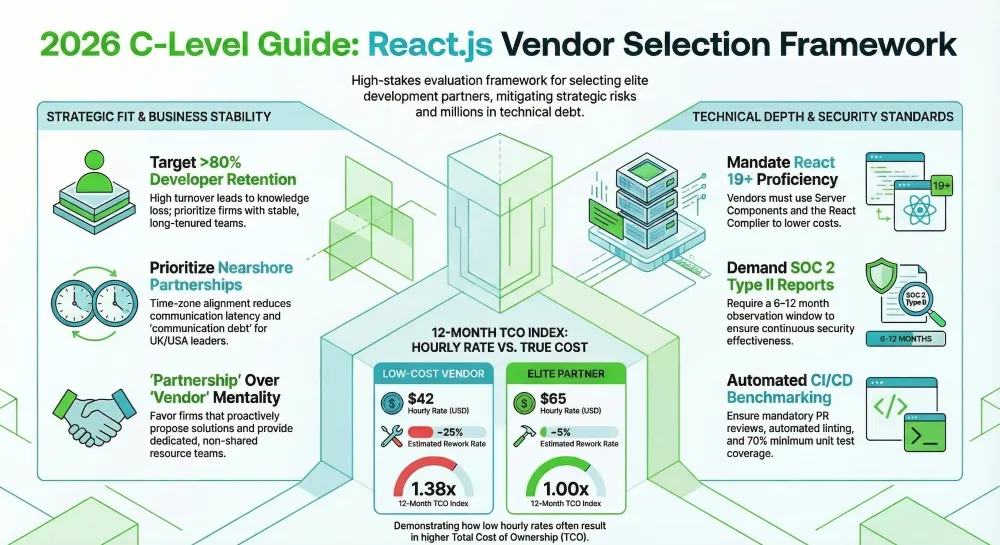
Section 1: Strategic Fit & Business Alignment
The most technically competent React.js development company can still be the wrong partner if it does not align with your business model, communication style, timeline expectations, and growth trajectory. Begin your evaluation here.
1.1 Company Vision & Engagement Model
- Partnership vs. Vendor Mentality — Does the firm proactively propose solutions, or do they simply execute tickets? Look for evidence of thought leadership — blog posts, case studies, open-source contributions.
- Dedicated Team Model Available — Can they provide a dedicated team structure vs. a shared resource pool? Dedicated teams are critical for complex, long-running projects.
- Flexible Engagement Models — Do they offer Time & Material, Fixed Price, and Dedicated Team models? Rigid engagement structures are a red flag for enterprise deals.
- Proven Scale-Up Capability — Can they scale from 3 developers to 15+ within 60 days if product-market fit demands it? Verify with client references.
- Cultural & Time Zone Compatibility — Evaluate overlap hours. A vendor operating 0 overlap hours with your team creates compounding communication debt.
- Clear Escalation Path — Is there a named account executive, project manager, and technical lead accessible to your team at all times?
1.2 Business Longevity & Financial Stability
- Years in Operation — Prefer React.js development companies with 5+ years in the market. Newer firms carry higher delivery risk for enterprise engagements.
- Client Retention Rate — Ask directly: what is your 12-month and 24-month client retention rate? Anything below 70% warrants scrutiny.
- Publicly Available Case Studies — Verify that published case studies are specific, verifiable, and include measurable outcomes — not generic testimonials.
- NDA & IP Protection Clauses — Confirm standard NDA is signed before any technical discussion. IP assignment should default to the client.
- Insurance & Compliance Certifications — E&O insurance, SOC 2, ISO 27001, or GDPR compliance documentation should be available upon request.
Full-Stack Techies is a purpose-built React.js development company that operates on dedicated team and T&M engagement models with a documented 90%+ client retention rate. Their leadership team has 10+ years of experience building enterprise-grade React applications and can provide verifiable references across fintech, healthtech, and e-commerce verticals.
Section 2: Technical Competency & React.js Expertise
Technical depth is non-negotiable. The React.js ecosystem has evolved dramatically — a vendor still building with class components and Redux alone in 2026 is a liability. Use this section to separate junior shops from genuinely expert React.js development services.
2.1 Core React.js Proficiency Assessment
- React 18+ Expertise — Confirm hands-on experience with React 18/19 features: Concurrent Mode, Suspense, Server Components, useTransition, useDeferredValue.
- TypeScript-First Development — In 2026, TypeScript is the standard. Any vendor not writing TypeScript by default introduces long-term maintainability risk.
- State Management Sophistication — Can they articulate trade-offs between Redux Toolkit, Zustand, Jotai, Recoil, and Context API? The vendor should recommend based on your use case, not personal preference.
- React Server Components (RSC) — RSC is production-standard in 2026. Confirm the vendor has shipped RSC-based applications — not just read the docs.
- Custom Hook Architecture — Request examples of complex custom hooks they have built. This reveals architectural maturity better than any interview question.
- Performance Optimization Track Record — Ask for before/after Core Web Vitals data from past projects. LCP improvements, bundle size reductions, and TTI optimizations are concrete proof points.
2.2 Full-Stack & Ecosystem Fluency
- Next.js & Remix Proficiency — Meta-frameworks are now inseparable from React. Confirm production deployments using Next.js 14+ App Router or Remix.
- Testing Culture (Unit, Integration, E2E) — Minimum acceptable: Jest + React Testing Library for unit/integration, Playwright or Cypress for E2E. Ask for coverage % on past projects.
- GraphQL & REST API Integration — Can they build and consume both? Confirm experience with Apollo Client, TanStack Query, SWR, and RTK Query.
- Micro-Frontend Architecture — For enterprise scale, confirm experience with Module Federation, single-spa, or Webpack 5 micro-frontend patterns.
- Accessibility (WCAG 2.2 Compliance) — ADA compliance is a legal requirement in many jurisdictions. Confirm WCAG 2.2 AA as a baseline delivery standard.
- Design System Integration — Experience integrating with Figma, Storybook, MUI, Shadcn/ui, Radix UI. Ask about tokens, theming, and multi-brand support.
2.3 DevOps & CI/CD Integration
- GitHub Actions / GitLab CI Pipelines — Automated test-on-PR pipelines should be a standard deliverable, not an optional add-on.
- Docker & Kubernetes Familiarity — For scalable deployments, confirm containerization experience. Serverless deployment (Vercel, AWS Lambda) is also acceptable for relevant architectures.
- Environment Management — Dev, Staging, Production environments with feature flags (LaunchDarkly, Unleash) should be offered as standard.
When you hire React.js developers through a reputable vendor, you should receive a comprehensive technical onboarding document covering their stack defaults, toolchain choices, and non-negotiable engineering practices before the first sprint begins.
Full-Stack Techies developers are evaluated on React 18+, TypeScript, Next.js App Router, and micro-frontend architecture as part of their internal certification process. Every engagement includes a mandatory Storybook setup, Playwright E2E suite, and CI/CD pipeline configured before Sprint 1 begins.
Section 3: Team Structure & Developer Quality
The quality of the developers who will actually build your product is more important than the quality of the sales team that signs your contract. This section helps you look behind the proposal.
3.1 Hiring & Vetting Standards
- Internal vs. Subcontracted Developers — Ask directly: are all developers on our project full-time employees or subcontractors? Subcontractor-heavy models introduce quality inconsistency.
- Technical Assessment Process — What is their internal hiring bar? The best React.js development services conduct multi-stage technical assessments including live coding, system design, and code review exercises.
- GitHub Portfolio Review — Request GitHub profiles or anonymized code samples from the specific developers assigned to your project.
- Developer Tenure & Retention — Average developer tenure above 2 years indicates a healthy culture. High churn creates institutional knowledge loss during your project.
- Seniority Mix Transparency — Get a named roster with seniority levels. A team heavy on juniors with one senior as lead is a risk pattern for complex projects.
3.2 Team Stability Commitments
- Key Person Replacement SLA — If a lead developer leaves, what is the replacement timeline? A 2-week SLA is acceptable; 6-week is not.
- Knowledge Transfer Protocols — Are ADRs (Architecture Decision Records), Confluence wikis, and video walkthroughs standard? These protect you against attrition.
- Dedicated vs. Shared Allocation — Confirm that developers assigned to your project are not simultaneously allocated to 3 other clients at 25% each.
3.3 Communication & Collaboration
- Daily Async Updates — Loom or written async standups should be a standard offering for distributed teams.
- Slack / Teams Integration — Your vendor’s team should communicate in your tools, not the other way around.
- Sprint Cadence Alignment — 2-week sprints with demo + retrospective are the standard. Confirm alignment before engagement starts.
- PM & Technical Lead Separation — Project manager and technical lead should be different people. Combined roles create accountability blind spots.
Section 4: Process, Methodology & Delivery Standards
Great code written chaotically is still a liability. Evaluate the vendor’s engineering process as rigorously as you evaluate their technical skills.
4.1 Project Kickoff & Discovery
- Structured Discovery Phase — A professional React.js development company provides a paid discovery phase producing: technical architecture document, component library plan, API contract definitions, and sprint 1 backlog.
- Definition of Done (DoD) Agreement — Before any code is written, confirm DoD criteria: code reviewed, tests passing, accessibility checked, design-matched, and deployed to staging.
- Estimation Methodology — T-shirt sizing, story points, or three-point estimation — the method matters less than transparency and historical accuracy. Ask for estimates vs. actuals from past projects.
4.2 Code Quality & Review Standards
- Mandatory PR Reviews — No code merges to main without at least one senior developer review. Confirm this is enforced via branch protection rules.
- Automated Linting & Formatting — ESLint + Prettier configured as pre-commit hooks should be non-negotiable.
- Code Coverage Minimums — Minimum 70% unit test coverage on business logic. Ask for coverage reports from past projects.
- Security Scanning in Pipeline — SAST tools (Snyk, SonarQube, or equivalent) should run on every PR to catch vulnerabilities before they reach production.
4.3 Documentation Standards
- Component Documentation (Storybook) — All shared UI components documented in Storybook with props, variants, and usage examples.
- API Documentation (OpenAPI/Swagger) — Backend API endpoints documented and kept in sync with implementation.
- README & Onboarding Docs — Any developer should be able to clone the repo and run the project locally within 15 minutes using documented instructions.
- Architecture Decision Records (ADRs) — Major architectural decisions recorded with context, options considered, and rationale.
Full-Stack Techies follows a documented Engineering Playbook that covers all of the above — from PR review requirements to Storybook component standards. Clients receive a live link to their project’s Engineering Playbook during the kickoff sprint.
Section 5: Commercial Terms & Pricing Transparency
Pricing conversations are where many vendor relationships begin to fray. This section ensures you structure a commercially fair and transparent engagement.
5.1 Pricing Model Clarity
- Fully Loaded Rate Card — Confirm that quoted rates include all costs: developer salary, benefits, management overhead, tooling licenses, and profit margin. Hidden costs are a red flag.
- Rate Lock Commitment — For engagements longer than 6 months, negotiate a rate lock or cap on annual increases (typically 5–8%).
- Billing Cycle Transparency — Monthly billing with detailed time logs per developer, per task. Weekly billing with lump-sum invoices should be avoided.
- Milestone-Based Billing Option — For fixed-price engagements, ensure billing is tied to accepted deliverables, not calendar time.
- Change Request Process — Any scope change above an agreed-upon hour threshold should require written approval before work begins.
5.2 Contract Protections
- IP Assignment Clause — All code, designs, and intellectual property created during the engagement transfer fully to the client upon final payment.
- Source Code Escrow Option — For long-term engagements, consider source code escrow provisions in case of vendor insolvency.
- Termination for Convenience Clause — You should be able to terminate the engagement with 30-day written notice without penalty, beyond fees for work already delivered.
- Warranty Period — A 30–90 day post-delivery warranty for bug fixes (not new features) should be included in fixed-price contracts at no additional cost.
- Liability & Indemnification — Confirm the vendor carries professional liability insurance and includes indemnification clauses for code defects causing business loss.
5.3 Total Cost of Ownership Analysis
When evaluating the best React.js development services, price per developer-hour is the least useful metric. The real Total Cost of Ownership (TCO) includes:
- Onboarding & ramp time (first 2–4 weeks are rarely full productivity)
- Management overhead your internal team spends coordinating with the vendor
- Rework cost from quality issues or missed requirements
- Technical debt remediation cost post-engagement
- Knowledge transfer and transition cost at engagement end
A vendor quoting $45/hr with chronic rework and weak documentation will cost more over 18 months than a vendor quoting $75/hr with rigorous quality standards. Model TCO across 12–18 months, not hourly rate.
| Criteria | Vendor A | Vendor B |
|---|---|---|
| Hourly Rate (USD) | $42 | $68 |
| Estimated Rework Rate | ~25% | ~8% |
| Onboarding Time | 6 weeks | 3 weeks |
| 12-Month TCO Index | 1.38x | 1.09x |
| IP Protection Included | No | Yes |
| Post-Delivery Warranty | None | 30 days |
Get scalable, fast, and user-friendly ReactJS solutions tailored to your needs.
Get Free ConsultationSection 6: Security, Compliance & Data Governance
In 2026, security and compliance are board-level conversations. Your React.js vendor is an extension of your engineering team — and your attack surface.
6.1 Secure Development Practices
- OWASP Top 10 Awareness — Confirm that developers are trained on and actively mitigate OWASP Top 10 vulnerabilities in React applications (XSS, CSRF, insecure deserialization, etc.).
- Dependency Vulnerability Scanning — Automated scanning of npm dependencies using Snyk, npm audit, or Dependabot on every build.
- Secrets Management — Zero tolerance for secrets in source code. Confirm use of environment variables, vault solutions, or secrets managers.
- Content Security Policy (CSP) Implementation — CSP headers configured and tested as part of every production deployment.
6.2 Compliance Certifications
- SOC 2 Type II Certification — For SaaS and enterprise clients. SOC 2 Type II confirms the vendor has sustained security controls over a 6–12 month audit period.
- GDPR Data Processing Agreement — If any EU personal data touches the vendor’s systems or developers, a signed DPA is legally required.
- HIPAA BAA (for Healthcare) — If your product handles PHI, confirm the vendor will sign a BAA and can demonstrate HIPAA-compliant development practices.
- PCI DSS Awareness (for Fintech) — For payment-handling applications, confirm PCI DSS scope understanding and developer training.
6.3 Access & Data Controls
- Principle of Least Privilege — Developers should only have access to systems, repositories, and data required for their specific tasks.
- VPN & Secure Remote Access — All development work should occur over encrypted connections. Confirm VPN policy for remote developers.
- Offboarding Protocol — When a developer rolls off your project, is their access revoked same-day? Confirm the vendor’s offboarding SLA.
- Background Checks — For sensitive industries (finance, healthcare, government), confirm that all assigned developers have undergone background verification.
Section 7: Post-Launch Support & Long-Term Partnership
The relationship with your React.js development company does not end at launch. In fact, the post-launch phase is where the true quality of the partnership reveals itself.
7.1 Maintenance & Support SLAs
- Tiered SLA Offering — P1 (production down) response within 1 hour, P2 (major degradation) within 4 hours, P3 (minor issues) within 24 hours. These should be contractual.
- On-Call Coverage — For 24/7 applications, confirm whether on-call coverage is available and at what additional cost.
- Monitoring & Alerting Setup — Confirm the vendor will configure Datadog, New Relic, Sentry, or equivalent monitoring before go-live — not after the first incident.
- Performance Review Cadence — Monthly performance reviews against defined KPIs (uptime, error rate, Core Web Vitals, deployment frequency) should be contractual.
7.2 Knowledge Transfer & Transition
- Handover Documentation Package — At engagement end, you should receive: codebase tour video, architecture overview, runbooks, deployment guides, and environment access inventory.
- Parallel Running Period — For critical applications, negotiate a parallel running period where both vendor and your internal team operate the system simultaneously.
- Training for Internal Team — If you are building internal capability to hire React.js developers and take the product in-house, the vendor should offer formal training sessions.
7.3 Continuous Improvement Partnership
- Quarterly Technology Reviews — A strong vendor proactively recommends upgrades (React version, dependency updates, infrastructure modernization) before they become emergencies.
- Roadmap Input — Your vendor’s senior architects should contribute to your product roadmap discussions — not just execute against it.
- Innovation Budget Discussion — Ask if they offer any R&D or innovation sprint time for exploring new approaches to your product’s challenges.
Section 8: Reputation, References & Due Diligence
This final section is your verification layer. Everything the vendor has said in proposals and meetings gets tested here.
8.1 Reference Checks (Non-Negotiable)
- 3+ Client References in Your Industry — Industry-specific references matter. A vendor with 10 fintech references is more credible for a fintech project than one with 10 e-commerce references.
- Reference Call Script — Do not accept written testimonials alone. Conduct 30-minute calls using a structured reference script covering: communication, quality, timeline adherence, and whether they would re-hire.
- Blind Reference Check — Ask your network if anyone has worked with this vendor unprompted. Vendor-provided references are inherently biased toward their best relationships.
8.2 Online Reputation Signals
- Clutch.co / G2 Reviews — 10+ detailed reviews with consistent 4.5+ ratings. Be skeptical of vendors with fewer than 5 reviews or suspiciously uniform 5-star ratings.
- LinkedIn Company Presence — Active LinkedIn presence with real employee profiles, thought leadership content, and genuine engagement. Ghost profiles are a red flag.
- Open Source Contributions — GitHub organization with active OSS contributions, React libraries, or developer tools signals genuine engineering culture.
- Conference & Community Participation — Speakers at React Conf, JSConf, or contributors to React RFC discussions indicate senior technical depth.
8.3 Technical Due Diligence
- Code Audit of Past Project (with Permission) — For large engagements, request permission to have your internal or third-party architect audit a sample of code from a past project.
- Paid Pilot Project — Before committing to a 12-month engagement, run a 4–6 week paid pilot. This is the single most reliable vendor evaluation method available.
- Technical Interview of Assigned Team — Your CTO or lead architect should interview the specific developers assigned to your project — not the vendor’s sales engineers.
Full-Stack Techies actively encourages paid pilot projects as the first phase of every new engagement. They maintain a public Clutch.co profile with 50+ verified reviews, and their engineering team contributes to several open-source React utility libraries available on GitHub.
The Future of React.js Development
Looking toward the end of 2026 and into 2027, the React landscape is shifting. Here are the trends you should discuss with your potential React.js development company:
- React Server Components (RSC): This will become the default way to build apps, significantly reducing the amount of JavaScript sent to the browser.
- AI-Driven Development: Vendors will increasingly use AI to write boilerplate code, allowing their developers to focus on high-level architecture and complex logic.
- Enhanced Cross-Platform Reach: With React Native and React Native for Web, a single vendor can help you dominate both web and mobile app stores with one codebase.
- Edge Computing: More React apps will be deployed “at the edge” (closer to the user) using platforms like Vercel or Cloudflare, making apps feel instant globally.
For businesses in the UK and Europe, staying ahead of these trends is essential to compete with tech giants. Choosing a forward-thinking partner like Full-stack Techies ensures you aren’t building on “legacy” tech from day one.
Why C-Level Leaders Choose Full-Stack Techies for React.js Development
In a market crowded with vendors making identical promises, Full-Stack Techies has built a reputation for engineering excellence, transparent communication, and measurable client outcomes. When you hire React.js developers through Full-Stack Techies, you are not buying a commodity service — you are gaining a strategic technical partner that treats your product goals as their own.
What Differentiates Full-Stack Techies as a React.js Development Company
React 18+ Certified Engineers. Every React developer at Full-Stack Techies is internally certified on React 18/19, TypeScript, Next.js App Router, and micro-frontend architecture before being assigned to client projects. There is no learning curve on your budget.
Engineering Playbook Transparency. Clients receive full access to Full-Stack Techies’ Engineering Playbook — covering code review standards, testing requirements, CI/CD pipeline configuration, and documentation expectations. No guesswork, no surprises.
No Subcontractor Model. All developers are full-time employees with competitive compensation, resulting in developer tenure averaging 3.2 years — significantly above the industry average. This directly translates to institutional knowledge stability on your project.
Pilot-First Philosophy. Every new client engagement begins with a 4–6 week paid pilot, allowing both parties to validate fit before committing to a long-term partnership. This is the vendor selection method this checklist recommends — and Full-Stack Techies actively encourages it.
Dedicated Client Success Manager. In addition to the technical team, every client is assigned a dedicated Client Success Manager responsible for business relationship health — separate from the project manager.
Proactive Roadmap Contribution. Full-Stack Techies senior architects participate in quarterly roadmap sessions as standard practice, not an upsell. They bring React ecosystem intelligence to your product strategy discussions.
Industry-Specific Experience. Proven delivery track record in fintech, healthtech, edtech, SaaS, and enterprise e-commerce — with verifiable client references in each vertical.
Full-Stack Techies represents the standard this React.js Vendor Selection Checklist was designed to identify: a React.js development company that combines technical excellence, process rigor, commercial transparency, and genuine long-term partnership orientation.
Also Read: React.js Developer Onboarding Checklist for Fast Ramp-Up 2026
Conclusion: Your React.js Vendor Decision Framework for 2026
Selecting the right React.js development partner in 2026 is a C-level decision with C-level consequences. The best React.js development services are not necessarily the cheapest, the largest, or the most aggressively marketed — they are the ones that demonstrate consistent engineering excellence, transparent communication, commercial fairness, and a track record of delivering measurable business outcomes for clients who look like you.
This React.js Vendor Selection Checklist gives your organization a structured, repeatable framework to make that decision with confidence. Use it to score every vendor you evaluate, weight the sections that matter most to your specific context, and never skip the due diligence phase, regardless of how compelling the sales conversation feels.
When you are ready to hire React.js developers who can deliver from day one without the typical ramp-up friction, Full-Stack Techies is ready to begin with a transparent discovery conversation and a clearly scoped pilot proposal.
Ready to apply this checklist to a real vendor evaluation? Contact Full-Stack Techies for a no-obligation technical consultation. Their senior architects will walk through your project requirements, propose an engagement structure, and provide a pilot project scope within 5 business days.
Frequently Asked Questions (FAQs)
Q1. Why should I choose React.js over other frameworks like Angular or Vue?
A: React has the largest ecosystem, the best talent pool, and the strongest support from Meta (Facebook). In 2026, its flexibility with AI and server-side rendering makes it the safest choice for enterprise-level scaling.
Q2. How do I verify the expertise of a React.js developer?
A: Look for their contributions to open-source projects, their understanding of modern hooks, and their ability to explain complex state management. A technical interview involving a real-world problem is better than a simple Q&A.
Q3. Can a React.js vendor help with mobile app development too?
A: Yes. Most top vendors use React Native, which allows them to use much of the same logic from your web app to build high-performance mobile apps for iOS and Android.
Q4. What is the typical timeline for a React.js project?
A: A Minimum Viable Product (MVP) usually takes 3 to 5 months. Larger enterprise migrations can take 6 to 12 months, depending on the complexity and the number of integrations required.
Q5. How does GDPR affect my choice of a React.js vendor?
A: If you have users in the EU, your vendor must follow strict data handling rules. They must be able to implement features like data encryption, u201cthe right to be forgotten,u201d and secure user authentication by default.
Q6. Should I hire an offshore or nearshore React.js development company?
A: Nearshore is usually better for C-level executives in the USA or UK because it offers better time-zone alignment and cultural similarity, which reduces communication errors and speeds up development.
Q7. What are React Server Components, and why do they matter for my business?
A: They allow parts of your website to be generated on the server. This makes your site load faster, improves your SEO rankings on Google, and provides a better experience for users on slow mobile connections.
Q8. How do I ensure my intellectual property is protected?
A: Your contract should include clear u201cWork for Hireu201d clauses, Non-Disclosure Agreements (NDAs), and a transfer of ownership upon payment. Ensure the vendor has a clean track record regarding IP legalities.
Q9. How often should I communicate with the vendor?
A: Daily or bi-weekly u201cstand-upu201d meetings are best. You should also have a monthly executive-level review to ensure the project is still aligned with your broader business goals.
Q10. Can Full-stack Techies help with existing React projects?
A: Yes, Full-stack Techies specializes in both greenfield projects and taking over/optimizing existing React codebases that need scaling or modernization.



