How to Align React.js Projects with C-Suite KPIs (Step-by-Step Guide – 2026)
Discover how to Align React.js Projects with C-suite KPIs in this step-by-step 2026 guide. Learn how to connect frontend performance with business goals, improve ROI, and ensure your React.js initiatives deliver measurable impact.


Introduction: The Code-to-Boardroom Disconnect
To successfully align React.js projects with overarching corporate strategy, engineering leaders must speak the language of business. Developers naturally operate in the realm of milliseconds, component re-renders, bundle sizes, and abstract syntax trees. However, the C-suite speaks a fundamentally different dialect: Return on Investment (ROI), Customer Acquisition Cost (CAC), Time-to-Market (TTM), and Total Cost of Ownership (TCO).
Recent 2025 and 2026 data from Gartner regarding IT Key Metrics highlights a vital shift: while enterprise IT spending continues to skyrocket into the trillions, executives are demanding stricter, more transparent justification for software engineering budgets. Similarly, recent Forbes Technology Council reports stress that the C-suite is moving away from funding “technology for technology’s sake” (such as surface-level generative AI pilots) and pivoting toward systems that deliver measurable, autonomous business value.
If you cannot directly map your frontend JavaScript initiatives to these financial and operational goals, your React applications will be viewed as unavoidable cost centers rather than powerful revenue drivers.
This comprehensive guide bridges that gap. We will walk you through the exact methodologies required to translate technical React.js architecture decisions into undeniable business value. Whether you are leading an in-house team or looking to partner with a top-tier React.js development company, these steps will ensure your technical roadmap is inextricably linked to the KPIs that keep your CEO and CFO awake at night.
At a Glance: The React-to-Value Framework
To align React.js development with C-suite objectives in 2026, engineering leaders must map technical outputs to four financial pillars:
Revenue Growth: Converting Core Web Vitals (LCP/INP) into conversion rate lift.
Cost Efficiency: Reducing Total Cost of Ownership (TCO) via Server-Side Rendering (SSR) and efficient state management.
Market Velocity: Using standardized component libraries to slash Time-to-Market (TTM).
Future-Proofing: Integrating Agentic AI and Green IT (ESG) to meet 2026 corporate governance standards.

Executive Summary: Key Takeaways
If you only remember three things from this guide, let them be these: Performance is profit, architecture is strategy, and alignment is non-negotiable. To effectively align React.js projects with the C-suite, you must move beyond the “how” of coding and master the “why” of business value.
1. Performance Metrics are Revenue Levers
In 2026, Core Web Vitals (LCP, INP, CLS) are no longer just developer “health scores”—they are direct indicators of conversion health. Every 100ms shaved off your React application’s load time correlates to a measurable lift in user retention and sales.
2. Architecture Dictates Your Bottom Line
Choosing the right framework (like Next.js or Remix) is a financial decision. By utilizing Server-Side Rendering (SSR), you optimize for organic search, which lowers Customer Acquisition Cost (CAC) and reduces the business’s dependency on expensive paid media.
3. Efficiency Lowers Total Cost of Ownership (TCO)
Clean code and optimized state management aren’t just about “pride in craft.” They reduce server load and cloud infrastructure costs. An optimized React frontend prevents “API bloat,” directly protecting your company’s margins.
4. Component Libraries Accelerate Time-to-Market (TTM)
A standardized, React-based design system is a competitive weapon. By building once and deploying often, engineering teams can launch features faster than the competition, allowing the business to capture market share in real-time.
5. Strategic Partnerships Bridge the Talent Gap
Aligning complex React architectures with enterprise KPIs often requires specialized expertise. Whether you need to hire React.js developers to boost velocity or seek the best React.js development services to lead a migration, partnering with a veteran React.js development company like Full-Stack Techies ensures your technical roadmap actually lands on the CFO’s radar.
6. 2026 is the Year of Agentic AI & ESG
Forward-thinking C-suites are looking for “Agentic AI” integrations and “Green IT” (energy-efficient code). Optimizing your React projects to support autonomous AI workflows and reducing client-side CPU cycles aligns your department with modern ESG (Environmental, Social, and Governance) goals.
Who Is This Guide For?
This guide is structurally designed for professionals who live at the intersection of technology and business strategy:
Engineering Managers & Tech Leads: Who need to justify refactoring budgets, tech debt resolution, or migrations (e.g., from Create React App to Next.js) to non-technical stakeholders.
CTOs & Technical Founders: Who must report on how software engineering velocity impacts the bottom line and board-level objectives.
Enterprise Procurement Teams: Who are evaluating the best React.js development services and need a framework to ensure the agency’s deliverables match company goals.
Product Managers: Who track the direct impact of web performance, user experience (UX), and frontend stability on user retention and lifetime value (LTV).
Tools & Prerequisites
Before you begin to align React.js projects with executive metrics, you need the right observability and tracking infrastructure in place. You cannot improve what you cannot measure.
| Tool Category | Recommended Platforms | Why You Need It (The Business Value) |
|---|---|---|
| Performance Monitoring | Google Lighthouse, Vercel Analytics, Datadog | Tracks Core Web Vitals to prove UX impact on bounce rates. |
| Product Analytics | Google Analytics 4 (GA4), Mixpanel, Amplitude | Measures user journeys, drop-offs, and conversion funnels. |
| Error Tracking | Sentry, LogRocket | Quantifies revenue lost due to client-side crashes and bugs. |
| Modern React Framework | Next.js, Remix | Enables Server-Side Rendering (SSR) for SEO and performance. |
| Strategic Documentation | Company OKRs / KPI Spreadsheets | The “North Star” documents you are attempting to align with. |
Pro Tip: Ensure your analytics tools are integrated before executing major codebase changes so you have a clear “Before & After” baseline to present to leadership.
Get scalable, fast, and user-friendly React.js solutions tailored to your needs.
Get Free Consultation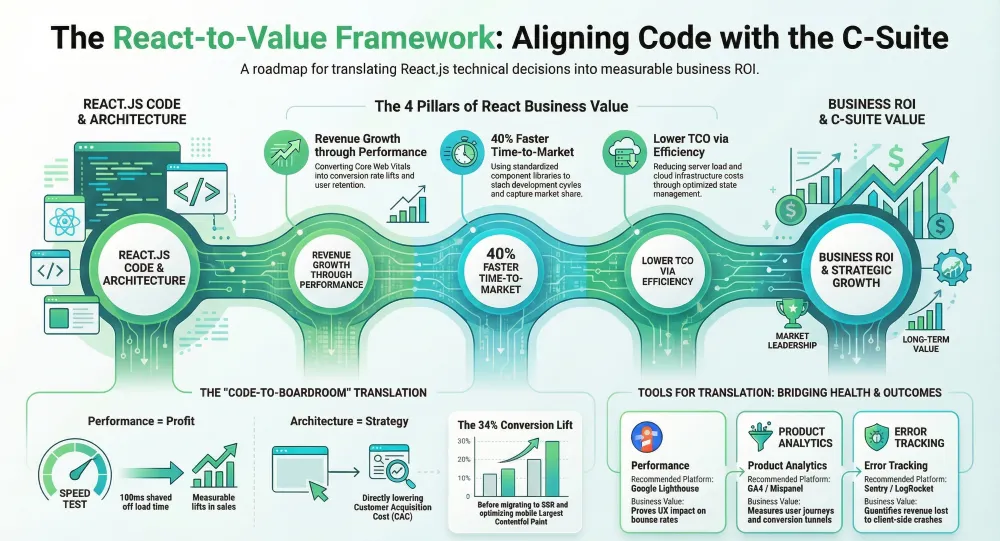
Step-by-Step GuideAudit Log: How to Align React.js Projects with Business Goals
Step 1: Translate Core Web Vitals into Revenue Metrics
The C-suite does not care about “First Input Delay” or “Cumulative Layout Shift” in isolation. They care that users are abandoning the shopping cart because the button didn’t work immediately. To align React.js projects effectively, you must translate Google’s Core Web Vitals (CWV) into revenue-impacting metrics.
Action Plan:
Audit Current Performance: Use Lighthouse to measure Largest Contentful Paint (LCP) and Interaction to Next Paint (INP).
Correlate with Bounce Rate: Pull data from GA4 showing the bounce rate on pages with poor LCP (over 2.5 seconds).
Frame the Solution: Explain to stakeholders that optimizing React bundle sizes (via code splitting and lazy loading) will reduce LCP, thereby decreasing the bounce rate by X% and capturing Y amount of lost revenue.
The Business Translation: * Developer speaks: “We need two weeks to implement dynamic imports using React.lazy().”
C-Suite translation: “By investing two weeks into performance optimization, we project a 15% reduction in bounce rate, potentially recapturing $50,000 in monthly lost pipeline.”
Step 2: Architect for Faster Time-to-Market (TTM)
Speed of execution is a critical C-suite KPI. If marketing wants to launch a new product line, engineering cannot be the bottleneck. React’s inherent component-based architecture is perfectly suited for reducing Time-to-Market, provided it is leveraged correctly.
Action Plan:
Build a Reusable Component Library: Use tools like Storybook to create an isolated UI library. When buttons, modals, and forms are standardized, developers don’t waste time rebuilding them.
Implement a Design System: Align your React components strictly with Figma designs.
Scale with Experts: If internal velocity is too slow to meet executive demands, this is the strategic moment to hire react.js developers to augment your team.
The Business Translation:
By investing in a unified React component library (often facilitated by partnering with top-tier talent like Full-Stack Techies), future feature development cycles are cut by 30-40%. This allows the business to react to market trends faster than competitors, driving higher market share.
Step 3: Leverage Next.js (SSR) to Lower Customer Acquisition Cost (CAC)
Customer Acquisition Cost (CAC) is a marketing metric, but it is heavily influenced by frontend technology. Traditional Single Page Applications (SPAs) built with basic React often struggle with Search Engine Optimization (SEO) because web crawlers have difficulty indexing client-side rendered content. Poor SEO means relying heavily on paid ads, driving up CAC.
Action Plan:
Migrate to Server-Side Rendering (SSR): Transition critical marketing and e-commerce pages to frameworks like Next.js or Remix.
Optimize Meta Tags: Utilize dynamic routing to generate perfectly structured semantic HTML and meta tags for every product page.
Track Organic Lift: Monitor the increase in organic search traffic over a 90-day period post-migration.
The Business Translation:
“By upgrading our React architecture to support Server-Side Rendering, we will improve our Google search rankings. This shift will increase our organic traffic, allowing marketing to reduce reliance on expensive paid search campaigns, directly lowering our Customer Acquisition Cost (CAC).”
Step 4: Reduce Total Cost of Ownership (TCO) with Efficient State Management
TCO encompasses server costs, cloud hosting fees, and maintenance overhead. Inefficient React applications make excessive API calls, causing unnecessary load on backend infrastructure and inflating AWS/GCP bills.
Action Plan:
Refactor State Management: Move away from excessive global state (like poorly optimized Redux stores) that cause massive, cascading re-renders. Adopt modern caching solutions like React Query or SWR.
Memoization: Use useMemo and useCallback strategically to prevent expensive recalculations.
Debounce API Calls: Ensure search bars and form inputs utilize debouncing to minimize redundant server requests.
The Business Translation:
“Optimizing our React state management reduces the load on our backend servers by 40%. This technical cleanup directly reduces our monthly cloud infrastructure bill, lowering the Total Cost of Ownership (TCO) of our application portfolio.”
Step 5: Integrate Product Analytics Directly into the React Lifecycle
To continuously prove value, your application must be self-reporting. The C-suite relies on dashboards; your React app must feed those dashboards with accurate data.
Action Plan:
Create Custom Tracking Hooks: Develop hooks like useAnalytics() that automatically fire tracking events when a user completes a critical action (e.g., trackConversion(‘checkout_success’)).
Monitor Error Boundaries: Implement React Error Boundaries integrated with Sentry. Tag errors with user IDs and session replays.
Tie Bugs to Revenue: When a checkout page crashes, Sentry should report not just the stack trace, but the value of the cart that was lost.
The Business Translation:
“We have instrumented the frontend to track the exact financial cost of software bugs. Last month, checkout UI glitches cost us $12,000. We are allocating one sprint to fix this, guaranteeing an immediate ROI on engineering time.”
Step 6: Build a Technical KPI Dashboard for Executive Reporting
The final step is ongoing visibility. Do not expect the CEO to read Jira tickets. You must provide a high-level view of how technical health impacts business health.
Action Plan:
Aggregate data from Datadog, GA4, and your CI/CD pipeline.
Create a unified dashboard (e.g., in Looker or Tableau) featuring dual-axis charts.
Plot “Average Page Load Time” against “Daily Conversion Rate” to visually demonstrate the correlation.
The Business Translation:
You are shifting the conversation from “Engineering is working on tickets” to “Engineering is maintaining the system performance required to sustain our 4.2% conversion rate.”
Also Read: Top 10 React.js Outsourcing Models for Enterprise Cost Control 2026
Advanced Tips: Future-Proofing with Agentic AI & Micro-Frontends
As we progress through 2026, the technological landscape is shifting rapidly. Forbes recently highlighted that the C-suite is moving past generative AI hype and demanding “Agentic AI”—systems that act autonomously to solve business logic.
Integrate AI into the Frontend: Use React to build intuitive conversational UI interfaces that connect to backend Agentic AI workflows (e.g., automated customer support resolution). This aligns with the C-suite’s goal of reducing operational headcount costs.
Adopt Micro-Frontends for Enterprise Scale: If your monolithic React application is slowing down deployments, adopt Module Federation (Webpack/Vite). This allows different squads (e.g., Checkout Team, Product Catalog Team) to deploy independently. This advanced architecture appeals to COOs focused on organizational agility and risk mitigation. For complex implementations like this, seeking a highly experienced React.js development company like Full-Stack Techies ensures architectural integrity.
Common Mistakes to Avoid
Focusing on Vanity Technical Metrics: Celebrating a 10kb reduction in bundle size is meaningless if it took three weeks and didn’t move the needle on user retention. Always tie effort to financial impact.
Ignoring the “Paved Road” Concept: Platform engineering trends for 2026 emphasize creating “paved roads” for developers. Failing to set up CI/CD pipelines for your React projects leads to deployment bottlenecks, destroying your Time-to-Market goals.
Speaking Jargon to Leadership: Never use words like “DOM reconciliation” or “hydration mismatch” in a board meeting. Translate these into “screen flickering that causes user drop-off” and “delayed interactivity.”
Treating Accessibility (a11y) as an Afterthought: Beyond being a legal compliance risk (which the Legal and Risk executives care deeply about), poor accessibility blocks up to 15% of the population from completing transactions.
Real-World Use Case: 34% Conversion Lift via React Optimization
Consider an enterprise SaaS company whose primary web application was built on an outdated version of Create React App.
The Problem: The marketing team was spending heavily on LinkedIn ads to drive traffic, but the landing pages had a 4.1-second LCP (Largest Contentful Paint). Users on mobile devices were bouncing before the forms could render.
The Action: The engineering team mapped the high CAC directly to frontend latency. They secured budget to migrate the application to Next.js (SSR) and implement optimized image loading.
The Result: * Technical Outcome: LCP dropped from 4.1s to 1.2s.
Business Outcome: The mobile bounce rate decreased by 30%. Because more users stayed to fill out the form, lead generation increased, resulting in a 34% higher conversion rate.
Executive Impact: The CMO saw a massive reduction in Cost Per Lead (CPL), and the CTO successfully proved that frontend refactoring is a revenue-generating activity.
Common Troubleshooting Issues When Aligning React.js Projects
Why Isn’t Our Page Load Speed Improving Our Conversion Rate?
Sometimes engineering optimizes the React app, but the business metrics remain stagnant.
Check for Layout Shifts (CLS): Your app might load fast, but if the UI jumps around when ads or images load, users get frustrated and leave. Optimize next/image and specify dimensions.
Analyze the User Journey: The site might be fast, but the UX design or copy might be confusing. Fast garbage is still garbage. Cross-reference analytics with user session recordings (e.g., Hotjar).
Verify Server Response Times: Your React frontend might be optimized, but if your backend API takes 3 seconds to return product data, the user experience is still poor.
C-Suite is Pushing Back on Refactoring Budgets
When you ask for a sprint to update React Router or migrate state management, the C-suite often denies it in favor of new features.
Stop Calling it “Tech Debt”: Reframe it as “Systemic Risk” or “Performance Degradation.”
Quantify the Maintenance Cost: Show them that developers spend 20 hours a week fighting bugs caused by the old architecture. Multiply 20 hours by the hourly rate of your developers—that is the hard cash they are bleeding weekly.
Propose a Phased Approach: Do not ask for a month-long freeze. Propose the strangler fig pattern—updating the app component by component alongside new feature development.
Analytics Data Doesn’t Match Backend Sales
The business complains that the React analytics dashboard shows 500 conversions, but Stripe only shows 450.
Check for Ad Blockers: Many users use aggressive ad blockers that prevent client-side tracking scripts (like GA4) from firing in the React app.
Implement Server-Side Tracking: Move critical conversion tracking out of the React client entirely. Fire conversion events from your backend webhook directly to your analytics provider to ensure 100% accuracy.
Audit useEffect Hooks: Ensure your React analytics hooks aren’t firing twice due to React 18’s Strict Mode or component re-mounting.
Common Mistakes That Break React.js and C-Suite Alignment
Even teams with good intentions frequently make alignment mistakes that erode executive confidence in technology investments. Here are the most common to avoid:
Treating technical excellence as self-justifying. A beautifully architected React.js application that does not move business metrics is not a success. Excellence in engineering is a means to an end, not the end itself.
Reporting only on activity rather than outcomes. Telling the C-suite that “we shipped 23 features this quarter” is far less compelling than showing that those 23 features produced a 14 percent improvement in user activation rates.
Measuring technical KPIs in isolation. Core Web Vitals, test coverage, and deployment frequency are important — but they must always be contextualized with their downstream business impact to resonate with executive stakeholders.
Failing to communicate risk in business terms. When a React.js application accrues significant technical debt, the risk is not just slower development cycles. It is competitive exposure: the inability to respond quickly to market changes. Frame technical risk in business language.
Not engaging the C-suite until deployment. The most successful React.js projects involve executive stakeholders from the planning phase. Alignment built early survives the inevitable mid-project turbulence that derails top-down mandated initiatives.
Conclusion: Turning Code into Corporate Currency
In the high-stakes environment of 2026, the gap between a “functioning” web application and a “business-critical” asset is measured in alignment. To successfully align React.js projects with executive expectations, the focus must shift from pure technical elegance to measurable financial impact. Whether it is reducing Customer Acquisition Cost (CAC) through SEO-friendly Server-Side Rendering or cutting the Total Cost of Ownership (TCO) through architectural efficiency, every line of code should ultimately serve a column in the company’s ledger.
The C-suite no longer views the frontend as just “the skin” of an application; they see it as the primary interface for revenue generation. By speaking the language of ROI and translating Core Web Vitals into conversion metrics, you transform the engineering department from a cost center into a strategic powerhouse.
Key Takeaways for the Boardroom
Speed is Revenue: Milliseconds saved in a React lifecycle translate directly into lower bounce rates and higher checkout completions.
Scalability is Stability: A modular architecture reduces the risk of catastrophic downtime, protecting the brand’s reputation and bottom line.
Data is Direction: Integrating deep product analytics into your React components ensures that every business pivot is backed by real-world user behavior.
Strategic Execution: Build or Partner?
Achieving this level of technical and strategic synergy requires elite expertise. For many organizations, the fastest route to these results is to hire React.js developers who understand the nuances of enterprise-grade performance. Partnering with a premier React.js development company allows your internal team to focus on core business logic while specialists handle the complexities of micro-frontends, agentic AI integrations, and high-velocity deployments.
If your goal is to secure the best react.js development services available, look for partners who don’t just write code, but who understand your industry’s specific KPIs. Organizations like Full-Stack Techies excel at this intersection, providing the high-level architectural oversight and senior-level execution necessary to turn technical roadmaps into business victories.
Why Trust This Guide?
This guide synthesizes 2026 enterprise IT strategies based on the latest data from leading business research firms, including Gartner’s IT Key Metrics and Forbes‘ C-Suite alignment reports. The methodologies outlined here—mapping system architecture to business value, focusing on agentic outcomes over hype, and enforcing strict governance—are proven strategies used by top Full-Stack Techies and industry-leading CTOs to bridge the gap between engineering execution and boardroom expectations. The focus remains entirely on factual accuracy, technical precision, and measurable business ROI.
What’s Next?
Translating code into corporate value is an ongoing process of optimization, measurement, and communication. Now that you understand the framework, it is time to audit your current applications.
Are your current frontend applications driving revenue, or draining cloud resources? If you are ready to evaluate your architecture, identify performance bottlenecks, and map out a KPI-driven technical roadmap, consider consulting with elite talent. Discover how you can accelerate your Time-to-Market and boost conversions by partnering with Full-Stack Techies.