

MLOps vs DevOps: Which Pipeline Strategy Fits Your Machine Learning Team?
Understand MLOps vs DevOps and choose the right pipeline strategy for your machine learning team. This guide explains key differences, benefits, and real-world use cases to help you optimize model deployment, automation, and scalability in 2026.


Introduction
If you’re running a machine learning team in 2026, you’ve almost certainly wrestled with one persistent question: should we lean into DevOps, embrace MLOps, or somehow blend both? The debate around MLOps vs DevOps isn’t new, but it has never been more consequential. As enterprises race to operationalize AI, the choice of pipeline strategy can mean the difference between models that actually deliver value and models that quietly die in staging environments.
This article breaks down both disciplines — their philosophies, toolchains, workflows, and real-world trade-offs — so your team can make a genuinely informed decision. We’ll also look at how forward-thinking partners like Full-Stack Techies are helping organizations bridge the gap between traditional software delivery and AI-native operations.
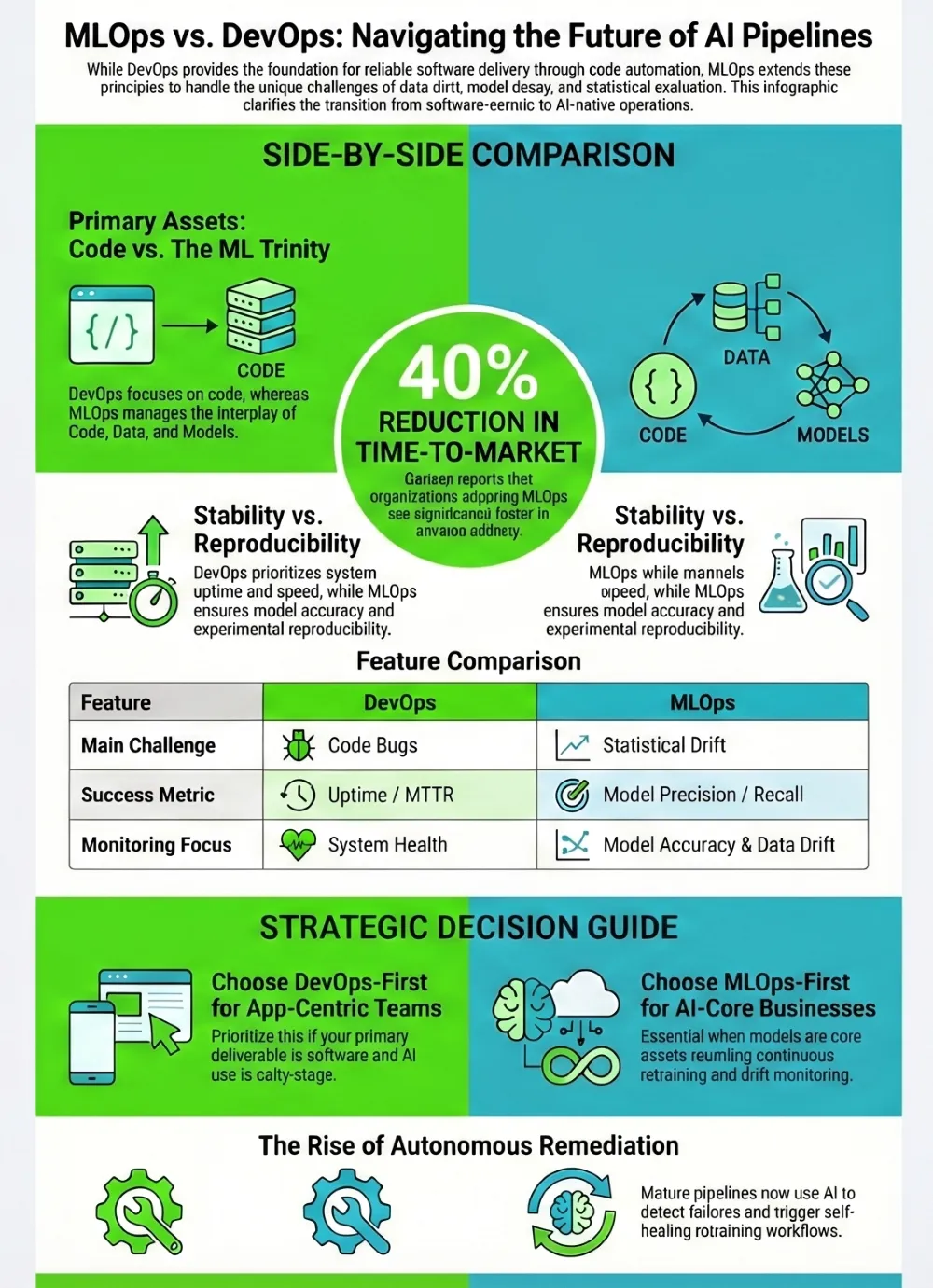
At a Glance: MLOps vs. DevOps
| Feature | DevOps | MLOps |
|---|---|---|
| Primary Asset | Code | Code + Data + Models |
| Goal | Stability & Speed | Reproducibility & Accuracy |
| Main Challenge | Code Bugs | Statistical Drift |
| Success Metric | Uptime / MTTR | Model Precision / Recall |
Also Read: How to Choose the Right DevOps Solutions Company for Your Enterprise (2026 Guide)
Key Takeaways
1. MLOps vs DevOps Is Not a Competition — It’s a Progression. DevOps lays the foundation. MLOps builds on it. Teams don’t choose one over the other — they evolve from DevOps fundamentals into MLOps maturity as their machine learning workloads grow in complexity and scale.
2. Standard DevOps Pipelines Were Not Built for Model Lifecycle Management. Traditional DevOps handles code reliably but cannot manage data drift, model decay, experiment tracking, or statistical evaluation. Once ML models become core business assets, DevOps alone creates dangerous blind spots.
3. MLOps Reduces Time-to-Market for AI by Up to 40%. According to Gartner, organizations that adopt MLOps practices see up to a 40% reduction in time-to-market for AI solutions — directly translating into competitive advantage and faster ROI on machine learning investments.
4. AI-Driven CI/CD Is Transforming Both Disciplines. AI-assisted CI/CD is no longer a future concept. Intelligent pipelines now deliver predictive monitoring, automated risk scoring, and autonomous remediation — making deployments faster, safer, and significantly less dependent on manual oversight.
5. Predictive Monitoring Is the New Standard for Production AI. Monitoring uptime and latency is no longer enough. Predictive monitoring — tracking feature drift, label shift, and model confidence in real time — is what separates teams that catch model degradation early from those that discover it after it has already damaged business outcomes.
6. Autonomous Remediation Closes the Loop on Self-Healing Systems. The most mature MLOps and DevOps implementations combine monitoring automation with autonomous remediation — systems that detect, diagnose, and fix failures automatically, reducing Mean Time to Recovery and freeing engineering teams for higher-value work.
7. DevOps as a Service Lowers the Barrier to Enterprise-Grade Pipelines. Not every team needs to build pipeline infrastructure from scratch. DevOps as a Service gives organizations access to production-ready CI/CD, environment management, and monitoring automation without the overhead of maintaining a dedicated internal platform engineering team.
8. Regulatory Pressure Is Making MLOps Non-Negotiable. Frameworks like the EU AI Act are creating compliance requirements — audit trails, drift monitoring, explainability documentation — that effectively mandate MLOps practices for enterprises operating in regulated industries like finance and healthcare.
9. The MLOps Engineer Is One of the Fastest-Growing Roles in Tech. LinkedIn data shows MLOps engineering roles have grown 9.8x over five years. Organizations that invest in MLOps infrastructure today are building a talent magnet — attracting engineers who want to work on meaningful, well-instrumented AI systems.
10. The Right Implementation Partner Accelerates Everything. Whether you’re starting with DevOps foundations or scaling a full MLOps platform, having a partner with end-to-end expertise matters. Full-Stack Techies helps teams move from fragmented tooling to unified, observable, and self-improving delivery pipelines — across software and AI workloads alike.
The Core Difference: Why “DevOps for ML” Isn’t Enough
At its simplest, DevOps is the practice of unifying software development and IT operations through culture, automation, and continuous delivery. It brought us CI/CD pipelines, infrastructure as code, and the idea that code should move from commit to production in hours, not months.
MLOps inherits all of those principles — but adds a second dimension that DevOps was never designed to handle: the data. Machine learning systems don’t just depend on code. They depend on data quality, feature distributions, model weights, experiment configurations, and statistical drift. A model that was accurate in January may be subtly wrong by March — not because anyone touched the code, but because the world changed.
As Wikipedia’s definition of MLOps puts it, the discipline “aims to facilitate the creation of machine learning products by leveraging principles of CI/CD automation, workflow orchestration, reproducibility, versioning of data, model, and code; collaboration; continuous ML training and evaluation; ML metadata tracking and logging; continuous monitoring; and feedback loops.”
That’s a significantly broader surface area than what DevOps was built to cover.
Industry Signals: Why This Debate Is Urgent Right Now
The stakes couldn’t be clearer. Reports show that up to 88% of corporate machine learning initiatives are struggling to move beyond test stages — a staggering waste of investment. Yet organizations that do successfully put machine learning into production have seen profit margin increases of 3–15%, according to McKinsey & Company.
From the analyst community, the signals are equally unambiguous. According to Gartner, 70% of enterprises will operationalize AI architectures using MLOps, with sectors like finance, healthcare, and e-commerce leading the adoption to deploy AI-powered features consistently and at scale. Gartner also notes that organizations adopting MLOps see a 40% reduction in time-to-market for AI solutions — a number that dwarfs most conventional DevOps optimization gains.
The market is responding. The MLOps market size was valued at USD 2,191.8 million in 2024 and is projected to reach USD 16,613.4 million by 2030. LinkedIn data shows that MLOps engineer roles have grown 9.8x over five years, with compensation for ML/MLOps roles jumping roughly 20% year-over-year.
Meanwhile, DevOps itself is undergoing a parallel transformation. Gartner predicts that by 2026, 80% of software development companies will move to internal development platforms (IDPs) — and the discipline is rapidly absorbing AI capabilities at every layer.
What DevOps Does Well (And Where It Hits Its Limits With ML)
DevOps excels at repeatability. Given a stable codebase, it can reliably automate build, test, and deploy cycles. Modern DevOps pipelines — powered by AI-driven CI/CD tooling — are now smarter than ever. As research from DevOps.com summarizes, CI/CD systems are “evolving into AI-ready platforms that embed intelligence for faster feedback, predictive failure detection, and automated remediation.”
Capabilities that AI-assisted CI/CD now brings to DevOps teams include:
- Predictive monitoring: AI analyzes application behavior patterns to warn teams of deviations before they escalate into incidents. Platforms like Dynatrace, Datadog, and New Relic are integrating AI anomaly detection and forecasting models to eliminate blind spots entirely.
- Autonomous remediation: When anomalies are identified, AI can work with response tools to automatically trigger remediation workflows. Netflix, for example, uses AI-driven DevOps for auto-remediation and predictive failure detection across its cloud infrastructure.
- Self-healing pipelines: AI-powered systems now detect memory leaks, correlate them with past incidents, implement temporary fixes, and generate reports for engineers — without human intervention. This reduces Mean Time to Recovery (MTTR) significantly.
- Monitoring automation: AI-driven governance means fewer manual security reviews, smarter alerting with reduced noise, and automated policy enforcement across pipelines.
Where DevOps struggles with ML workloads, however, is fundamental:
- Code versioning tools (like Git) were not designed to version datasets or model artifacts. A 50GB training dataset requires different infrastructure than a Python module.
- Tests in DevOps are deterministic — the same input produces the same output. ML model evaluation is probabilistic. “Did the model get better?” is not a question a traditional test suite can answer.
- DevOps pipelines don’t account for model drift. An application that worked perfectly last week still works perfectly today. A model trained on last-quarter’s customer behavior may have silently degraded.
- The feedback loop in DevOps is technical — did the build pass? The feedback loop in MLOps is partly statistical — is the model still performing within acceptable bounds on live data?
As IDC analyst Sriram Subramanian has noted, “MLOps brings model velocity down to weeks — sometimes days. Just like the average time to build an application is accelerated with DevOps, this is why you need MLOps.”
Also Read: CI/CD vs DevOps (2025–2026): Which Delivers More Value?
What MLOps Adds: The Unique Dimensions of ML Pipelines
MLOps doesn’t discard DevOps — it extends it. Think of it as DevOps with three additional layers that are specific to machine learning.
Layer 1 — Data Versioning and Pipeline Management
Where DevOps versions code, MLOps versions everything. Tools like DVC (Data Version Control) allow teams to track changes to datasets, feature stores, and preprocessing pipelines alongside model code. This means any experiment can be reproduced exactly — not just the model architecture, but the exact data it was trained on.
This matters enormously for regulated industries. Financial services and healthcare companies adopting MLOps often cite reproducibility as a compliance requirement, not just a convenience.
Layer 2 — Experiment Tracking and Model Registry
In a standard DevOps pipeline, there’s one codebase moving through environments. In ML, data scientists might run hundreds of experiments before settling on a model. MLOps platforms like MLflow, Weights & Biases, and Kubeflow provide experiment tracking dashboards, metadata logging, and model registries — creating a structured record of every training run, hyperparameter configuration, and evaluation result.
Without this, organizations face what Forrester described bluntly: “Data scientists regularly complain that their models are only sometimes or never deployed. A big part of the problem is organizational chaos in understanding how to apply and design models into applications.”
Layer 3 — Continuous Training and Model Monitoring
This is the most critical differentiator. In DevOps, once a deployment succeeds, monitoring is largely about infrastructure health — CPU, memory, latency. In MLOps, you also monitor statistical health: feature drift, label drift, prediction confidence distributions, and business-level KPIs tied to model outputs.
MLOps pipelines implement automated retraining triggers — either on a schedule, or event-driven when drift thresholds are breached. This is what monitoring automation looks like in an ML context: not just “is the service up?” but “is the model still accurate?”
As a practical example, a retail recommendation model may degrade significantly during a major shopping event when purchasing patterns shift dramatically from training distributions. An MLOps monitoring system would detect this drift and trigger a retraining pipeline — automatically.
MLOps vs DevOps: A Side-by-Side Comparison
| Dimension | DevOps | MLOps |
|---|---|---|
| Scope | Code from development to production | Code + data + models + experiments + monitoring |
| Versioning | Source code via Git | Code, datasets, model weights, feature definitions |
| Testing | Deterministic unit/integration/end-to-end tests | Statistical evaluation, A/B testing, shadow deployments, canary rollouts |
| Deployment Trigger | Code commit or PR merge | Code commit, data drift event, performance degradation, scheduled retraining |
| Monitoring Focus | System health (uptime, latency, error rates) | System health + model accuracy + data drift + feature distribution |
| Rollback Strategy | Previous code version | Previous model version + dataset snapshot + feature configuration |
| Primary Tools | Jenkins, GitHub Actions, CircleCI, Terraform, Docker, Kubernetes | MLflow, Kubeflow, DVC, Seldon, BentoML, SageMaker, Vertex AI |
| Team Composition | Developers + DevOps/SRE engineers | Data scientists + ML engineers + DataOps + DevOps + product owners |
The Rise of AI-Driven CI/CD Services and What It Means for Both Disciplines
One of the most significant developments of 2025–2026 is the convergence of AI-driven CI/CD services with both DevOps and MLOps practices. The pipelines themselves are becoming intelligent.
AI-assisted CI/CD platforms now use historical deployment data to assign risk scores to new builds. As one illustrative example from the industry describes it: “New build 187 has a 64% risk score due to increased p95 latency in the checkout service. Deployment paused automatically.” This kind of proactive gate-keeping was impossible with rules-based pipelines.
For ML teams specifically, AI-driven CI/CD services offer a particularly powerful advantage: they can evaluate not just whether a model deploys successfully, but whether the deployed model is likely to perform well — using pre-deployment shadow testing and statistical comparison against baseline models.
Full-Stack Techies has been at the forefront of implementing these next-generation pipelines for engineering teams that need both the rigor of enterprise DevOps and the statistical intelligence of MLOps. By combining platform engineering expertise with deep ML infrastructure knowledge, the team helps organizations move from fragmented tool sprawl to unified, observable, and self-improving delivery systems.
DevOps as a Service and MLOps as a Service: The Managed Path
Not every organization has the internal expertise to build these capabilities from scratch — and they shouldn’t have to. The emergence of DevOps as a Service and managed MLOps platforms has fundamentally changed the accessibility equation.
DevOps as a Service offerings abstract away the infrastructure complexity of CI/CD pipeline setup, environment management, and observability tooling. For software-focused teams, this accelerates time-to-delivery without requiring dedicated platform engineering headcount.
For ML teams, managed MLOps platforms like AWS SageMaker, Google Vertex AI, and Azure ML provide end-to-end lifecycle management — from data preprocessing and experiment tracking through deployment, monitoring, and automated retraining.
Full-Stack Techies offers both dimensions under one roof: full DevOps as a Service capabilities combined with managed MLOps infrastructure, enabling clients to deploy production-grade AI systems without building parallel teams. This integrated approach is particularly valuable for growth-stage companies that need enterprise-quality pipelines but can’t yet support the headcount those pipelines traditionally require.
Also Read: The Ultimate Guide to DevOps as a Service (DaaS) in 2026
Get scalable, fast, and user-friendly DevOps solutions tailored to your needs.
Get Free ConsultationWhich Strategy Fits Your Team? A Practical Decision Guide
The honest answer is that the MLOps vs DevOps framing eventually gives way to “both, at different layers.” But the decision of where to invest first depends on your organization’s current stage and primary bottleneck.
Choose a DevOps-First Approach If:
- Your primary deliverable is application software, not AI models
- Your team is in early stages of ML adoption (one or two models in production)
- You need to standardize deployment, testing, and infrastructure practices before adding ML complexity
- Your models update infrequently and don’t require continuous retraining
- You’re using AI-assisted CI/CD primarily to accelerate software delivery, not ML model lifecycle management
In this scenario, a well-implemented DevOps pipeline with strong monitoring automation and AI-driven CI/CD capabilities will serve you well. You can incrementally introduce MLOps tooling — starting with experiment tracking and model registries — as ML complexity grows.
Choose an MLOps-First Approach If:
- Machine learning models are core business assets (recommendation, fraud detection, forecasting)
- You have multiple models in production or a large backlog of models waiting to be deployed
- Data drift and model decay are active operational concerns
- Your data science team is spending more than 50% of their time on infrastructure and deployment (a common problem, cited by Algorithmia research at 47% of organizations)
- You’re in a regulated industry where reproducibility and audit trails are required
- You need predictive monitoring at the statistical layer, not just the infrastructure layer
- Autonomous remediation of model degradation (via automated retraining) is a business requirement
Consider a Converged Platform Strategy If:
- You operate at scale with both software and AI products
- You need DevOps as a Service capabilities alongside managed ML infrastructure
- Your platform engineering team is building internal developer platforms (IDPs) that need to serve both software engineers and data scientists
- You want to enable AI-driven CI/CD services that evaluate code deployments and model deployments through a unified risk framework
This is the direction the industry is clearly heading. As Gartner notes, organizations that focus on improving developer experience — including the experience of data scientists within MLOps pipelines — are expected to achieve twice the developer retention rate by 2027 compared to those that don’t invest similarly.
Real-World Architecture: What a Converged Pipeline Looks Like
For teams that have moved beyond the “which one?” question, here’s what a mature, converged pipeline typically includes:
Source Control and Versioning
- Git for application code
- DVC or LakeFS for data versioning
- MLflow Model Registry for model artifact versioning
CI/CD Layer
- AI-driven CI/CD via GitHub Actions, Harness, or CircleCI with ML-aware deployment gates
- Automated statistical tests (data schema validation, model performance thresholds) as pipeline stages
- Risk scoring for each deployment using historical deployment data
Training Orchestration
- Kubeflow Pipelines or Apache Airflow for scheduled and event-driven training workflows
- Feature store (Feast or Tecton) for consistent feature definitions across training and serving
Deployment and Serving
- Canary deployments and A/B testing via Seldon Core or KServe
- Shadow mode deployments for new model validation against live traffic
- Rollback automation based on statistical performance degradation
Monitoring and Observability
- Infrastructure monitoring via Datadog or Dynatrace with AI anomaly detection
- Predictive monitoring for model performance: feature drift, label drift, confidence distribution
- Monitoring automation that triggers alerts, opens tickets, and initiates retraining workflows
- Autonomous remediation for known failure patterns — self-healing pipelines that don’t wait for engineers to respond
This architecture is complex, but it represents the operational reality of teams running ML at scale. The teams that navigate it most successfully are typically those with a trusted implementation partner who has built these systems before.
Full-Stack Techies has developed repeatable frameworks for this kind of converged pipeline architecture, working across industries from fintech to healthcare to e-commerce — sectors where the accuracy and reliability of ML systems is directly tied to business outcomes.
Emerging Trends Shaping the MLOps vs. DevOps Landscape
The Rise of Autonomous MLOps
The next evolution beyond monitoring automation is autonomous systems that self-optimize. We’re seeing early versions of this today: AI DevOps agents that function like distributed, autonomous SRE squads — running builds, analyzing failures, suggesting fixes, and executing safe auto-fixes without human escalation. For ML systems, this extends to automated drift detection → trigger → retrain → validate → promote workflows that operate entirely without manual intervention, except where human approval is required for regulatory reasons.
Platform Engineering as the Unifier
Gartner’s prediction that 80% of organizations will move to internal developer platforms (IDPs) by 2026 reflects a broader truth: the MLOps vs DevOps divide is most harmful when it creates separate silos. The organizations winning this transition are those building unified platforms that serve both software engineers and data scientists through a single self-service interface — reducing friction, standardizing practices, and enabling teams to focus on value creation rather than infrastructure management.
Regulation Driving MLOps Adoption
The EU AI Act and equivalent regulatory frameworks are creating compliance requirements that effectively mandate MLOps practices — audit trails, model cards, drift monitoring, and explainability documentation. For enterprises in regulated industries, MLOps is increasingly not optional. It’s the infrastructure layer that makes compliance feasible at scale.
The Full-Stack AI Engineer
LinkedIn’s data shows that MLOps engineering has a 9.8x growth trajectory over five years. But the more interesting shift is the emergence of engineers who span the full stack: software delivery, ML infrastructure, and data engineering. Organizations like Full-Stack Techies have built their service model around exactly this profile — professionals who can architect, implement, and manage the end-to-end pipeline from data ingestion to model serving to production monitoring, without requiring three separate teams to hand off between.
Alternatives and Extensions (2025–2026)
The tech world never stops evolving. While MLOps vs DevOps are the two main pillars, several other specific pipeline strategies have emerged in 2025 and 2026 to handle unique challenges.
- LLMOps (Large Language Model Operations): A highly specialized version of MLOps built specifically for tools like ChatGPT or Claude. LLMOps deals with the unique challenges of prompt engineering, incredibly high API costs, and non-deterministic outputs where the AI might give a different answer every time.
- DataOps: This focuses purely on the data. Before you can even do machine learning, you need clean data. DataOps applies DevOps principles to data pipelines, ensuring that data is clean, secure, and ready for analysts to use.
- DevSecOps: This is DevOps with a massive focus on security. Instead of checking for security at the very end of the process, DevSecOps uses automation to test for security vulnerabilities every single time a developer writes a line of code.
- AIOps: This uses AI to help the IT operations team. It uses predictive monitoring and machine learning to manage traditional software infrastructure more efficiently.
Conclusion: The Question Isn’t Either/Or — It’s Where to Start
The MLOps vs DevOps debate ultimately resolves to this: both are necessary, neither is sufficient alone, and the right sequencing depends entirely on your team’s current bottleneck.
If your models aren’t reaching production, start with MLOps fundamentals — experiment tracking, model registry, and basic deployment automation. If your deployment pipeline is broken for everyone, start with DevOps foundations. If you’re scaling and need both, invest in platform engineering that serves both disciplines.
What’s clear from the data is that the organizations winning with AI are not the ones that have chosen one over the other. They’re the ones that have built systematic, observable, automated pipelines that treat model lifecycle management with the same rigor as software delivery.
That’s what Full-Stack Techies helps teams build — not just the tools, but the architecture, culture, and operational practices that make AI-driven CI/CD, predictive monitoring, autonomous remediation, and DevOps as a Service capabilities work together as a coherent, scalable system.
Because in the end, the pipeline strategy that fits your machine learning team is the one your team will actually use — reliably, repeatedly, and at scale.
Why Trust This Comparison?
This MLOps vs DevOps breakdown isn’t built on theory alone. It draws on data from globally recognized research authorities — including Gartner, McKinsey & Company, Forrester, and IDC — alongside real-world deployment patterns observed across enterprise AI and software delivery projects.
The technical insights are grounded in hands-on experience implementing production-grade AI-driven CI/CD pipelines, MLOps infrastructure, and DevOps as a Service solutions across industries like fintech, healthcare, and e-commerce. Every claim around tools, workflows, and maturity models reflects what engineering teams actually encounter — not just what vendor documentation promises.
Full-Stack Techies brings a practitioner’s perspective to this comparison: a team of full-stack engineers and ML infrastructure specialists who have architected, built, and maintained the exact pipeline systems discussed here. That means the trade-offs outlined are ones we’ve navigated firsthand — so you get an honest, experience-backed view rather than a generic feature checklist.
If you’re making a real decision about pipeline strategy for your machine learning team, this comparison is designed to give you the signal, not the noise.



