

DevOps for Healthcare: Compliance, Speed & Security Considerations in 2026
Learn how DevOps for Healthcare enables organizations to balance compliance, speed, and security in 2026. This guide explores best practices for protecting sensitive data, meeting regulatory standards, and accelerating software delivery in healthcare environments.


Why DevOps for Healthcare Is No Longer Optional
Healthcare has always been a high-stakes industry. But in 2026, it is also a high-speed one. Hospitals, health systems, telehealth platforms, medical SaaS companies, and digital health startups are all racing to ship better software faster — without compromising the privacy of millions of patients or falling foul of regulators who are more vigilant than ever.
The answer to that challenge is DevOps for healthcare: a disciplined, automated, and security-first approach to building, deploying, and maintaining the software that powers modern clinical care.
This is not a trend for technology teams to keep to themselves. It is a board-level, executive-level, and clinical-level priority. As IBM’s 2025 Cost of a Data Breach Report found, the healthcare industry topped IBM’s league table for breach costs, averaging $7.42 million per incident — the highest across all industries. More alarming still, healthcare was the costliest sector for the 14th consecutive year, and breaches took an average of 279 days to detect and contain.
No other industry operates under this combination of pressure: life-critical uptime requirements, complex regulatory frameworks like HIPAA and HITECH, a workforce that handles extremely sensitive Protected Health Information (PHI) every day, and an attack surface that grows with every new connected device, telemedicine app, and cloud migration. DevOps for healthcare exists to manage all of that — and do it without slowing innovation to a crawl.
At a Glance: The 2026 Healthcare DevOps Mandate
| Metric/Requirement | 2026 Standard |
|---|---|
| Primary Threat | Agentic AI & Shadow AI data leakage |
| Regulatory Focus | HIPAA Security Rule (Mandatory MFA & Encryption) |
| Security Model | Zero-Trust & Shift-Left DevSecOps |
| Infrastructure | Immutable IaC (Terraform/Pulumi) |
| Average Breach Cost | $7.42 Million (Industry Highest) |
| Compliance Strategy | Policy-as-Code (Continuous Automation) |
Also Read: The Ultimate Guide to DevOps as a Service (DaaS) in 2026
Key Takeaways
The article emphasizes that DevOps for healthcare is no longer a technical choice but a strategic necessity in 2026 to manage high-stakes compliance, speed, and security. The following are the key takeaways:
- Critical Financial and Safety Stakes: Healthcare remains the costliest industry for data breaches for the 14th consecutive year, with an average cost of $7.42 million per incident. Because modern clinical care relies heavily on software—from EHRs to AI diagnostic tools—any performance failure or security breach directly threatens patient safety.
- Compliance as an Engineering Discipline: Regulatory requirements like HIPAA, GDPR, and the HITECH Act must be treated as engineering problems rather than manual checklists. Compliance-ready DevOps automates these controls using policy-as-code and Infrastructure as Code (IaC), ensuring that security and privacy standards are enforced on every code commit.
- The Rise of DevSecOps: Moving security to the earliest stages of development—a “shift-left” approach known as DevSecOps—is essential. This includes automated security scanning (SAST and DAST), software dependency analysis (SCA), and zero-trust architecture to protect sensitive Protected Health Information (PHI).
- Emerging 2026 Threats: Organizations must now account for AI-augmented attack vectors, such as AI-driven social engineering and “Shadow AI,” where untracked AI queries may leak patient data. Additionally, the article highlights the need to adopt post-quantum cryptography to protect long-term health records from future decryption attacks.
- Measurable Business Value: Beyond risk mitigation, mature DevOps practices offer significant ROI, including:
- Faster Releases: Moving from quarterly to daily deployments without increasing risk.
- Lower Costs: Automation and AI security can reduce breach costs by an average of $1.76 million and shorten the breach lifecycle by 108 days.
- Operational Reliability: Reducing downtime, which can cost hospitals up to $900,000 per day.
- The Managed Services Advantage: Due to a global cybersecurity workforce gap of 4.8 million professionals, many healthcare organizations are opting for DevOps as a service. Specialist providers like Full-Stack Techies offer pre-built, HIPAA-validated pipelines and domain expertise that are often too expensive or slow to build in-house.
- A Phased Roadmap for Implementation: Success requires a structured approach starting with a gap assessment, followed by securing the pipeline, automating compliance, and finally optimizing for scale and ongoing governance.
The State of Healthcare Software in 2026: What Has Changed
Before diving into the mechanics of HIPAA DevOps services and compliance-ready DevOps, it helps to understand why the stakes are so much higher today than they were even three years ago.
The digital infrastructure of healthcare has expanded dramatically. Electronic health records (EHRs), Internet of Medical Things (IoMT) devices, AI diagnostic tools, insurance claims processing platforms, patient portals, and telemedicine systems all run on software. Any downtime, performance failure, or security incident directly impacts patient care — and potentially patient safety.
Regulatory pressure has intensified. In early 2025, the HHS issued a Notice of Proposed Rulemaking to overhaul the HIPAA Security Rule for the first time in over a decade. The most significant proposed change is the removal of the distinction between “required” and “addressable” implementation specifications, meaning key security controls that were once considered flexible — like encryption and multi-factor authentication — would become mandatory for all covered entities and business associates.
Cyber threats have become more sophisticated. According to Gartner, the chaotic rise of AI, geopolitical tensions, regulatory volatility, and an accelerating threat landscape are the driving forces reshaping cybersecurity in 2026. Agentic AI is expanding attack surfaces. Supply chain attacks are now targeting CI/CD pipelines directly. Recent incident data shows that a significant share of attacks now target CI/CD pipelines and software supply chains, prompting regulators and customers to demand greater transparency and integrity guarantees.
The workforce gap is widening. Healthcare IT teams are stretched thin. ISC2’s 2024 Cybersecurity Workforce Study documented a global workforce gap of 4.8 million professionals, a 19% year-over-year increase — with 90% of organizations reporting skills shortages and 58% believing the shortage puts their organization at significant risk.
Against this backdrop, DevOps as a service for healthcare has emerged as a practical, scalable solution. Rather than building sprawling in-house DevOps teams from scratch, healthcare organizations are partnering with specialist providers who bring compliance expertise, security tooling, and healthcare-domain knowledge to the table from day one.
What Is DevOps for Healthcare, Really?
At its core, DevOps for healthcare applies the same continuous delivery, automation, and cross-functional collaboration principles that have transformed software development in other industries — but within the strict compliance framework that governs how patient data is handled, stored, and transmitted.
HIPAA and GDPR requirements mean that every pipeline decision carries regulatory weight that most other industries don’t face. Tools like Jenkins, GitLab CI, and GitHub Actions remain standard for pipeline automation, Terraform for infrastructure as code, and Kubernetes for container orchestration — but what changes is the configuration around them, with compliance logging, access controls, and security scanning built into every stage.
In practical terms, DevOps for healthcare means:
- Automated CI/CD pipelines that enforce HIPAA controls on every code commit and deployment, not just at audit time
- Infrastructure as Code (IaC) that provisions secure, compliant environments consistently across every environment
- Continuous monitoring that catches performance anomalies and security incidents before they affect patient care
- Automated audit trails, access logs, and compliance evidence that make regulatory audits faster and less disruptive
- Security scanning is baked into the pipeline, not bolted on after the fact
DevOps in healthcare addresses HIPAA by treating compliance as an engineering problem — audit logging, encryption standards, and access control policies are automated into the pipeline rather than reviewed manually after deployment.
This is the shift that separates modern regulatory DevOps solutions from the legacy approach of periodic manual audits and reactive remediation. Compliance becomes a continuous, automated process rather than a once-a-year scramble.
Get scalable, fast, and user-friendly DevOps solutions tailored to your needs.
Get Free Consultation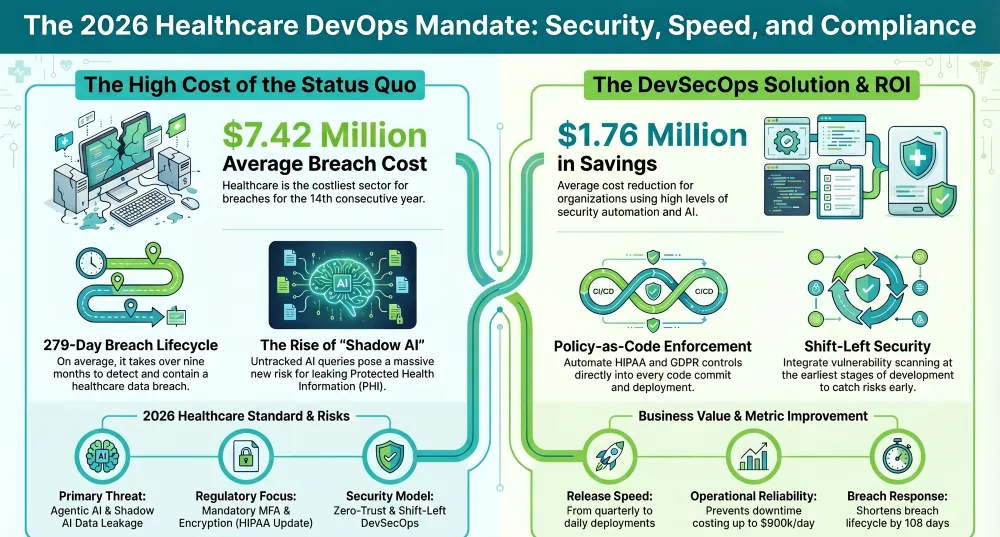
HIPAA DevOps Services: Compliance Built Into Every Line of Code
HIPAA compliance is the foundation upon which all DevOps for healthcare must be built. It is not a checkbox. It is not a one-time certification. It is an ongoing operational requirement that touches every layer of the software delivery lifecycle.
HIPAA DevOps services are designed to embed that requirement directly into the development process. Key practices include:
- Policy-as-Code Enforcement: Rather than relying on manual reviews to catch HIPAA violations, policy-as-code tools automatically enforce industry standards on every deployment. Policy-as-code tools can automatically enforce industry standards like HIPAA, PCI-DSS, or GDPR on every deployment, and automated compliance tools scan infrastructure and code continuously, producing evidence — logs, reports — that auditors can review.
- Automated Audit Trails: Every access to PHI, every configuration change, and every deployment must be logged and attributable. Automated audit trails generate the evidence base that OCR investigators and internal compliance officers require, without adding manual overhead to engineering teams.
- Encryption at Every Layer: Regulatory compliance standards like HIPAA require access controls, encryption, audit trails, and vendor risk management — all of which must be enforced programmatically in a mature HIPAA DevOps pipeline. This means encrypting PHI in transit and at rest, enforcing TLS across all services, and managing encryption keys through dedicated secret management systems.
- Business Associate Agreement (BAA) Management: Third-party tools and cloud providers used in a healthcare DevOps pipeline must all be covered by valid BAAs. Managing these agreements and ensuring compliance across a complex vendor ecosystem is a key function of HIPAA DevOps services.
- Breach Notification Readiness: HIPAA requires healthcare organizations to notify affected individuals and HHS within 60 days of discovering a breach. AI security and automation reduced the breach lifecycle by an average of 108 days, and organizations making serious use of automation and AI cybersecurity enjoyed an average cost reduction of $1.76 million compared to those without such technologies. That is a compelling ROI argument for investing in compliance-ready DevOps infrastructure now, rather than reacting to a breach later.
DevSecOps as a Service: Shifting Security Left in Healthcare
The most transformative development in DevOps for healthcare over the past two years has been the mainstream adoption of DevSecOps — the practice of embedding security at every stage of the software development lifecycle, rather than treating it as a final gate before deployment.
Healthcare data requires strict protection, so DevOps must include security controls from the earliest stages. This early focus on security is DevSecOps, a methodology that integrates protection into every phase of the development lifecycle.
DevSecOps as a service takes this principle and delivers it as a managed capability, which is particularly valuable for healthcare organizations that lack the in-house security engineering expertise to build and maintain it themselves. Core components of a healthcare DevSecOps as a service offering include:
- Static Application Security Testing (SAST): Code is scanned for vulnerabilities before it is ever deployed. This catches insecure coding patterns, hardcoded credentials, and PHI exposure risks at the source.
- Dynamic Application Security Testing (DAST): Live applications are scanned automatically for vulnerabilities that only manifest at runtime — injection attacks, authentication bypasses, and configuration weaknesses that SAST cannot catch.
- Software Composition Analysis (SCA): Healthcare applications typically rely on dozens or hundreds of open-source dependencies. SCA tools continuously monitor those dependencies for known CVEs and license compliance issues, flagging risks before they reach production.
- Container Security: Kubernetes and Docker have become standard in healthcare infrastructure, but containers introduce their own security surface. Container image scanning, runtime protection, and network policy enforcement are all essential components of DevSecOps in this environment.
- Zero-Trust Architecture: Healthcare environments are increasingly moving toward zero-trust network models, where no user, device, or service is trusted by default. Skills like configuring CI/CD pipeline security checks, managing IAM roles and permissions properly, and implementing network security basics such as VPC, firewall rules, and zero-trust principles are now essential in advanced DevSecOps practice.
Gartner identifies agentic AI as a significant new cybersecurity concern for 2026, noting that no-code/low-code platforms and vibe coding are expanding attack surfaces, driving unmanaged AI agent proliferation, unsecured code, and potential regulatory compliance violations. Healthcare organizations building AI-powered clinical tools must account for this in their DevSecOps posture.
Regulatory DevOps Solutions: Beyond HIPAA
While HIPAA is the dominant regulatory framework for US-based healthcare organizations, modern regulatory DevOps solutions must account for a broader and increasingly complex compliance landscape.
- HITECH Act: The Health Information Technology for Economic and Clinical Health Act expanded HIPAA’s breach notification requirements and increased penalties significantly. A comprehensive DevOps as a service for healthcare providers will incorporate HITECH compliance requirements into pipeline controls alongside HIPAA.
- GDPR: For healthcare organizations operating in or serving patients in Europe, GDPR’s requirements around data subject rights, data minimization, and cross-border data transfers add another layer of compliance to manage. GDPR Article 30 requires maintaining records of all processing activities — impossible when organizations can’t track how data flows through systems and tools.
- SOC 2 Type II: Healthcare SaaS vendors are increasingly expected to hold SOC 2 Type II certifications as a baseline trust signal. Continuous compliance automation significantly accelerates the evidence collection process for SOC 2 audits.
- FDA Software as a Medical Device (SaMD) Regulations: For organizations building software that constitutes a medical device, FDA SaMD guidelines impose additional quality management, risk analysis, and post-market surveillance requirements that must be integrated into the development pipeline.
- State Privacy Laws: Beyond federal frameworks, many US states have enacted their own health data privacy laws that impose requirements beyond HIPAA. A mature compliance-ready DevOps platform must be configurable to meet state-level requirements as well.
Gartner forecasts that global information security spending will reach $244.2 billion in 2026, up 13.3% — with regulatory volatility and the direct personal liability now facing boards and executives for compliance failures among the key drivers of that growth.
The compliance landscape is not getting simpler. It is getting denser. Regulatory DevOps solutions that treat compliance as an engineering discipline — automated, version-controlled, continuously tested — are the only scalable path forward.
Compliance-Ready DevOps: The Architecture of Trust
Building compliance-ready DevOps in healthcare requires more than the right tools. It requires an architectural philosophy that treats every pipeline stage as a potential compliance touchpoint.
- Infrastructure as Code (IaC) for Compliance: Terraform, Pulumi, and CloudFormation allow healthcare organizations to define their infrastructure in version-controlled code, ensuring that every environment is provisioned identically and that compliance baselines are applied automatically. Using tools such as Terraform or CloudFormation, teams can quickly provision secure environments that meet compliance and audit requirements. IaC also simplifies rollback, scaling, and disaster recovery procedures.
- Immutable Audit Logs: Every action in a compliance-ready DevOps pipeline must generate an immutable audit record. This is not just good practice — for HIPAA-covered entities, it is a regulatory requirement. Modern pipeline orchestration tools support structured logging to SIEM platforms that can correlate events across systems in real time.
- Secrets Management: Credentials, API keys, and encryption keys must never be stored in source code or container images. Dedicated secrets management tools like HashiCorp Vault, AWS Secrets Manager, and Azure Key Vault are essential components of healthcare DevOps infrastructure.
- Environment Parity: Development, staging, and production environments in healthcare must be configured identically to ensure that compliance controls validated in lower environments are faithfully reproduced in production. IaC and containerization together make this achievable and auditable.
- Disaster Recovery and High Availability: From ICU dashboards to telemedicine apps, downtime is unacceptable — DevOps monitoring for healthcare ensures systems stay responsive and reliable under all conditions. Multi-region deployment strategies, automated failover, and tested recovery runbooks must all be part of the compliance-ready DevOps framework.
- Software Bills of Materials (SBOMs): SBOM generation, SLSA-aligned provenance, and attestation must occur as code moves through the pipeline, not through manual audits. For healthcare organizations subject to supply chain scrutiny, SBOMs provide the traceability that regulators and procurement teams increasingly demand.
DevOps as a Service for Healthcare: Why Managed Delivery Wins
Building a world-class internal DevOps for healthcare function from scratch is expensive, slow, and difficult. The talent required — engineers who understand both Kubernetes and HIPAA, who can design zero-trust networks and also explain compliance implications to clinical stakeholders — is exceptionally scarce.
Recent surveys show that nearly three-quarters of organizations have adopted DevOps practices, and 86% of IT leaders say that rapid software releases are important. But saying you have DevOps and having compliance-ready DevOps built for the specific demands of healthcare are very different things.
DevOps as a service for healthcare fills that gap. A qualified managed DevOps as a service provider brings:
- Pre-built, healthcare-validated CI/CD pipeline templates that incorporate HIPAA controls from day one
- Security tooling already integrated and configured for PHI protection
- 24/7 monitoring with healthcare-specific alerting thresholds
- Audit-ready reporting dashboards that simplify regulatory evidence collection
- Expertise in healthcare domain requirements — EHR integration patterns, HL7/FHIR compliance, IoMT security — that general DevOps providers lack
- Ongoing compliance updates as regulatory requirements evolve
By 2026, roughly 80% of software development organizations will rely on internal developer platforms to manage complexity and improve developer experience. For healthcare organizations, those platforms must be purpose-built with compliance guardrails baked in — not retrofitted from generic enterprise DevOps tooling.
In the specialized context of healthcare, DaaS (DevOps as a Service) is defined as the outsourcing of compliant infrastructure management, security orchestration, and CI/CD automation to a partner with specific domain expertise in HIPAA, HITECH, and HITRUST frameworks. This allows clinical teams to focus on software features while the partner maintains the “compliance-as-code” layer.
This is where Full-Stack Techies delivers measurable value. As a specialist in DevOps as a service for healthcare, Full-Stack Techies brings together compliance engineering, security architecture, and healthcare domain expertise under one roof. Whether a client is a large hospital system modernizing legacy infrastructure, a digital health startup building its first HIPAA-compliant pipeline, or a healthcare SaaS company preparing for a SOC 2 audit, Full-Stack Techies provides the end-to-end DevOps as a service capability that turns compliance complexity into a competitive advantage.
Real-World Impact: What DevOps for Healthcare Delivers
The business case for investing in DevOps for healthcare is not abstract. It shows up in measurable outcomes across clinical, operational, and financial dimensions.
- Faster, safer feature releases: Healthcare product teams that adopt mature DevOps for healthcare practices move from quarterly release cycles to weekly or even daily deployments — without increasing regulatory risk. Automated compliance checks catch violations before they reach production, not after.
- Dramatically reduced audit costs: Organizations that have implemented compliance-ready DevOps report significantly shorter audit cycles because compliance evidence is generated automatically and continuously. There is no last-minute scramble to reconstruct six months of change logs.
- Lower breach costs: Organizations making serious use of automation and AI cybersecurity enjoyed an average cost reduction of $1.76 million compared to those without such technologies, and AI security and automation reduced the breach lifecycle by an average of 108 days. For a healthcare organization where the average breach already costs $7.42 million, that is a transformative risk reduction.
- Improved clinical uptime: Hospitals can lose up to $900,000 per day during downtime, when surgeries, prescriptions, and claims are disrupted. DevOps monitoring for healthcare — with automated alerting, self-healing infrastructure, and rapid incident response playbooks — directly reduces that exposure.
- Competitive positioning: Healthcare technology vendors with demonstrable HIPAA DevOps services and compliance-ready DevOps capabilities win enterprise contracts faster. Procurement teams at health systems now routinely demand evidence of automated compliance controls as a vendor qualification criterion.
Emerging Challenges in 2026: What Healthcare DevOps Teams Must Address
The DevOps for healthcare landscape in 2026 is shaped by a set of emerging challenges that teams must actively address.
- AI-Augmented Attack Vectors: ISACA’s 2026 Tech Trends and Priorities Global Pulse Poll identified AI-driven social engineering as the top threat for 2026. Healthcare organizations are particularly vulnerable because their workforces interact with patients and handle sensitive requests under time pressure — ideal conditions for AI-generated phishing and deepfake-based social engineering.
- Shadow AI and PHI Leakage: Only 35% of healthcare organizations can track their AI usage, yet HIPAA requires tracking 100% of patient data access — meaning every untracked AI query containing patient information creates federal liability exposure. DevSecOps as a service providers must now include AI governance tooling as a standard component of their healthcare offering.
- Post-Quantum Cryptography: Gartner predicts advances in quantum computing will render asymmetric cryptography unsafe by 2030, and recommends that post-quantum cryptography alternatives be adopted now to avoid “harvest now, decrypt later” attacks targeting long-term sensitive data. Healthcare records have long retention requirements, making them a particular target for harvest-now attacks.
- Machine Identity Management: Increasing adoption of GenAI, cloud services, automation, and DevOps practices has led to the prolific use of machine accounts and credentials for physical devices and software workloads — and IAM teams are only responsible for 44% of an organization’s machine identities. In a healthcare environment with thousands of connected devices, this is a significant governance challenge.
- Regulatory Volatility: Gartner advises cybersecurity leaders to formalize collaboration across legal, business, and procurement teams to establish clear accountability for cyber risk, and to align control frameworks to recognized standards to reduce compliance gaps. As HIPAA Security Rule updates move from proposed to final rulemaking, healthcare DevOps teams must be ready to update pipeline controls rapidly.
How Full-Stack Techies Approaches DevOps for Healthcare
At Full-Stack Techies, we believe that DevOps for healthcare done right is a force multiplier for the organizations we work with. We approach every engagement with a healthcare-first mindset: compliance is not a constraint on delivery velocity, it is a design principle that makes delivery more reliable, more predictable, and ultimately faster.
- Our HIPAA DevOps services cover the full software delivery lifecycle — from initial pipeline architecture and security tooling selection, through to ongoing monitoring, compliance automation, and incident response. We work with hospitals, health systems, digital health startups, and healthcare SaaS companies at every stage of their DevOps maturity journey.
- Our DevSecOps as a service offering embeds security into every stage of the development process, using a shift-left philosophy that catches vulnerabilities early — where they are cheap to fix — rather than late, where they are expensive, disruptive, and potentially reportable.
- Our regulatory DevOps solutions are built for the healthcare compliance landscape specifically: HIPAA, HITECH, GDPR, FDA SaMD, SOC 2, and state-level health privacy laws. We do not offer generic enterprise DevOps with a healthcare label on it. We offer compliance-ready DevOps designed from first principles for the regulatory environment that healthcare organizations actually operate in.
And as a full-service DevOps as a service provider, Full-Stack Techies can take on as much or as little of the operational burden as each client needs — from advisory and architecture, to full managed delivery with 24/7 support.
Getting Started: A Practical Roadmap
For healthcare organizations beginning or accelerating their DevOps for healthcare journey, a phased approach reduces risk and builds institutional capability over time.
Phase 1 — Assess and Baseline. Conduct a comprehensive audit of your current software delivery process, security posture, and compliance gaps. Identify the highest-risk areas: unautomated compliance checks, manual access controls, unmonitored third-party integrations, and legacy systems with inadequate logging.
Phase 2 — Secure the Pipeline. Implement foundational DevSecOps controls: static and dynamic security scanning, secrets management, IaC for all environments, and automated audit logging. This phase directly addresses the most common HIPAA Security Rule findings.
Phase 3 — Automate Compliance. Build policy-as-code enforcement into the pipeline so that HIPAA, HITECH, and any applicable state-level requirements are checked automatically on every deployment. Implement automated evidence collection for audit readiness.
Phase 4 — Optimize and Scale. Once the foundation is solid, focus on delivery velocity: streamlining CI/CD pipelines, implementing feature flagging for safer releases, building internal developer platform capabilities, and using observability data to continuously improve system reliability.
Phase 5 — Ongoing Governance. Compliance-ready DevOps is not a destination. As regulations evolve, threats change, and systems grow, the pipeline must be continuously updated. Establish a governance cadence — quarterly compliance reviews, annual penetration testing, continuous threat modeling — to keep the posture current.
Conclusion: The Cost of Inaction
The numbers are unambiguous. Healthcare has been the costliest industry for data breaches for 14 consecutive years, with an average breach cost of $7.42 million and detection and containment taking 279 days — the longest of any industry. Regulatory scrutiny is intensifying. Attack surfaces are expanding. The workforce to manage all of it is stretched thin.
DevOps for healthcare is not a technology investment. It is a risk management investment, a patient safety investment, and increasingly, a license-to-operate investment. Organizations that treat HIPAA DevOps services, DevSecOps as a service, and compliance-ready DevOps as optional extras are accumulating technical debt, regulatory liability, and security risk simultaneously.
The organizations that are winning in healthcare technology in 2026 are the ones that have made DevOps as a service for healthcare a strategic priority — building delivery pipelines that are fast, secure, and compliant by design, not by accident.
Full-Stack Techies is ready to help your organization get there. Whether you are starting from scratch or maturing an existing DevOps practice, our team of healthcare compliance and DevOps specialists will meet you where you are and build toward where you need to be.



