MLOps vs DevOps vs DataOps: Which Pipeline Strategy Fits Your Team?
Explore the differences between MLOps vs DevOps vs DataOps and discover which pipeline strategy best fits your team. This guide explains how each approach supports automation, scalability, AI workflows, and data operations for modern engineering organizations in 2026.


Introduction
The modern software and data engineering landscape is no longer a one-size-fits-all world. Teams today are grappling with a critical strategic decision: should they invest in MLOps vs DevOps vs DataOps — or some combination of all three? The answer depends entirely on what your team builds, how your data flows, and where your AI ambitions are headed.
If your organization is shipping software at scale, training machine learning models, or managing complex data pipelines, you need to understand the fundamental differences — and surprising overlaps — between these three operational disciplines. Getting this wrong doesn’t just slow you down; it creates technical debt, siloed teams, and misaligned pipelines that cost millions to untangle later.
This article breaks down MLOps, DevOps, and DataOps in plain language, compares them across the dimensions that matter most to engineering leaders, and helps you decide which pipeline strategy — or which hybrid — is right for your team’s specific goals.
Quick Summary: MLOps vs. DevOps vs. DataOps
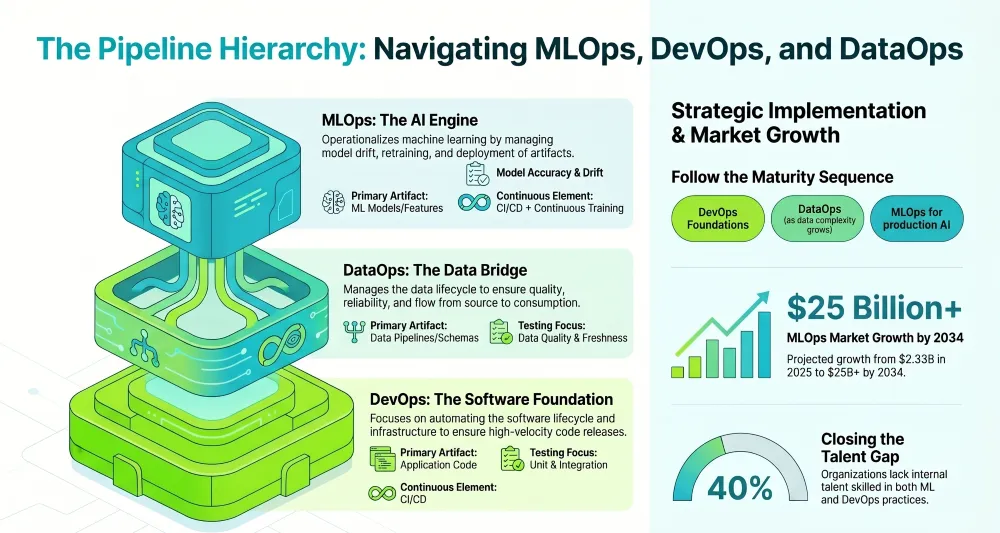
- DevOps focuses on the Software Lifecycle, automating code deployment and infrastructure to ensure high-velocity releases.
- DataOps focuses on the Data Lifecycle, ensuring data quality, reliability, and flow from source to consumption.
- MLOps focuses on the Model Lifecycle, managing the unique challenges of model drift, retraining, and deployment of machine learning artifacts.
The Verdict: DevOps is the non-negotiable foundation; DataOps is the bridge for data-heavy teams; MLOps is the specialized engine for production-grade AI.
Key Takeaways: MLOps vs DevOps vs DataOps
1. They Solve Different Problems, Not the Same One. MLOps, DevOps, and DataOps are not interchangeable. DevOps accelerates software delivery, DataOps ensures data pipeline reliability, and MLOps operationalizes machine learning models. Confusing their roles leads to misaligned tooling, siloed teams, and expensive technical debt.
2. DevOps Is the Non-Negotiable Foundation. Regardless of your AI ambitions or data complexity, DevOps comes first. Stable CI/CD pipelines, infrastructure automation, and deployment governance are the bedrock on which both DataOps and MLOps are built. Skipping this foundation makes everything else fragile.
3. DataOps Is the Bridge Between Raw Data and Business Value. DataOps is not just pipeline automation — it is the operational discipline that ensures your data arrives fast, clean, and trusted. Without it, analysts debug pipelines instead of generating insights, and downstream ML models train on unreliable data.
4. MLOps Is What Separates AI Experimentation From AI Production. Nearly 45% of ML projects never reach production. MLOps closes that gap by bringing version control, automated retraining, model monitoring, and governance to machine learning workflows — turning one-off experiments into reliable, production-grade AI systems.
5. The Three Disciplines Are Complementary, Not Competing. The most effective engineering organizations invest in all three — sequentially and strategically. DevOps first, DataOps as data complexity grows, and MLOps as AI initiatives move toward production. Treating them as competitors leads to underinvestment across the board.
6. AI-Driven DevOps Is Reshaping All Three Disciplines. AI-driven DevOps is no longer a future concept — it is actively transforming how pipelines are monitored, how deployments are managed, and how failures are predicted. Organizations embedding AI into their DevOps, DataOps, and MLOps workflows are compressing delivery timelines and reducing operational toil significantly.
7. The Talent Gap Is Real and Growing. Approximately 40% of organizations report shortages of engineers skilled in both ML and DevOps practices. This scarcity makes internal capability-building slow and expensive, strengthening the case for partnering with a trusted DevOps development company or leveraging DevOps as a Service to close the gap faster.
8. Market Growth Signals Urgency, Not Optionality. The MLOps market is projected to grow from $2.33 billion in 2025 to over $25 billion by 2034. The DevOps automation tools market hit $18.48 billion in 2026. These numbers confirm that pipeline strategy is now a core competitive differentiator — not a back-office IT decision to defer.
9. DevOps as a Service Accelerates Maturity Without the Overhead. For teams without deep in-house expertise, DevOps as a Service offers immediate access to senior-level architects, proven tooling stacks, and battle-tested practices. It compresses years of organizational learning into weeks and allows engineering teams to focus on product innovation rather than infrastructure plumbing.
10. Sequence Your Investment Deliberately. The right pipeline strategy is not the most popular one — it is the one most aligned to your current stage and near-term goals. Assess your team’s maturity honestly, invest in devops engineering services where gaps exist, and build toward a unified DevOps, DataOps, and MLOps architecture as your organization scales.
The Core Problem: Why Do We Need Different “Ops”?
To understand the difference between MLOps, DevOps, and DataOps, we first need to look at the artifacts they manage.
In traditional software development, the primary artifact is code. Code is deterministic. If you write a function to calculate the sum of two numbers, it will always return the correct sum, provided the code remains unchanged and the environment is stable. The challenge is moving that code from a developer’s laptop to a production environment quickly and securely.
However, data and machine learning do not behave like traditional code.
- Data is messy and constantly changing. A schema might evolve, a third-party API might drop a column, or a sensor might send corrupted values.
- Machine Learning models are dynamic and degrade over time. An ML model is essentially code that writes itself based on data. If the underlying data changes in the real world (a concept known as “data drift”), the model’s predictions will lose accuracy, even if the application code hasn’t changed a single line.
Because the underlying assets—code, data, and models—possess fundamentally different life cycles and failure modes, they require distinct operational philosophies and toolchains.
The State of Pipeline Operations in 2025–2026: Why This Decision Matters More Than Ever
Before diving into definitions, let’s put some numbers on the table.
The global MLOps market was valued at $2.33 billion in 2025 and is projected to reach $25.39 billion by 2034, growing at a CAGR of 28.90%. Meanwhile, the DevOps automation tools market reached $14.91 billion in 2025, driven by sharp rises in cloud-based tool adoption and deeper integration of automation into existing IT workflows. By 2026, the market hit $18.48 billion at a CAGR of 23.9%.
According to Gartner’s 2025 Market Guide for DataOps Tools, “The DataOps market has evolved into a strategic data management foundational capability, driven by the increased need for optimized data pipelines to support AI initiatives and growing analytic use cases.”
The message is clear: pipeline strategy is now a core business differentiator, not a back-office IT concern. Organizations that choose and implement the right operational framework — or a thoughtful blend of all three — are the ones outpacing their competition on delivery speed, model reliability, and data quality.
What Is DevOps? The Foundation of Modern Software Delivery
DevOps is a cultural and technical methodology that unifies software development (Dev) and IT operations (Ops) with the goal of shortening the software delivery lifecycle while maintaining high quality. It is built on principles of continuous integration, continuous delivery (CI/CD), infrastructure as code (IaC), automated testing, and cross-functional collaboration.
At its core, DevOps answers one question: How do we ship code faster, more reliably, and with fewer production incidents?
Key characteristics of DevOps:
- CI/CD pipelines that automate build, test, and deployment
- Infrastructure as Code (IaC) using tools like Terraform and Ansible
- Containerization and orchestration via Docker and Kubernetes
- Monitoring and observability across the software stack
- A culture of shared ownership between developers and operations engineers
More than 70% of organizations report increased software delivery efficiency through DevOps toolchain integration, with faster feedback loops, automated testing, and streamlined deployments as the primary drivers.
DevOps is your best fit if: Your team’s primary output is software applications, APIs, or microservices. You need faster release cycles, lower mean time to recovery (MTTR), and consistent deployments across environments.
Companies like Full-Stack Techies, a leading DevOps development company, have built their service delivery around exactly this discipline — helping organizations implement robust CI/CD pipelines, automate infrastructure, and build the cultural practices that make DevOps development services sustainable at scale.
Also Read: The Ultimate Guide to DevOps as a Service (DaaS) in 2026
What Is DataOps? The Discipline of High-Velocity, High-Quality Data
DataOps applies the principles of DevOps — automation, collaboration, CI/CD thinking — to the world of data engineering and analytics. Where DevOps is focused on software delivery, DataOps is focused on the entire data lifecycle: from ingestion and transformation to delivery and consumption by analysts, data scientists, and business intelligence tools.
Think of DataOps as the operational backbone of your data platform. It governs how data moves, transforms, and lands in the hands of people who need it — with reliability, speed, and verifiable quality.
Key characteristics of DataOps:
- Automated data pipeline orchestration
- Data quality testing integrated into pipelines
- Version control for data transformations and schemas
- Observability across data freshness, lineage, and completeness
- Collaborative workflows between data engineers, analysts, and consumers
DataOps vs DevOps is a comparison that often confuses teams. The simplest way to think about it: DevOps manages code pipelines; DataOps manages data pipelines. Both apply similar philosophies — automation, iteration, monitoring — but the artifact being moved and tested is fundamentally different. Software builds are deterministic; data pipelines contend with volume, velocity, variety, and the unpredictable behavior of upstream source systems.
Gartner describes DataOps as a prominent trend involving all stages of the data lifecycle, and projects that due to the development of AI orchestration platforms, the proportion of businesses that have operationalized their AI initiatives will jump from 8% in 2020 to 70% in 2025.
DataOps is your best fit if: Your team manages complex ETL/ELT pipelines, serves multiple business intelligence consumers, operates a data warehouse or lakehouse, and struggles with data quality, freshness, or discoverability issues.
What Is MLOps? The Engine of Production AI
MLOps — short for Machine Learning Operations — is the operational discipline specifically designed to manage the end-to-end lifecycle of machine learning models: from data collection and feature engineering, through model training and validation, all the way to production deployment and continuous monitoring.
If DevOps is for software engineers and DataOps is for data engineers, MLOps is where data scientists, ML engineers, and operations teams converge.
MLOps introduces new challenges in automation, collaboration, and monitoring specific to ML models and data pipelines — including model versioning and governance, automation of the ML pipeline similar to CI/CD for software applications, and better collaboration between data scientists and engineers to ensure models are deployed and maintained effectively in production environments.
Key characteristics of MLOps:
- Feature stores for managing and sharing ML features
- Model versioning and experiment tracking
- Automated retraining pipelines triggered by data drift or performance degradation
- Model registry and governance for audit and compliance
- A/B testing and shadow deployment of new model versions
- Monitoring for model accuracy, bias, and data drift in production
MLOps vs DevOps is not a competition — it’s an evolution. MLOps extends DevOps principles to handle the unique complexity of ML artifacts, where the “code” is inseparable from the data it was trained on, and where a model can silently degrade in production without any code change ever occurring.
According to Gartner, by 2023, over 75% of large organizations planned to hire ML engineers, up from less than 5% in 2018 — highlighting the growing importance of MLOps skills across the industry. A study by Dataiku found that companies that have successfully implemented MLOps practices are 2.5 times more likely to have high-performing machine learning models.
MLOps is your best fit if: Your team is building, deploying, and maintaining machine learning or deep learning models in production, dealing with data drift, model decay, regulatory compliance around AI decisions, or the need to retrain models frequently as new data arrives.
Head-to-Head Comparison: MLOps vs DevOps vs DataOps
To make the best strategic decisions, technical leaders must understand how these disciplines compare across several critical axes.
| Feature / Discipline | DevOps | DataOps | MLOps |
|---|---|---|---|
| Primary Goal | Fast, reliable software delivery. | High-quality, accessible data pipelines. | Reliable, accurate machine learning models in production. |
| Core Artifact | Application Code, Infrastructure as Code. | Data Pipelines, Schemas, Datasets. | ML Models, Hyperparameters, Feature Sets. |
| Trigger for Update | New feature request, bug fix. | Schema change, new data source. | Model degradation (drift), new data availability. |
| Testing Focus | Unit, Integration, UI, Performance. | Data Quality, Schema Validation, Freshness. | Model Accuracy, Bias, Data/Concept Drift. |
| Continuous Element | Continuous Integration (CI), Continuous Deployment (CD). | Continuous Integration (CI), Continuous Deployment (CD), Continuous Observation. | CI, CD, plus Continuous Training (CT). |
| Failure Modes | Syntax errors, server crashes, security breaches. | Corrupt data, delayed syncs, schema mismatches. | Inaccurate predictions, biased outputs, model staleness. |
| Typical Tools | Git, Jenkins, Docker, Kubernetes, Terraform. | dbt, Airflow, Snowflake, Monte Carlo, Fivetran. | MLflow, Kubeflow, Sagemaker, Weights & Biases. |
MLOps vs DevOps vs DataOps: A Direct Comparison
Let’s put these three disciplines side by side across the dimensions that engineering leaders and CTOs care about most.
Primary Goal
- DevOps: Accelerate software delivery with reliability
- DataOps: Ensure fast, high-quality data delivery across the organization
- MLOps: Operationalize machine learning models in production at scale
Primary Artifact
- DevOps: Application code and software builds
- DataOps: Data pipelines, schemas, and datasets
- MLOps: Machine learning models, features, and experiments
Core Pipeline
- DevOps: CI/CD pipeline (code → test → deploy)
- DataOps: Data pipeline (ingest → transform → deliver → monitor quality)
- MLOps: ML pipeline (data → train → validate → deploy → monitor → retrain)
Key Teams Involved
- DevOps: Software developers, operations engineers, SREs
- DataOps: Data engineers, analytics engineers, data analysts, BI teams
- MLOps: Data scientists, ML engineers, data engineers, DevOps engineers
Monitoring Focus
- DevOps: Application uptime, latency, error rates, deployment health
- DataOps: Data freshness, completeness, lineage, quality scores
- MLOps: Model accuracy, feature drift, data distribution shift, prediction latency
Version Control Subject
- DevOps: Code, infrastructure, configuration
- DataOps: Data transformations, schemas, pipeline definitions
- MLOps: Models, features, datasets, experiments, hyperparameters
Failure Mode
- DevOps: Service outages, failed deployments, regressions
- DataOps: Stale data, broken pipelines, quality degradation, schema changes
- MLOps: Silent model degradation, prediction bias, retraining failures, data drift
Maturity of Tooling
- DevOps: Highly mature — GitHub Actions, Jenkins, Terraform, Kubernetes
- DataOps: Rapidly maturing — dbt, Airflow, Great Expectations, Monte Carlo
- MLOps: Rapidly evolving — MLflow, Kubeflow, SageMaker, Weights & Biases
Also Read: GitOps vs DevOps (2026): Key Differences, Benefits, and When to Use Each Approach
DataOps vs DevOps: Understanding the Nuances
The dataops vs devops debate is one of the most common points of confusion in modern engineering organizations — particularly in companies that are growing their data teams alongside their product engineering teams.
Here’s the cleanest way to think about it: both disciplines are cultural philosophies first, and tooling choices second. Both borrow from Agile. Both emphasize automation, monitoring, and cross-team collaboration. But their concerns diverge significantly in practice.
A DevOps engineer asks: “Did my last deployment break anything in production? How quickly can I roll it back?”
A DataOps engineer asks: “Did my upstream data source change its schema overnight? Are there null values in fields that should never be null? Is my data warehouse reflecting the last 24 hours of transactions correctly?”
These are fundamentally different failure modes requiring fundamentally different tooling, monitoring strategies, and alert logic. A company that tries to use its DevOps toolchain to manage data quality will quickly find it inadequate. And a company that tries to run ML model deployments through a pure DataOps framework will struggle with the non-determinism of model outputs and the complexity of retraining orchestration.
The best-in-class organizations don’t choose one over the other — they build distinct competencies in all three disciplines and create integration points between them.
Learn about DataOps vs DevOps: Which Is Better for Modern Enterprises in 2025–2026?
Get scalable, fast, and user-friendly DevOps Solutions tailored to your needs.
Get Free ConsultationAI-Driven DevOps: The Convergence Reshaping All Three Disciplines
One of the most significant developments in 2025 and 2026 is the emergence of AI-driven DevOps — the integration of machine learning and AI into the DevOps toolchain itself to predict failures, automate root cause analysis, optimize deployment strategies, and reduce toil for engineering teams.
The Global DevSecOps Report 2025 stated that 63.3% of security professionals reported that AI has become a helpful copilot for writing more secure code and automating application security testing.
AI-driven DevOps doesn’t just automate the mechanical tasks of deployment — it applies intelligence to the entire software delivery lifecycle. Anomaly detection in CI/CD pipelines, predictive alerting on infrastructure health, intelligent test selection, and automated rollback decisions are all becoming table stakes in mature DevOps organizations.
According to Gartner’s forecast, organizations that focus on improving developer experience (DevEx) are expected to achieve twice the developer retention rate by 2027 compared to those that do not make similar investments.
This convergence also means that the lines between MLOps, DevOps, and DataOps are blurring. An AI model monitoring a production system is itself a deployed ML artifact (MLOps territory) that depends on data pipelines (DataOps territory) and lives on infrastructure managed by operations teams (DevOps territory). The most sophisticated engineering organizations understand this interconnection and design their pipelines accordingly.
Full-Stack Techies actively helps organizations navigate this convergence through purpose-built DevOps engineering services that incorporate AI automation, intelligent monitoring, and adaptive deployment strategies tailored to each team’s unique architecture.
DevOps as a Service: A Strategic Option for Teams Without In-House Expertise
Not every organization has the budget, time, or talent to build full in-house expertise in DevOps, DataOps, and MLOps simultaneously. This is where DevOps as a Service has emerged as a transformative model.
DevOps as a Service allows organizations to outsource the design, implementation, and ongoing management of their DevOps infrastructure and practices to a specialized partner. Instead of hiring a full DevOps team, you engage a devops development company that provides:
- CI/CD pipeline design and implementation
- Cloud infrastructure provisioning and management
- Monitoring, alerting, and incident response frameworks
- Security integration (DevSecOps)
- Scalability planning and capacity optimization
- Training and upskilling of internal teams
Large enterprises accounted for 64.05% of total DevOps automation market revenue in 2025 — their scale of operations and multi-cloud environments require comprehensive automation coverage across the full development lifecycle to maintain reliability and speed.
But it’s not just enterprise-scale organizations driving demand for DevOps as a Service. Fast-growing startups and mid-market companies are increasingly turning to providers like Full-Stack Techies to accelerate their DevOps maturity without the overhead of building an internal team from scratch. The model delivers immediate access to senior-level expertise, proven tooling stacks, and battle-tested deployment practices — compressing what would otherwise be 12–18 months of organizational learning into weeks.
Full-Stack Techies’ devops development services are designed for exactly this kind of engagement: flexible, outcome-oriented, and deeply integrated with your existing engineering culture rather than replacing it.
Which Pipeline Strategy Fits Your Team? A Decision Framework
The right answer to the MLOps vs DevOps vs DataOps question depends on four key dimensions: what you’re building, who’s building it, how data-intensive your operations are, and how far along the AI maturity curve your organization sits.
Start with DevOps if: Your primary deliverable is software — web applications, mobile apps, APIs, microservices, or cloud-native platforms. If your biggest pain points are around slow release cycles, flaky deployments, manual infrastructure management, or poor visibility into production systems, DevOps is your foundational investment. Everything else builds on top of a solid DevOps foundation.
This is especially true for startups and growth-stage companies that need to ship features fast, maintain SLA commitments, and scale infrastructure without proportional headcount increases. Engaging a devops development company like Full-Stack Techies early in this journey accelerates time-to-value significantly.
Layer in DataOps if: Your organization is generating, storing, and analyzing significant volumes of data — operational data, customer data, event streams, or third-party feeds. If your data analysts spend more time debugging pipeline failures than generating insights, or if business stakeholders routinely receive stale or inconsistent reports, DataOps is your next investment.
The DataOps vs DevOps decision isn’t either/or — it’s sequential. A solid DevOps foundation makes DataOps implementation faster and more reliable, since you can apply the same CI/CD thinking to your data transformation code (dbt models, Spark jobs, Airflow DAGs).
Invest in MLOps if: Your data science team has moved beyond experimentation and is deploying models to production — or is planning to do so within the next 6–12 months. The absence of MLOps is one of the most expensive invisible costs in AI-forward organizations. Around 45% of ML projects fail to reach production due to poor monitoring and retraining pipelines. Without proper MLOps infrastructure, your data scientists spend 70–80% of their time on operational plumbing rather than model development.
Around 72% of enterprises are adopting automation tools as a key driver in the MLOps market, while 68% prioritize scalable model deployment in production environments.
Consider a hybrid approach if: Your organization is operating across all three domains simultaneously. This is the reality for most scaled tech companies, financial institutions, healthcare platforms, and e-commerce businesses. In this case, the question shifts from “which one?” to “how do we integrate all three into a coherent operational architecture?”
The answer lies in building clear integration points between your DevOps CI/CD system, your DataOps pipeline orchestration layer, and your MLOps model registry and serving infrastructure. Shared tooling (Kubernetes, observability platforms, secrets management), shared governance practices (RBAC, audit logging, change management), and shared incident response protocols are what hold this unified architecture together.
Common Pitfalls When Choosing Your Pipeline Strategy
Even well-resourced engineering teams make avoidable mistakes when rolling out MLOps, DevOps, or DataOps strategies. Here are the most costly ones:
- Treating MLOps as just DevOps for models. This underestimates the unique complexity of ML systems — particularly data versioning, feature consistency between training and serving, and the non-deterministic behavior of model outputs. MLOps requires purpose-built tooling and workflows, not just a re-skinned CI/CD pipeline.
- Implementing DataOps without data quality testing. Many teams automate pipeline orchestration but skip the data quality testing layer. This results in automated delivery of bad data — faster and at greater scale than before. Tools like Great Expectations, Soda, and Monte Carlo exist precisely to prevent this.
- Building DevOps silos. The cultural dimension of DevOps is often underestimated. Teams that implement CI/CD tooling without changing their team structure, ownership model, and incident response culture will see diminishing returns. True DevOps transformation requires organizational change, not just tool adoption.
- Skipping the foundation and going straight to MLOps. Nearly 59% of organizations face compliance barriers, while 63% struggle with high integration complexities across existing systems when implementing MLOps. Teams that attempt to operationalize ML models before having a stable data platform and reliable infrastructure create fragile, difficult-to-maintain systems. MLOps is a top-floor investment; DevOps and DataOps are the foundation and first floor.
- Underestimating the talent gap. Around 40% of organizations report shortages of engineers skilled in both ML and SRE/DevOps practices. This makes the case for partnering with a specialized devops development company like Full-Stack Techies — an organization that already carries the cross-disciplinary expertise your team may take years to build internally.
How Full-Stack Techies Helps You Navigate the DevOps, DataOps, and MLOps Landscape
At Full-Stack Techies, we understand that the MLOps vs DevOps vs DataOps conversation isn’t purely theoretical — it has direct consequences on your team’s velocity, your product reliability, and your ability to deliver AI-powered features that actually work in production.
As a trusted devops development company, we offer end-to-end devops development services that are designed to evolve with your organization’s maturity curve:
- Our DevOps as a Service offering gives growing teams immediate access to senior DevOps architects who design and implement CI/CD pipelines, cloud infrastructure automation, and observability frameworks — tailored to your stack, not a generic template.
- Our DevOps engineering services go beyond tooling. We embed with your engineering culture, helping you build the cross-functional practices, incident response playbooks, and deployment governance models that transform how your teams collaborate.
- For organizations moving into AI and machine learning territory, our team bridges the gap between your existing DevOps foundation and the MLOps capabilities you need to take models from notebook to production — with confidence, repeatability, and auditability baked in from day one.
- And for data-intensive organizations, we help architect DataOps frameworks that bring reliability and speed to your data pipelines without sacrificing the governance and quality controls your downstream consumers depend on.
The question isn’t which of DevOps, DataOps, or MLOps you eventually need — most scaling organizations will need all three. The question is which you need now, and how to sequence your investment for maximum impact. That’s a conversation Full-Stack Techies is built to have.
Industry Signals: What the Research Says About Where This Is All Heading
The direction of travel is unmistakable. Key trends in the DevOps and operations space include increased AI integration, the evolution of MLOps, widespread adoption of serverless computing, and a focus on reducing operational overhead through greater automation.
AIOps and MLOps are among the most prominent DevOps market trends, with the DevOps market predicted to become a $40.91 billion entity by 2026.
The emergence of AI-driven DevOps is particularly significant. As organizations integrate AI into both the software they build and the pipelines they use to build it, the three disciplines of MLOps, DevOps, and DataOps will increasingly converge into a unified operational intelligence layer — where pipelines are self-healing, deployments are predictive, and data quality is continuously validated without human intervention.
MLOps extends its reach beyond IT operations into diverse spheres, including enterprise search and broader business contexts, and involves collaboration among teams including data scientists and data engineers. This signals a future where MLOps principles become embedded in every layer of the engineering stack — not just in dedicated ML teams, but in how software is built, tested, and shipped.
For engineering leaders, the imperative is clear: don’t wait until the perfect moment to invest in pipeline maturity. The organizations building these capabilities now — with or without in-house expertise, through partners like Full-Stack Techies — are creating compounding advantages in speed, quality, and AI readiness that will be very difficult to replicate later.
Conclusion: There Is No Single Right Answer — But There Is a Right Order
The MLOps vs DevOps vs DataOps debate ultimately resolves into a sequencing question, not a competition.
DevOps is your foundation — the operating discipline every engineering team needs, regardless of whether they’re building APIs or training neural networks. Without it, everything else is built on sand.
DataOps is your data platform’s reliability layer — the difference between a data team that’s constantly firefighting and one that confidently delivers insights at the speed of business.
MLOps is your AI-readiness infrastructure — the capability that determines whether your machine learning investments actually make it to production and stay valuable over time.
The teams that win in 2026 and beyond are not the ones who pick the flashiest option. They’re the ones who make deliberate, staged investments in pipeline maturity — starting with a solid DevOps foundation, layering in DataOps as their data complexity grows, and building MLOps infrastructure as their AI ambitions become operational priorities.
Whether you’re just getting started with devops development services, scaling a mature DataOps platform, or operationalizing your first production ML models, Full-Stack Techies has the cross-disciplinary expertise to meet you where you are and take you where you need to go.
The pipeline that fits your team isn’t the one that’s most popular — it’s the one that’s most aligned to what you’re building today and where you need to be in the next 12 to 24 months. Choose deliberately. Invest sequentially. And don’t underestimate how much faster you move with the right partner.
Also Read: AIOps vs DevOps: Key Differences and When to Use Intelligent Automation
Also Read: AI in DevOps: How Generative AI Is Transforming Developer Workflows in 2026
Frequently Asked Questions: MLOps vs DevOps vs DataOps
Q1. What is the main difference between MLOps, DevOps, and DataOps?
DevOps automates software delivery pipelines, DataOps ensures fast and reliable data pipeline management, and MLOps operationalizes machine learning models in production. Each discipline solves a different problem but shares a common philosophy of automation, collaboration, and continuous monitoring.
Q2. Can a team use MLOps, DevOps, and DataOps simultaneously?
Yes, and most scaling organizations eventually do. DevOps forms the foundation, DataOps manages data pipeline reliability, and MLOps handles ML model lifecycle management. They are complementary disciplines designed to work together, not compete.
Q3. Which pipeline strategy should a startup adopt first?
Start with DevOps. It establishes the CI/CD, infrastructure automation, and deployment reliability that every other discipline depends on. Engaging a devops development company like Full-Stack Techies early accelerates this foundation without requiring a large in-house team.
Q4. What is DevOps as a Service and who needs it?
DevOps as a Service is a managed model where a specialized provider designs, implements, and manages your DevOps infrastructure on your behalf. It is ideal for startups, mid-market companies, and enterprises that need senior DevOps expertise quickly without the overhead of building a full internal team.
Q5. How is DataOps different from DevOps if both use automation?
Both use automation, but the artifact is different. DevOps automates code pipelines; DataOps automates data pipelines. The failure modes also differ u2014 DevOps deals with broken deployments, while DataOps addresses data quality issues, schema changes, and pipeline freshness failures.
Q6. Why do so many ML projects fail without MLOps?
Without MLOps, machine learning models lack proper monitoring, retraining workflows, and deployment governance. Studies show nearly 45% of ML projects never reach production due to poor pipeline infrastructure. MLOps solves this by bringing the same operational discipline to models that DevOps brings to software.
Q7. What is AI-driven DevOps and how does it differ from traditional DevOps?
AI-driven DevOps integrates artificial intelligence into the DevOps toolchain itself u2014 enabling predictive failure detection, automated root cause analysis, intelligent test selection, and adaptive deployments. Traditional DevOps automates processes; AI-driven DevOps makes those processes smarter and self-optimizing.
Q8. What skills does a team need to implement MLOps effectively?
Effective MLOps requires a blend of data science, software engineering, cloud infrastructure, and DevOps knowledge. This cross-disciplinary skill set is rare u2014 approximately 40% of organizations report a shortage of engineers skilled in both ML and DevOps practices, which is why many partner with specialized devops engineering services providers.
Q9. How do devops development services support DataOps and MLOps adoption?
Professional devops development services establish the CI/CD pipelines, cloud infrastructure, and observability frameworks that both DataOps and MLOps build upon. Without a mature DevOps foundation, data and ML pipelines become fragile and difficult to scale reliably in production environments.
Q10. How does Full-Stack Techies help teams choose the right pipeline strategy?
Full-Stack Techies assesses your teamu2019s current maturity, business goals, and data complexity to recommend the right sequencing of DevOps, DataOps, and MLOps investments. From DevOps as a Service engagements to full MLOps implementation, their cross-disciplinary expertise helps teams move faster with less risk.